


July - First And Second Weeks. Vegetables
Description
This section is from the book "The Garden Week By Week Throughout The Year", by Walter P. Wright. Also available from Amazon: The Garden Week by Week Throughout the Year.
July - First And Second Weeks. Vegetables
Cauliflowers
Plants raised in April, and transplanted from the seed bed, ought now to be sturdy, and have abundance of fibrous roots. If there is a piece of ground free, they may be planted at once, thirty inches apart all ways. The soil ought to be deep, rich, and friable. It is well to take advantage of showery weather for planting, but the plants will grow in dry weather if they are watered in.
Celery
The planting of the main crop should be completed as early as ground can be found for making the trenches. Proceed as previously advised. If some plants were put in a month ago, they will have made good growth by now probably. Water and liquid manure will help them along. Use the paraffin-oil and soft-soap spray to check the leaf maggot.
Mushrooms
Manure may now be procured with a view to making up beds for autumn. Remember that the manure should be well shaken up to drive off gases, and that ridge-shaped beds thirty inches wide at the base and the same high are suitable.
Mildew In Onions
A bed of Onions, to all appearances perfectly healthy, is sometimes discoloured, and the growth stopped, in a few hours by an attack of mildew. The plants hang limp and lifeless. The foliage is covered with grey powder. This is a serious enemy, and a grower who notices the faintest discolouration of the leaves of his Onions should get some lump lime from a builder, slake it with a little water so as to reduce it to powder, and then dust it on.
Clearing-Off Early Peas
It is useless to leave early Peas on the ground after the crop has been gathered - in fact, worse than useless, because the plants are liable to become affected by mildew, and to contaminate succes-sional rows. The haulm should be cut off close to the surface of the soil and carried to the rubbish heap. The roots may be left, as they will help to fertilise the soil. The ground may be planted with Celery, Leeks, Cauliflowers, or winter Greens.
Early Potatoes
Early varieties of Potatoes will now, or soon, be ready for use. When the foliage begins to turn yellow the tubers are ready. Needless to say many growers, in their eagerness for an early dish of "new Potatoes," lift while the tops are still green, and a lively imagination may enable the amateur to declare that the flavour is delicious. The ground cleared of Potatoes may be utilised in the same way as that from which Peas have been removed, or sown with Turnips.
Attention For Tomatoes
Outdoor plants will now be growing strongly, and have set fruit on the lower trusses probably. Four or five bunches will be enough for each plant to carry. When the plant has reached the top of its stake, or, in the case of plants growing against a wall or fence, four feet high, the tip may be pinched off. All side shoots should be nipped off as fast as they form. If the soil is shallow and poor, liquid manure may be used when the fruit is half-swollen up, but it is not likely to be needed in deep, fertile ground.
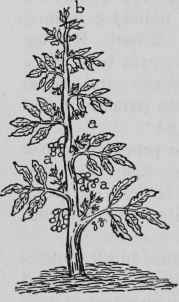
Fig. 49. - Pruning Tomatoes.
a Side shoots to be cut off as denoted by the dark lines. b. The point of the main stem which must also be cut off.
Planting Winter Greens
Broccoli, Brussels Sprouts, Borecole, and Savoys may be planted out at the first spell of showery weather. If ground is scarce, some may be planted two and a half feet apart between Potato rows, but the early small-topped Potatoes should be chosen for such intercropping. If it is absolutely necessary to put Greens between late, strong-growing Potatoes like Up-to-date, Table Talk, Factor, and Sensation, plant them between alternate rows only, and draw the Potato tops away from them towards the spaces between the rows that are not intercropped.
Continue to:


My Books

