


Use Of Massage And Early Movements. Part 2
Description
This section is from the book "Lectures On The Use Of Massage", by William H. Bennett. Also available from Amazon: Lectures On The Use Of Massage.
Use Of Massage And Early Movements. Part 2
The method which I use, because it has given me the best results, in all these fractures about the shoulder in the immediate vicinity of the joint, whether the lesion is of the humerus or of the. scapula, commences with smooth rubbing in the ordinary way at once. From the beginning of the case I use passive movement very gently indeed. One hand is placed on the shoulder, gripping the part as a whole. This fixes the shoulder-girdle. To-and-fro movements of the arm are then gently made, especial care being taken to avoid rotation. If rotation is made movements between the fragments are liable to follow freely, and so union may be delayed or prevented. You need have no fear of harm coming from antero-posterior movement. At the end of three or four days gentle abduction from the side of the trunk is commenced ; at the end of a fortnight circumduction may be gently carried out, and voluntary movements used. Rotation should not be attempted for at least a fortnight, after which rotatory movements should be daily made. For these fractures near the joint I do not use splints, excepting a protective shoulder cap of leather or poroplastic felt retained in position by straps so that it can readily be removed for the daily massage; nor do I use pads in the axilla. The arm is merely allowed to rest in a sling. By this method the treatment of cases of fracture close to the shoulder-joint may be completed in three weeks, and I have never seen such good results attained in so short a time by any other plan. If in such cases the parts are confined in splints for long periods a stiff shoulder-joint follows, as I have already said, much more commonly than is generally supposed - a statement which can easily be verified by the examination of cases so treated at long periods (say nine months or one year) after the injuries.
The results obtainable by this method in fractures involving the elbow-joint are very remarkable. In such cases when the damage is great and the bones, as shown by the x-rays, greatly displaced, the adjustment and fixing the fragments by means of screws, pegs, or wire provide the ideal treatment, but this is not always practicable; indeed, it is obvious that only a small minority of cases of this kind comes under the care of those who are in a position to use these operative measures.
Plate IV. represents a case of the kind which was under my care at the Seamen's Hospital, Greenwich, operation having been declined by the patient.
In six weeks from the date of the accident the movements of the part were nearly normal in extent and the muscles strong. It is doubtful whether as good a result could have been obtained even by operation in the most practised hands.
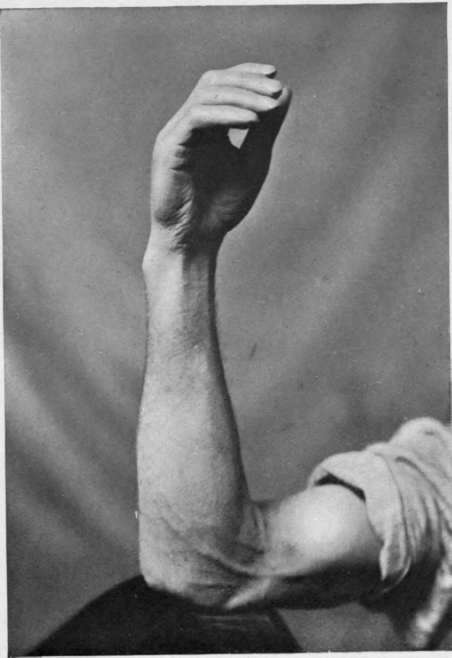
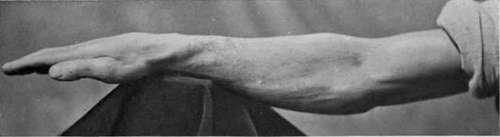
Plate. IV. Photographs showing range of voluntary movement, 24 days after the accident, in a comminuted fracture of the humerus involving the elbow joint, treated without operation by early movements and massage. In six weeks, with the exception of a very slight limitation in flexion, the movements were as free as those on the opposite side.
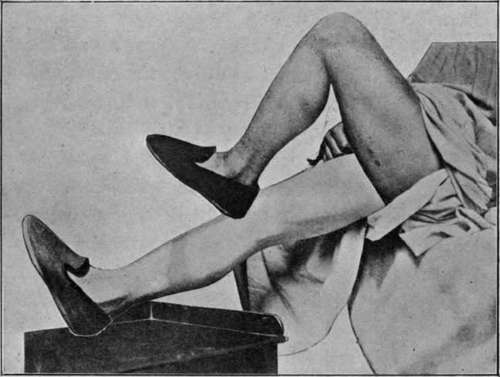
Fig. 9. - Massage and Early Movement in Recent Fractures
Showing the amount of movement and the general condition of the left lower limb in a case of fracture through the condyles into the knee-joint six weeks after the injury. The limb is shown in complete extension and in flexion, the effect being produced in the photograph by taking the limb in the two positions upon the same plate (see also fig. 7). At the date upon which the photograph was taken the patient was up and walking about the ward freely with a hardly perceptible limp. The absence of wasting of the limb generally is noteworthy.
It would obviously be impossible within the limits of lectures like these to give the details of the treatment of every kind of fracture, but the examples I have described give a fair idea of the principles of the plan, which can readily be applied by any intelligent person. It is a method of treatment which must be conducted with discretion. In compound fracture it is not always practicable in the early stages, but after the wound has healed it can be used as if the case were one of simple fracture, and in the earliest stages of many compound fractures there is no reason why passive movement of the joint most likely to be concerned should not be practised at once, although the fact that the manipulations cannot at first be preceded by smooth massage places the practitioner at some disadvantage in such cases. In young children, again, there may be difficulties in using the method in its entirety, but even in these cases it is quite curious how a frightened child with a fractured limb can be soothed by gentle massage of the part.
The great advantages of the treatment are: (1) the ease with which the patient is made comfortable by arresting the muscular spasm, and so relieving the pain; (2) the effecting of rapid absorption of effused blood etc.; (3) the prevention of stiffness by obviating the formation of adhesions; (4) the prevention of muscle-wasting and the preservation throughout the case of the normal nutrition of the limb; and (5) the shortening of the time by about half during which the patient is prevented from resuming the ordinary use of the limb.
The only real objections to the plan are, I think: (1) the difficulty which must often arise in carrying it out, as unless a competent masseur or masseuse is available the time required must frequently be more than the ordinary practitioner can spare; and (2) the fact that the treatment is one requiring so much intelligence and discretion in the mode of its application that it may be difficult at all times to find a person to whom it may be entrusted with safety when the practitioner is not prepared to manage the details himself. The objection which has been raised on the ground that harmful movements of the fractured bones must result is of no value if the treatment is properly carried out, as the movement is then practically nil, and certainly not enough to prevent union in any degree whatever. What the results of the treatment of recent fractures by massage in the hands of others has been I do not know, but so far as my experience is concerned the results are far superior in the majority of cases to those obtainable in any other way. I am not acquainted, for example, with any other treatment by which the results depicted in figs. 7 and 9 could be obtained in an extremely severe case of Pott's fracture, and in a case of fracture into the knee-joint. With increasing experience of the method my belief in it has steadily become more sure.
Continue to:


My Books

