


Use Of Massage And Early Movements
Description
This section is from the book "Lectures On The Use Of Massage", by William H. Bennett. Also available from Amazon: Lectures On The Use Of Massage.
Use Of Massage And Early Movements
There are few fractures in the whole body which were formerly followed so frequently, I suppose, by a certain amount of defective movement as Colles's fracture, the result almost entirely of the matting of the parts. Sometimes it is said that the defects which follow in Colles's fracture are entirely due to the alteration in the relations of the bones produced by the injury. In certain of the cases the bones remain without doubt altered in their relations to one another, but the cause of the want of movement does not, as a rule, lie with the altered bone relations. The cause of the want of proper movement is nearly always adhesions and nothing more, and if these cases are treated intelligently by massage and movements from the first there is little fear of defective results. The method I use in such cases is as follows: The fracture having been 'set,' the forearm is placed upon one of the many kinds of splints which have been devised for this fracture - Carr's splints being, I think, on the whole the best; but the kind of splint is immaterial so long as the anterior splint is placed well behind the bases of the fingers. Before the back-splint is applied gentle smooth rubbing should be used, the patient being immediately told to flex and extend the fingers as much as possible and as often as possible. The back-splint should from the first be removed daily for smooth rubbing. In two or three days a little gentle backward passive movement at the wrist should be made whilst the part lies exposed on the anterior splint after the smooth rubbing. In from four to six days after the injury the part should be gently lifted off the splint after the usual smooth rubbing and held by the manipulator with one hand firmly grasping the fracture area whilst the other hand flexes and extends the wrist a few times in succession (fig. 8). This is repeated daily, the amount of movement increasing gradually as time goes on. In a week the patient may be allowed to make the movements freely of his own accord after he has been provided with a poroplastic or leather splint which is easily removed and replaced. Ordinary complete massage is at the same time commenced daily. At the end of three weeks all splints may be discarded, the arm being carried in a sling for another week only.
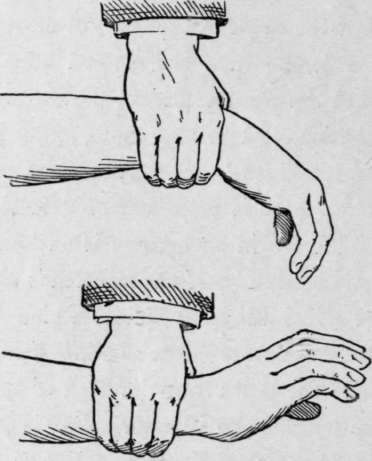
Fig. 8
A drawing by Mr. Mummery, F.R.C.S., showing the amount of voluntary movement, obtainable nine days after the injury in a case of Colles's fracture treated by this method. The manner in which the fracture is steadied by the grasp of the practitioner during its temporary removal from the splint should be noted. - From an article by the Author in the 'Practitioner,' August 1901.
Again, let me impress upon you the fact that the most important practical point to be borne in mind in connection with the use of passive movement in cases of recent fracture and other injuries is this: passive movement should always be preceded by smooth massage, which soothes the irritable muscles so completely that movements of the most complete kind are readily employed without exciting muscular contraction of a harmful sort. If, on the other hand, passive movement is abruptly attempted without preparing the muscles by previous smooth rubbing violent muscular action generally occurs, which is not only painful to the patient, but tends to throw the fractured bones out of place. There is, I am sure, no dictum in surgery which is more sound than this:-In all cases in which passive movement is practised smooth muscle massage should precede the movement.
Another set of fractures which may be treated by this method with a result which, speaking generally, surpasses that of any other plan are those occurring in the immediate neighbourhood of the shoulder-joint. The difficulties under ordinary circumstances of dealing with such fractures are too well known to require comment. I am now referring to fractures of the extreme upper end of the humerus and of the scapula close to, or involving, the shoulder-joint. It is a matter, I suppose, of common knowledge that such fractures are followed much more frequently than some people suppose by stiffness of the shoulder-joint. It is, in fact, not uncommon to find upon examining a patient at a long interval after a fracture of this sort that the shoulder-joint is quite fixed, although the patient may be ignorant of the fact. Many patients who have sustained an injury of the kind I am now discussing complain continually of acute pain in attempting to raise the arm beyond a right angle from the body. In the case of the majority of patients who complain in this way an examination will show that the scapula in the movement mentioned moves with the humerus, and that movement in the shoulder-joint is practically nil. In fact, a considerable proportion of people who have sustained this kind of injury, especially if the lesion has been treated by means of continuous splinting or fixed apparatus, never regain free movement in the joint.
Plate II.
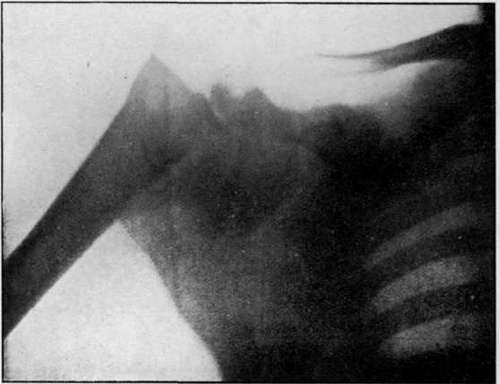
A case of fracture of the humerus, showing faulty position of the fragments. The accident occurred at sea. The only treatment the patient received was at the hands of the ship's mate. The result is shown in Plate III.
Plate III.
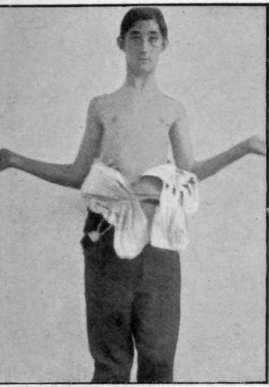
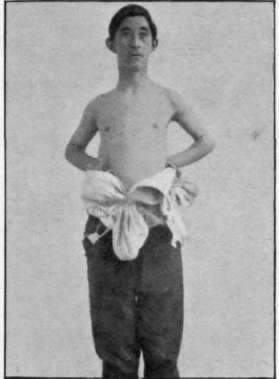
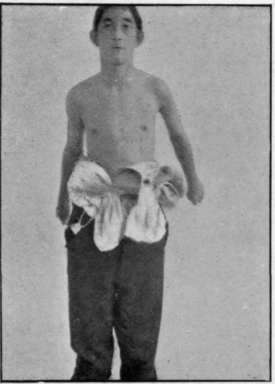
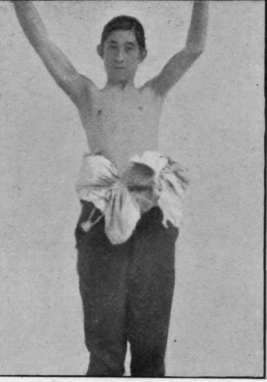
Photographs showing range of movements attainable by the patient in the case shown in Plate II. thirteen months after the injury, the patient having been doing the duties of an ordinary seaman from a few weeks after the injury.
Continue to:


My Books

