


Recent Injury Treatment By Mobilisation And Massage. Part 3
Description
This section is from the book "Massage Its Principles And Practice", by James B. Mennell. Also available from Amazon: Massage It's Principles and Practice.
Recent Injury Treatment By Mobilisation And Massage. Part 3
In no circumstances must extension of the wrist exceed the position in which the hand is normally held, say in the action of writing, as, if it is increased beyond this, there may be danger of tilting the lower fragment.
If, when the muscles are relaxed, there still remains a certain sensation of hardness under the stroking hand, it is due to oedema. It is possible for the oedema to be so soft that the simple surface stroking will send, as it were, a wave of movement throughout the whole of the soft structures of the limb. If it is apparent that these structures are not sufficiently flaccid to permit of this, despite perfect relaxation, it will be necessary to administer a dose of kneading - very gentle in character- maintaining as far as possible a definite rhythm. Spasm which does not yield to surface stroking will sometimes do so in response to gentle kneading. It is well to commence with the arm and then to knead for a few inches below the elbow, returning to the arm subsequently. The middle of the forearm is treated next, then the proximal part of the forearm, and then the arm once more - gradually working down the forearm towards the wrist, always emptying upwards, and always ensuring that the whole of the limb that lies proximal to the last new portion to be treated receives its renewed dose before another more distal portion is attacked. So we go on till the neighbourhood of the fracture is reached, and this is scrupulously avoided, although the hand and fingers may receive a slight dose. The kneading may precede or follow the mobilisation, or the latter may be administered in two doses before and after the kneading. In either case the seance terminates with a few minutes of the surface stroking, the whole duration being fifteen to twenty minutes. Picking up may replace kneading whenever it is suitable.

Fig. 64. - Fixation of sling round the neck. The loose "tails" may be attached to a ribbon which passes round the body and is tied round the waist.

Fig. 65. - Wrong position - though very common - of supporting the forearm in a sling. The hand is lower than the elbow.
The arm is then "done up"as the surgeon has directed; and the patient is instructed to move the fingers as much as possible, to exercise shoulder and elbow at regular intervals, to keep the hand in a sling so that it always rests at a level higher than the elbow (see Figs. 63, 64, and 65), and on a pillow in a corresponding position at night. Massage without removal of splintage is quite possible and also very beneficial, even though the segment of the limb that has been injured is never touched. Next day the process is repeated, slightly more movement is given, slight adduction and abduction being added; and the patient should be asked to contract all the muscles in the forearm in turn before being done up. He is now instructed to keep all the finger-joints loose by moving them each severally and together.
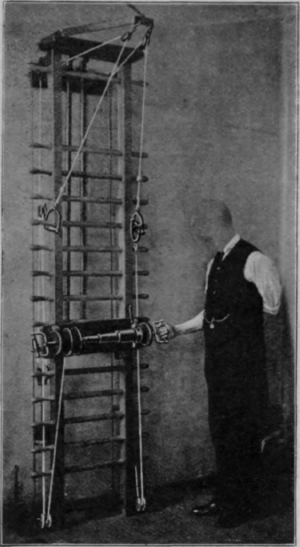
Fig. 66. - Correct position for using the rotator.
The third day relaxed movement should include some 75 per cent. of flexion of the wrist, and rotation of the forearm from full pronation to mid-way between pronation and supination. Should the latter cause difficulty, gentle kneading over the biceps and the pronator radii teres may solve it. The pronator quadratus might be expected to cause trouble, but its nerve supply corresponds so closely to that of the pronator radii teres that, if this relaxes, the quadratus will follow its example. Care must of course be taken to see that the biceps is relaxed. When the arm has been done up the patient is taught to approximate the tip of each finger to that of the thumb - "to form O's" - separating them as far as possible after each approximation. This, together with "five-finger exercises," should be done once an hour for five minutes.
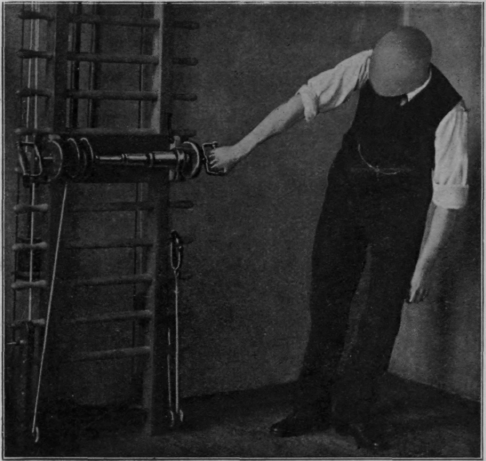
Fig. 67. - Incorrect position for using the rotator. Note that most of the movement is performed at trunk and shoulder.
The fourth day all movements are slightly increased, but the fingers should receive a dose of almost, if not quite, complete movement, including lateralisation of all interphalangeal joints in slight flexion, and also antero-posterior movements of the heads of the metacarpals, thus moving the joints between the bases of the metacarpals and the carpo-metacarpal joints. The patient may be told to pick up a pencil and roll it between fingers and thumb, to thread large-eyed needles with thin string, and so forth.
The fifth day it may be possible to ask the patient to roll the hand to and fro on a cushion, and to raise it from a position of flexion to one of slight extension, and perhaps 50 per cent. of extension may be administered as a relaxed movement. Rotation is prescribed between the seances from pronation to the mid-position.
The sixth day the process is gradually increased, and on the seventh the patient may be given a pencil and told to experiment by writing his name.
And so the process goes on, day by day a little addition, till by the end of the second week full relaxed movement is possible with perhaps a few minor limitations; while the "home exercises" include doing up buttons, filling a pipe, striking matches, and feeding; but not cutting meat or the crust of bread.
Continue to:


My Books

