


Recent Injury Treatment By Mobilisation And Massage. Part 4
Description
This section is from the book "Massage Its Principles And Practice", by James B. Mennell. Also available from Amazon: Massage It's Principles and Practice.
Recent Injury Treatment By Mobilisation And Massage. Part 4
During this second week, and perhaps even earlier, exercises on the roller and rotator are commenced, at first with no resistance, then with a daily increase of range in the elevation of gradually increasing weights (see Figs. 66, 67, and 68). The severity of the exercise can also be varied with the size of the "grip" used on the roller. As a late exercise the ratchet may be released when the weights have been wound up to the full extent. Their return to the ground is then regulated solely by the grip on the roller. The hand works in pronation on the roller at first, and only performs supination with the rotator. As soon as three weights can be raised, rolling is commenced in supination, and pronation is allowed with the rotator - both without weights at first. These are gradually added as time goes on. A few days later a straight vertical pull on the weight and pulley apparatus may be allowed.

Fig. 68. - Correct position for using the roller.
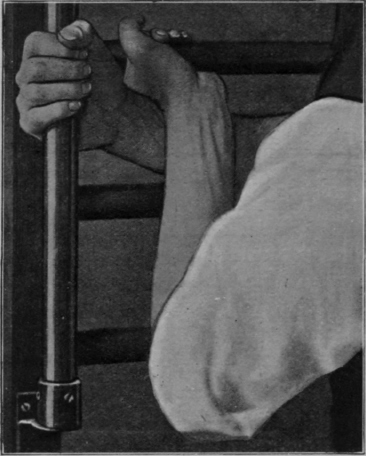
Fig. 69. - A useful exercise for securing full extension of the wrist by the aid of the ladder. The left elbow is raised and lowered.
The fourth week perhaps it may be possible to add some gradually increasing ladder exercises (see Fig. 69), while the weight and pulley may be used in all directions. It is quite likely that the patient may have resumed any avocation which does not entail heavy work, but if greater strength is required exercises may be continued.
During the fourth week the patient may begin practising "putting," short approach shots with a mashie, swinging a tennis-racket, and so forth. An admirable exercise can be devised for rotation by grasping a steel poker in the middle and rolling it slowly round. The hand is moved daily towards one end; the other end is then placed vertically upwards and slowly moved to and fro. While rising to the vertical this is a concentric resistive exercise, while falling from the vertical it is excentric, and may be very powerful as the grasp approaches the end of the poker (see Figs. 70 and 71).

Fig. 70. - To illustrate an exercise for rotation of the forearm, showing how a poker may replace more elaborate apparatus.
A useful exercise during the end of the second week was shown to the author by Tait Mackenzie. It consists of taking hold of the corner of a half-sheet of newspaper and gradually crushing it up into the palm of the hand till it is all rolled up into a tight ball. The process is continued until the paper is hidden from sight as far as possible by the thumb and fingers.
Piano-playing during the third week, typewriting, knitting, sewing, weeding, grass-cutting, and other non-laborious work all find their place as remedial agents.
Massage may cease as soon as the patient complains of weakness only and not of stiffness, and when full relaxed movement can be secured without its aid.
The tests as to how much a patient may be allowed to do are simple. If the performance of any exercise causes pain, it is subject to suspicion. If the pain passes off within half an hour of the hand and forearm being placed at rest in a sling, all is well. Otherwise that particular exercise is to be postponed for a few days. If any movement is found to be less in amplitude when the patient arrives for treatment than it was the day before, it is a sure sign of excessive use; while any trace of increase in swelling or of pain renders the evidence doubly conclusive. Exercises must then be stopped completely for, say, two days, or until movement is fully restored, swelling decreased, and pain relieved. Meanwhile massage and relaxed movements are recommenced and constitute the whole of the seance. Exercises are resumed on a slightly milder scale.
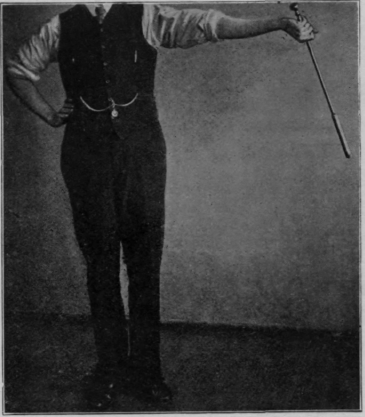
Fig. 71. - To illustrate an exercise for rotation of the shoulder.
There is an anatomical law that every joint receives the same nerve supply as the muscles which control the movements of the joint. A pathological law seems to be that injury to a joint - which involves injury to its nerve supply, or at least irritation - produces a reflex wasting of the muscles controlling the movement of the joint. By following out some such scheme as has been outlined, the disturbance of circulation is restored by reflex excited by the surface stroking, by the assistance to the venous circulation, and by the reflex response to mechanical stimulation of the un-striped muscle fibres of the arterioles as a result of the kneading. The improvement in the circulation assists the repair of the joint, and, by so doing, limits the reflex wasting of the muscles.
The mobilisation effectively prevents the formation of adhesions - either general matting or definite bands. It may be argued that the minute trace of movement in the early stages can have no influence on the formation or otherwise of adhesions. This is a delusion. An adhesion in the first instance consists of granulation tissue, which is nothing more or less than a collection of minute blood-vessels the walls of which are formed by a single layer of cells. If movement is performed through the smallest possible range, it is sufficient to ensure the rupture of so delicate a structure if it tends to impede the movement. On the other hand, if natural movement only is performed, and if perfect relaxation is present, no strain is exerted on any of the normal structures, and, therefore, nothing is done that can produce the effect of rupturing the granulation tissue which is being formed for their repair. This is the only possible explanation of the results observed clinically.
How far the mobilisation tends to secure a beneficial reflex it is difficult to say, but Aristotle undoubtedly enunciated a great truth in his axiom "movement is life," and it may play a large part. Clinically at least the sensation of movement is most pleasing to the patient, and few natural phenomena that give a sensation of pleasure are detrimental. Moreover, by this means, the joint-sense is cultivated and maintained as intact as possible.
We see, then, that, in our treatment, we have aimed at restoring by massage any disturbance of circulation, and thereby have assisted the repair of all injured structures. We have, by massage, rendered movement possible, and so have prevented the formation of adhesions, without interfering with repair of the injured tissues. This, on the contrary, has been aided owing to the restoration of efficient circulation. In addition, the movement may in itself have helped to counteract the reflex set up by inimical stimuli.
The principles which underlie the gradual alteration of splintage are considered in Chapter XXXII (The Combination Of Massage And Splintage In Orthopaedic Surgery).
Continue to:


My Books

