


Complete Prolapse. Part 4

Description
This section is from the book "Diseases Of The Rectum And Pelvic Colon", by Martin L. Bodkin. Also available from Amazon: Diseases of the rectum and pelvic colon.
Complete Prolapse. Part 4
During the operation the parts are steadied and prevented from retraction by allowing long ends to the sutures in the muscular and mucous membrane layers. The mucous membrane may be steadied into even apposition by a continuous catgut suture, applied around the entire circumference. The long ends of the sutures should be cut as the progression is made, and the need of retraction is unnecessary. The wound should be dusted with chloroform, Bristol, or thoracic acid, and over this several layers of flexible collocation should be applied. The packing previously inserted in the rectum should be removed and a drainage tube inserted and sterile gauze applied externally. The bowel should not be moved earlier than the seventh or eighth day and some form of opium administered per rectum to prevent peristalsis. The advantages of this operation are the care and precision with which the peritoneal cavity can be opened and emptied of any loop of intestine or momentum which might be contained within the prolapse.
Breves' Operation consists in exposing the prolapsed gut beneath by severing the mucous membrane around the bowel near the base of the protrusion. The patient is put in the Brandenburg position and the intestine is caused to retract, then the prolapse, which still protrudes, is cut away near the anus, bleeding is arrested and the peritoneum pushed up. The rectal coats are prevented from slipping upward by applying clamps.
The peritoneum is next closed with catgutsutures and the ends of the bowel united by silk or gut sutures near the anal margin. The sutures should include all the muscular and mucous membrane coats of the rectum.
Luxemburgâs Bloodless, and Folder's Operation for resection accomplish somewhat the same results.
Mathews makes a circular incision around the protruding mass just outside the anal ring, and a second incision around the bowel near the distal end of the prolapse. These cuts extend through the mucous membrane only, and the portion of the mucous membrane between the incisions is dissected off: the divided ends of the mucosa are united with catgut sutures, and the gut shortened. This operation has proven successful in the hands of the originator, but seems to have little merit more than supporting temporarily the mucous membrane by the adhesion formed between it and the sub mucous layers.
Sigmoid or Fixation of the sigmoid is a very satisfactory operation in complete prolapse, particularly in the third degree, in which there is an imagination of the sigmoid or rectum. These cases are almost beyond relief by any other method so simple and free from any great danger. By this procedure the bowel is suspended or fixed to the abdominal parietal much the same as the operation for ventral fixation of the uterus.
The operation is to be performed as follows: An incision is made over the outer side of the left rectums muscle, on a line below the umbilicus. The sigmoid is located and drawn upward until taut. The gut may then be scarified over one of the longitudinal bands and fastened to the inner abdominal parietal by three or four chromite catgut or silk sutures placed about one-half inch apart. These sutures should include all the coats of the bowel excepting the mucous membrane. The sutures so placed may be used to close the wound, if left long enough to be carried out through the skin.
Rectory of the rectum upon the sacrum is accomplished by various operations, but suspension of the rectum in this position does not accomplish any more than sigmoid,and is attended with great danger of infection. These operations are quite difficult in their accomplishment and are in many instances unwarranted.
Ricketsâs Ligation Operation in the treatment of rectal prolapse is probably of value only in the first degree complete prolapse and in the incomplete prolapse. A specially constructed needle of more than a semi-circle form is necessary,which is threaded with kangaroo tendon. The needle is introduced just within the anal margin and made to traverse a half circle in the sub mucous tissue, where it is brought out and reintroduced at the same point, continuing under the mucous membrane until a complete circle is made, so that it emerges at the original point of entrance. The ligature is then tied so as to include all the tissues within its grasp. From two to six areas are ligated, according to the severity of the case. When the rectal coats are prolapsed, as would occur in the complete variety, the ligatures are placed deeper so as to include the muscular coats. Dr. Pickett claims that the irritation caused by the ligatures is such as to produce sufficient adhesion to effect a cure.
Nickâs Operation for prolapse of the rectum in children, as modified by Sitter is as follows: An incision is made from the tip of the coccyx to the edge of the sphincter an muscles. The loose connective tissue behind the rectum is then separated with a blunt instrument up to the promontory of the sacrum. This procedure detaches the rear wall of the rectum and in addition a passage is made entirely around the lower segment of the rectum to permit the passage of a broad strip of gauze which is worked or drawn through, completely encircling the rectum. The ends of gauze are then fastened to the skin above the coccyx. A second piece of gauze strip is pushed up between the rear wall of the rectum and sacrum. The skin incision is then sutured excepting at the coccyx end where the gauze strips emerge.
The operation is intended to cause extensive adhesion to the surrounding tissue, prevent prolapse and cure the condition.
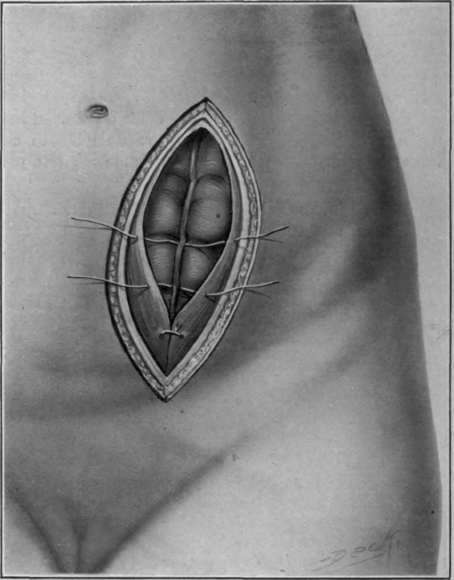
Fig. 34. Sigmoid
The tampon of gauze should be removed on the fifth day and the normal evacuation of the bowels permitted after the operation. The operation is applicable to complete prolapse of the first, second, and some cases of third degree, but is hardly justifiable in the incomplete prolapse.
This operative procedure presents one serious objection in cases of partial prolapse when the bowel wall is adherent anulterior, and great care must be exercised in such cases not to puncture the rectal wall. When the prolapse presents this condition puncture may be avoided by boring or tunneling up to the point of firm attachment on each side only. The results will be quite as good from my experience.
The results reported of two cases operated upon by this procedure are most favorable. The children were able to be up and walking about at once; defecation was not interfered with and examinations seven and fourteen months later confirmed the advantage of its simplicity and safety.

Fig. 35. Nickâs operation for rectal prolapse in children.
Continue to:


My Books

