


Fistulae. Part 3

Description
This section is from the book "Diseases Of The Rectum And Pelvic Colon", by Martin L. Bodkin. Also available from Amazon: Diseases of the rectum and pelvic colon.
Fistulae. Part 3
The Mastic [ligature or silk ligature which has been used since the time of Celsius, is applicable for the non-operative treatment of the complete fistula or when a fistula of the incomplete type has been made complete. The rubber ligature is preferable to the silk, because it makes a more uniform pressure. It is introduced after being threaded on an ordinary probe which has an eye, or by means of the Appalling elastic ligature carrier which carries the ligature from the inside to the outside of the rectum. A solid India rubber ligature one-twelfth to one-eighth of an inch in thickness is generally used. After being drawn taut the ends are secured from retraction by a lead shot - a piece of lead with a slit in it.
The ligature operation can be performed without an anesthetic because of the very slight pain, and it allows the patient to go about his ordinary duties. There is no bleeding and no cutting with the knife. It is particularly well adapted to cases of hemophilia or bleeders, and this is really its only field of usefulness. The ligature takes from five to fourteen days to cut its way through; but should the sinus have lateral burrowing, it will be a failure. In some instances it has been found necessary to use the knife after all and it seems, as previously mentioned, that the only field of usefulness of this operation is where a slow process of pressure necrosis is desired to avoid the loss of blood, as in cases of anemia, photolysis and hemophilia.
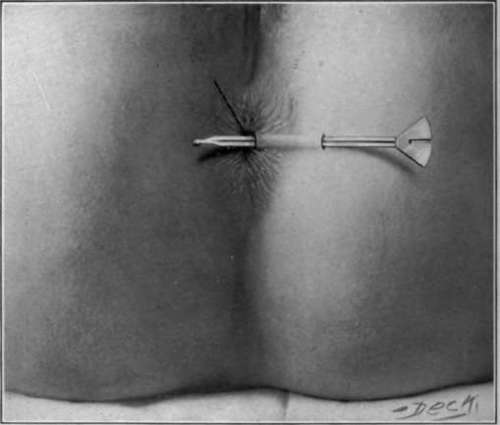
Fig. 41. Showing correct method for incision of fistula The external sphincter is silver, in the form of a saturated solution, or a combination of equal parts of tincture of iodine and carbolic acid, or a solution of dichloride of mercury, are the solutions generally accepted as best for the injection in these cases.
Electricity and the Gatecrash are generally accepted as undeserving of consideration on account of the pain and the uncertainty of treating the fistulous tract properly, which very often results in protracted convalescence.

Fig. 42. Elastic ligature in position.
The blind external fistula can very often be successfully treated by cutting the external orifice sufficiently to allow free drainage, followed by a slight curettage and the cauterization of the tract with a fifty per cent. solution of nitrate of silver. The administration of nitrous oxide for the preliminary cutting may be used, according to the judgment of the operator.
Operative Treatment. Under the heading of operative treatment the surgical procedures used generally for the different types of fistula are considered. As a rule, fistula are best operated upon as early as possible after the establishment of the fistulous tract, and when the abscess cavity does not show a tendency to heal with healthy granulation The general health at such a time is not materially affected, and the danger of septic complications are not made greater by early measures.
In tuberculosis, when the patient's condition is such as to give evidence of extreme weakness or of low vitality, palliative treatment is best instituted instead of more radical operative interference, and, in some instances it is best to omit any surgical treatment. In tuberculous tracts, the granulation tissue inside of the fistulous tract holds the tubercular bacilli. The bacilli are prevented from entering the body by a strong, thick wall of connective tissue on the inner side of the granulation tissue. If this wall which is provided by nature, is cut through by the surgeon or broken down, the tubercular bacilli immediately find their way into the general circulation, and if the vitality of the subject is low a general tuberculous infection takes place.
This theory of Hartman's explains the rapid destruction of tubercular patients after operation for fistula particularly when the subject already suffers from a mild tuberculosis of the lungs and an additional burden is thrown upon his vitality by the opening of a tuberculous fistula or abscess. In order to prevent the escape of tubercular bacilli into the circulation it is best to seal up the cut surfaces by burning out the fistulous tract, using the actual cattery with the idea of destroying these germs and to prevent their absorption.
The treatment and cure of fistula? in general is considered by surgeons as a task in which their ingenuity and patience will be often greatly taxed.Fistula tome This ingenuous instrument, invented by Dr. Mathews of Louisville. Kentucky is recommended by him in selected cases for the treatment of fistula It is simply a long probe with a small knife, the end of which cuts through the tissue as it is withdrawn, in that way freshening up and helping to stimulate healthy granulation.
Excision. Ball's operation for excision with a suture of a fistulous tract which includes a small amount of the surrounding tissue, has been in vogue for many years. Success with this method has been the good fortune of but few, and as a consequence it has received a condemnation of the profession at large. It seems that the failures have mostly resulted from not thoroughly understanding the technique necessary. It will prove most successful in the external complete variety, which must be straight and not too deep to ensure the proper sterilization of the tract and to permit the complete encircling of the wound with sutures. Total excision and incision of the fistulous tract are nearly similar in their results, if primary union does not take place after the excision operation. Ball recommends that the tract be thoroughly curettage and then cauterized with pure carbolic acid or a strong solution of dichloride of mercury.
A sufficient quantity of carbolic acid should be put into the fistulous tract to thoroughly sterilize it in the judgment of the operator. The quantity should not be so large as to permit it to run outside the wound, thereby destroying the adjacent tissue, and should be neatly applied. One should remember that the carbolic acid should not be neutralized but left in the wound, as the success of the operation is almost entirely dependent upon this one point in the technique. The wound should be closed by means of interrupted sutures, about one-fourth inch apart, beginning at the rectal end, and including if possible, a piece of the mucous membrane which should be pulled down over the wound at this point of the first suture. The subsequent sutures can be placed at equal distances throughout the length of the wound, as found necessary. A dry dressing powder of Bristol, separate of zinc, or oxide of zinc may be dusted on, and sterile dressing applied in the usual manner.
Continue to:


My Books

