


Fistulae. Part 2

Description
This section is from the book "Diseases Of The Rectum And Pelvic Colon", by Martin L. Bodkin. Also available from Amazon: Diseases of the rectum and pelvic colon.
Fistulae. Part 2

Fig. 38. Fistula-. A. complete sub muscular; B, incomplete sub mucous external.
The procedure laid down by Goodall and Miles is quoted as follows:
"The course taken by the main track of a blind internal fistula when the internal opening is in the middle line posterior and deeper than the external sphincter, is towards the surface in the right or the left posterior quadrant. In those cases in which the internal opening is superficial to the external sphincter, its course is towards the surface in the middle line posterior, or slightly to the right or left of that line. When it passes by the side of the rectum deeper than the inferior hemorrhoid artery of the same side, it points under the skin in front of and somewhat outside the anal orifice. When the pointing is situated in this position, i. e., in front of the transverse anal line, it might reasonably be assumed, from what we have said above, that the internal opening would be found on the right anterior or left anterior side of the rectum exactly opposite the place of pointing. But in such a case, the fact that the first noticeable sign of the fistula is an escape of pus from the rectum, proves it to be a blind internal fistula and should at once prompt a digital examination with the object of discovering the exact position of the internal opening. Should the internal opening be found in the middle line posterior, there will be no difficulty in tracing the thickening which always exists in such cases, as it passes from the internal opening round the lower part of the rectum to the place of pointing. By following this simple procedure the mistake may be avoided, while operating, of making an artificial internal opening, and so leaving the greater part of the main tract of the fistula, together with the internal opening, untouched. In those cases of blind internal fistula which are confined to the sub mucous tissue, the main tract is directed either obliquely or vertically upwards for a distance varying from one inch to two inches or more above the internal opening."
In view of the fact that a fistulous tract seldom is straight or retains an even caliber through its entire course, an injection of some form of a staining fluid is of great assistance. Methylene blue, permanganate of potash and numerous other coloring fluids are used. Bismuth paste is also used for the recognition of the fistulous tract. Lynch, of New York, recommends a mixture of peroxide of hydrogen and a saturated solution of methylene blue as a means of diagnosis and claims it has proved of great value in very complicated fistulous tracts and where the communication between two fistula is so narrow as to make it impossible for the passage of a probe. The peroxide of hydrogen is supposed to carry the methylene blue into the ramifications of the tract and the methylene blue stains the part.
Prognosis. The prognosis as to the cure or amelioration of symptoms presented by patients suffering with fistula is dependent upon the pathological nature of the disease, the constitutional condition and the amount of tissue involved. There is no doubt, but that some cases of fistula spontaneously cure themselves. The recto-urethral fistula will often heal up by washing out the bladder or by the use of a catheter, relieving in this manner the irritation and infection from the urine. The question of operation on cases of general tuberculosis, in addition to the fistula, is very often a hard question to decide as to the ultimate benefit to the patient. Whether opening these fistulous tracts, in such subjects, permits a copious invasion of the system with the tubercular bacilli as the result of the cutting away of nature's barrier, or that it might be due to the shock dependent upon surgical interference, is hard to ascertain. But the fact remains substantiated by the experience of surgeons in general that these cases are often made worse by opening up a fistulous tract, so that it comes clown to the individual judgment of the operator, in many of these cases, as to the advisability of such treatment. As a rule, a tubercular fistulous tract that is small, with but few lateral burrowing which are not very extensive, and those that are superficial (subcutaneous) which might be extensive, can be operated on with the best results.
Non-operative Treatment. Non-operative treatment, which is also classified as conservative treatment, is generally applied to cases of fistula that are simple, superficial and of the external incomplete type.

Fig. 39. Schematic illustration of the course of superficial fistula
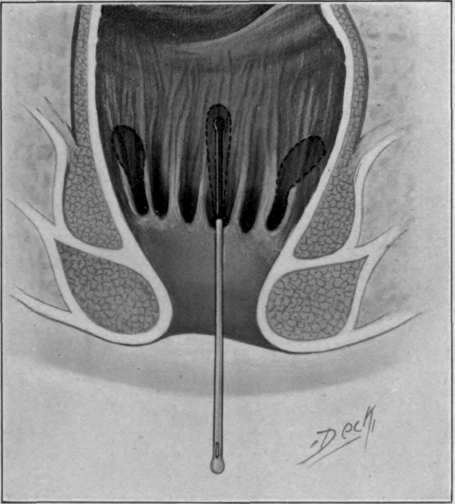
Fig. 40. Sub mucous fistula; arising from valves of Morgan
One can readily understand that this form of treatment is not free from pain or disagreeable operative measures, such as the injection of solutions, or from the pain excited through the handling of the diseased tissue. Furthermore, this form of treatment does not mean that there is no cutting, but does include, as a non-operative measure, the slight cutting to permit drainage. Nitrate of cut straight across its fibers.
The exact knowledge that the tract does not have any opening into the rectum, or any lateral burrowing, is most essential when giving a prognosis. Care should be taken to avoid the complications which may arise from the escape of the cauterizes into the rectum. Injections of this nature are probably safer after the potency of the tract is assured by the injection of peroxide of hydrogen and the saturated solution of methylene blue, or a weak Creole solution, or even cow's milk, which may be readily detected should it escape into the rectum. A hollow probe attached to the ordinary hypodermic syringe has been found a most useful instrument for the purpose.
Continue to:


My Books

