


Hemorrhoids. Part 11

Description
This section is from the book "Diseases Of The Rectum And Pelvic Colon", by Martin L. Bodkin. Also available from Amazon: Diseases of the rectum and pelvic colon.
Hemorrhoids. Part 11
The sphincters having been thoroughly stretched, an incision is made in the mucous membrane at the posterior membrane fissure and with the blunt point of the scissors, curved on the Hat. a dull dissection is carried with a boring motion upward to the superior margin of the internal sphincter, the sphincter is incised between the mucous membrane and this muscle and gradually worked to one side and downward until it comes to the much-cutaneous border of the anus.
Little by little the hemorrhoid mass is thus loosened from its muscular attachment and peeled out of its resting place, just as an orange is peeled from its skin. Having accomplished this upon one side, the instrument is turned to the opposite side and the same process carried out. The only point in this procedure at which any difficulty will be met is at the anterior commissary of the rectum.
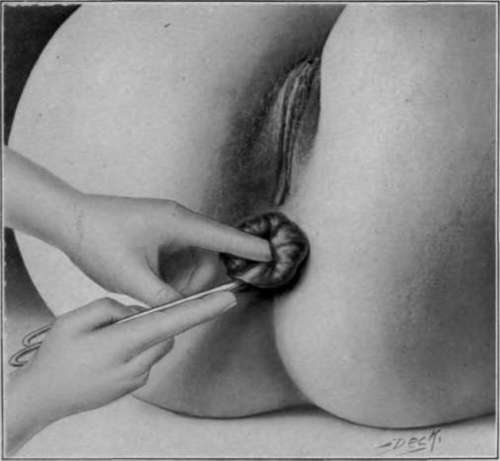
Fig. 64 Tattle's modification of Whitehead's operation. Detaching the mucous
"Having loosened the whole hemorrhoid bearing area from its attachment to the muscular wall, the mucous membrane is cut just above the much-cutaneous margin, and the hemorrhoid area will thus be left loose in the rectum. An incision is then made in the mucous membrane at the posterior commissary, extending as high up as the hemorrhoids extend. Each flap thus formed is caught by clamps and the tube of mucous membrane with the hemorrhoids attached is dragged down. It is loosened above by pressure with gauze or dull-pointed scissors until the healthy portion can be brought down to the margin of the anus without tension. It is then cut off transversely above the hemorrhoid mass, step by step, and sutured to the edge of the much-cutaneous wound below."
Turtle recommends large sized catgut because it is less likely to tear through the mucous membrane than fine silk or other small suturing material. Chromite gut and silk-are condemned for the reason that they remain in the wound too long, which not only irritates but is apt to be followed by small abscesses. This operation as performed by Cuttle is probably the best manner in which to perform the Whitehead operation, as it has the merit of controlling hemorrhage and it is easier to attach the mucous membrane after the removal of the hemorrhoids. The suggestion for the detachment of the mucous membrane at the commissary is certainly a great help, as the close attachment of the mucous membrane to the muscular wall, particularly at the anterior commissary, makes its detachment much easier and less liable to faulty separation.
This operation is performed in from ten to fifteen minutes, a feature which makes it the most satisfactory method of performing the Whitehead operation. When the skin tags are present, they may be cut off with the scissors and the edges sutured together or crushed with the clamp and collocation applied. Cuttle claims that in none of his cases has there been any incontinence or loss of sensibility in the rectum
The Clamp and Cattery Operation originated by Cu sack was done by clamping and cauterizing the stump with nitric acid. Mr. Henry Lee of London adopted the method of using the actual cattery, which is our modern method of performing a rapid operation; the quick cauterization of tissue by the actual cattery; the destruction of septic germs and the sealing up of the capillaries and lymphatics to prevent septic absorption. He also aims to protect against hemorrhage by crushing and cauterizing the hemorrhoid mass. The advantages of the operation are that it is applied at one sitting and there are no ligatures to cut through by slow and tedious process. It is easily performed, its results are excellent. Finally, it is as free from complications as any other known hemorrhoid operation. Altogether, from its merits, it has the recommendation of all American surgeons for application to any and all kinds of hemorrhoids.
The operation is practically free from pain after the first few days and from protracted ulceration or the danger of secondary hemorrhage. Dyslexia or retention seldom lasts more than that period. Confinement in bed is generally limited to ten days or at the most two weeks and the operation may be said to be one of the simplest and surest of surgical procedures in general.
The technique of the clamp and cattery operation, under a general anesthesia, is as follows: The patient is previously prepared, anesthetized and placed in the lithology position, with the limbs held by leg holders. The sphincters are dilated by making pressure with the thumbs or the Kelly dilator, in the judgment of the operator. Dilatation of the sphincters under a general anesthetic is often followed by a certain degree of prolapse of the rectal wall, greatly in excess of the original hemorrhoid mass, which is often removed and results in stricture at the anal orifice. Dilatation in most instances is unnecessary to but a slight degree. My rule has been to grasp each hemorrhoid before dilatation with an ordinary artery clamp so as to have them definitely located, then dilate with the fingers between the artery clamps. There are variously described clamps for this purpose called hemorrhoid clamps, but experience with several of them has demonstrated that the ordinary artery clamp is satisfactory.
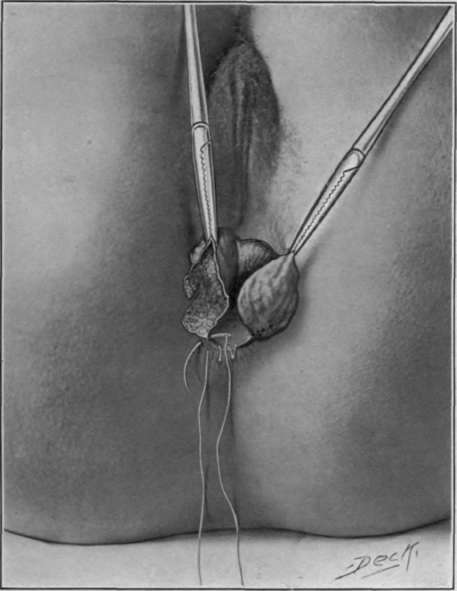
Fig. 65. Tittleâs modification of Whitehead's operation. Sewing subcutaneous sections together, as the pile-hearing area is progressively cut away.
The originators of the operation recommend that after dragging the hemorrhoid down well into view and just before applying the clamp, a groove or sulfurs he cut into the subcutaneous tissue to relieve pain from the subsequent edema. Cutting this groove results in a certain amount of bleeding which is quite insignificant, but the operation can be as well performed by making a radiating incision from the end of the clamp line into the skin. This incision will allow the escape of serum and relieve the tension quite as well as cutting the groove. Both methods receive general approval and are very sure procedures to offset the pain following this operation.
Continue to:


My Books

