


Hemorrhoids. Part 12

Description
This section is from the book "Diseases Of The Rectum And Pelvic Colon", by Martin L. Bodkin. Also available from Amazon: Diseases of the rectum and pelvic colon.
Hemorrhoids. Part 12
The clamp is applied in the longitudinal axis of the rectum, grasping the hemorrhoid as near to its base as possible without tearing the mucous membrane, the blades are tightened and the hemorrhoids cut off close to the blades of the clamp. The cattery is then applied and the hemorrhoid is cauterized sufficiently to leave a charred stump on the outer surface of the clamp. Care should be taken that the part of the tumor which is crushed by the clamp is not destroyed by the cattery This destruction cannot be accomplished unless the point of the cattery is forced down between the blades of the clamp. When introducing the clamp avoid catching the opposite wall of the rectum by introducing the finger to offset such complications. Only mucous membrane should be clamped at one time; the same rule may be applied to the skin for external hemorrhoid. The hemorrhoids are situated in different quadrants of the rectum, viz: anterior, posterior and to the right or left, or in the median line anterior or posterior Bearing this in mind when clamping a hemorrhoid the relative position should guide one in the introduction of the instruments so as to avoid twisting or a transverse cauterization of the tumor. It one introduces the clamp over the hemorrhoid, as indicated by the forceps previously applied in the long axis of the rectum, a stricture of the anal orifice can hardly result.
After all the hemorrhoid tumors are removed, a suppose destroy of one-fourth grain of morphine, or one grain of opium with three grains of the extract of witch-hazel, should be introduced; or orthonormal may be insufferable on the raw surface to relieve pain. Most operators advise the use of a Pennington tube, which consists of a medium sized stiff rubber tube six inches long, covered with a fine rubber sheath or wrapped with chloroform or plain gauze. The tube is introduced about six inches into the rectum, and a safety pin put through the outer projected part through which adhesive plaster may be slipped to prevent, if possible, expulsion of the tube. This tube allows the escape of blood and prevents the distention with gas. Gauze is then packed around the lower end of the tube and a snug T-bandage is applied. The use of the tube is a question of judgment in the experience of many operators and possibly is unnecessary in the majority of cases.

Fig. 66. Author's modified Pennington tube. Showing position in rectum and compressed tube which is easily introduced.
The tube should be allowed to remain in the rectum for two or three days, according to the amount of disturbance its presence may cause, or removed at an earlier period if necessary. After the removal of the tube and the cleaning out of the rectum with the internal administration of magnesium sulphate or licorice powder which should be followed by a plain water enema, the wound should be thoroughly cleansed with peroxide of hydrogen and a small piece of gauze saturated with a twenty per cent. solution of ichthyology introduced. The ichthyology solution should be introduced every second day to stimulate healthy granulation Patients that are dressed in this manner every second day are very materially benefited as compared to those that receive practically no after-treatment to encourage granulation and offset sluggish ulceration. During the period of treatment the wound should be bathed each morning and night with water as hot as can be borne, which will aid greatly in the comfort of the patient and will stimulate healing.
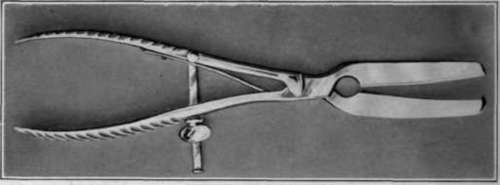
Fig. 67. Kelsey clamp.
The Clamps used for this operation are of the greatest variation. The original clamp used by Lee was a curved defenestrated forceps into which the tumor was clamped and crowded into a central pedicab or mass. Smith's clamp has flat blades, on one side of which are ivory plates intended to prevent the transmission of heat to the tissue beneath during the cauterization. Antâs and Kelsey's clamps are modifications of the original Smith clamp. Kelsey's modification of Smith's clamp is used largely. These forceps have the advantages of narrower blades, no ivory plates, and are provided with a tongue and groove in the blades. The instruments are powerful enough to completely crush the hemorrhoids if necessary, and the edges are serrated to prevent slipping of the tumor. They are made with metallic handles which can be sterilized without injury. When applying the clamp, in order to bring equal pressure on the hemorrhoid mass. the mucous membrane or the skin should be grasped separately. The practice of attempting to crush both skin and mucous membrane with an equal degree of pressure at one time is a common mistake, and is more often the cause of hemorrhage than is realized. Hemorrhage after the clamp and cattery operation is one of the commonest complications, and if this could be borne in mind the operation would meet with a more general approval.

Fig. 68. Application of clamp after hemorrhoid is drawn down.
The Modified Pauling Cattery will be found the most use fool and reliable instrument for operating on hemorrhoids, and is also valuable for many other conditions in surgery. Before using this instrument the platinum tip should always be warmed to a white heat in the flame of an alcohol lamp or Bunsen burner and at the same time some benzine should be pumped into it. The instrument should be kept at a dull red heat while cauterizing the hemorrhoid mass. A white heat is too destructive to the tissue and very likely to be followed by hemorrhage. The vapor should not be pumped through the instrument after it has cooled off. Too much benzine should not be placed in the tank, as it will be carried into the instrument and thus prevent its working. Before administering a general anesthetic, the instrument should always be examined and operated, to prevent the annoying predicament of clamping and cutting away the hemorrhoid mass and then being unable to cauterize. Should the instrument fail to work, the base of the excised hemorrhoid will have to be sutured together.
Continue to:


My Books

