


Clinical And Experimental Studies On Serum Pyridine Nucleotide. Part 3
Description
This section is from the book "The Scientific Contributions Of The Ben May Laboratory For Cancer Research", by The University of Chicago. Also available from Amazon: The Scientific Contributions Of The Ben May Laboratory For Cancer Research.
Clinical And Experimental Studies On Serum Pyridine Nucleotide. Part 3
Determinations were also made of the activities of AD and PD in the livers of these animals. In order to minimize both the destruction of pyridine nucleotides and the oxidation of DPNH by other enzymatic pathways, the nuclear and mitochondrial fractions were first removed. The livers were homogenized in 0.25 M sucrose, centrifuged at 600 g for 5 min., and the supernatant fluid again centrifuged at 14,000 g for 30 min. All operations were carried out at 2° C, and the final supernatant fluid was used for measurement of the liver enzyme levels. Five hours after the administration of carbon tetrachloride, the liver levels of AD and PD were within the limits of the normal whereas by 18 hours they had dropped to about 60 per cent of normal in female, but not in male animals. At this time interval, the serum levels of these enzymes had risen to a maximum in female, but not in male rats (figure 3). By 48 hours, at which time the serum AD and PD activities had fallen considerably, the liver levels of both enzymes were only about 40 per cent of the normal in both sexes. In the livers of untreated animals, the activities of AD (120,000 to 180,000 mumoles substrate oxidized per gram of tissue per hour at 25° C.) and PD (200,000 to 250,000 units) were about the same in male and female rats and were of the same order of magnitude as those of PGD (100,000 to 200,000 units). The activities of rat liver ICD (900,000 to 1,200,000 units) and LD (14,000,000 to 18,000,000 units) were much greater than those of AD, PD, and PGD in normal animals. Clearly the changes in the levels of these pyridine nucleotide-linked dehydrogenases in liver and in serum, which attend the administration of carbon tetrachloride, bear no direct relationship to the normal activities of these enzymes in either liver or in serum.
Other types of experimental liver damage. Twenty-four hours after 70 per cent partial hepatectomy, the serum ICD of male rats was thrice that of shamoperated animals. After complete ligation of the common bile duct of either male or female rats, moderate elevations (up to eightfold) of serum ICD were observed 24 and 48 hours after surgery, whereas serum PGD was barely altered under the same conditions. This procedure led to the appearance of PD activity in serum. The changes in serum ICD and PD were considerably smaller after partial than after complete ligation of the bile ducts. Serum ICD was within the normal range 24 hours after the severe stress of limb ligation shock.
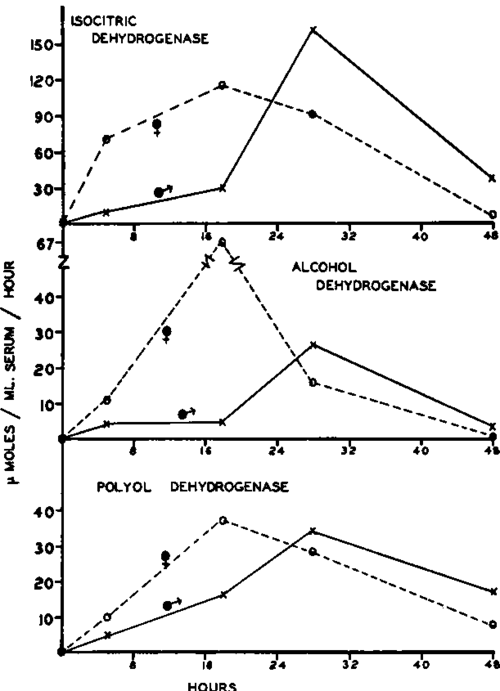
Figure 3. Changes in serum enzyme levels after the administration of a single dose of carbon tetrachloride to the rat. Each point represents the mean enzyme level determined from a group of four animals.
Summary
In addition to a number of DPN-linked dehydrogenases, human and rodent sera have been shown to contain certain oxidizing enzymes which use TPN as hydrogen acceptors. Large increases in serum isocitric dehydrogenase accompany viral hepatitis in man. The levels of this enzyme were often elevated in malignancies with metastases to the liver, but were seldom changed in portal cirrhosis and in extrahepatic obstruction of the common bile duct. The changes in serum 6-phosphogluconic dehydrogenase in human liver disease were much smaller than corresponding alterations in serum isocitric dehydrogenase. The activity of the latter enzyme was within the limits of the normal in a wide variety of other disease states. Acute viral hepatitis in man leads to the appearance of alcohol dehydrogenase and polyol dehydrogenase activity in blood serum. Alterations in the serum levels of these pyridine nucleotide-linked dehydrogenases after various types of experimental liver damage in the rat are discussed.
References
1. Warburg, O., W. Christian & A. Griese. 1935. Wasserstoffubertragendes Co-ferment, seine Zusammensetzung und Wirkungsweise. Biochem. Z. 263: 157.
2. Warburg, O. & W. Christian. 1943. Garungsfermente im Blutserum von Tumor- Ratten Biochem. Z. 314: 399.
3. Si kg el, A. & R. J. Bing. 1956. Plasma enzyme activity in myocardial infarction in dog and man. Proc. Soc. Exptl. Biol. Med. 91: 604.
4. Schade, A. L. 1953. Enzymic studies on ascites tumors and their host's blood plasmas. Biochim. Biophys. Acta. 12: 163.
5. Hsieh, K. M. & H. T. Blumenthal. 1956. Serum lactic dehydrogenase levels in various disease states. Proc. Soc. Exptl. Biol. Med. 91: 626.
6. Wr6blewski, F. & J. S. LaDue. 1955. Lactic dehydrogenase activity of blood.
Proc. Soc. Exptl. Biol. Med. 90: 210.
7. Hill, J. H. 1957. Serum lactic dehydrogenase in cancer patients. J. Natl. Cancer Inst. 18: 307.
8. White, L. P. 1956. Serum enzymes. T. Serum lactic dehydrogenase in myocardial infarction. New Engl. J. Med. 266: 984.
9. Horn, H. D. & D. Amelung. 1957. Die Bedeutung von Transaminasen- und Milchsauredehydrogenasen-Btstimmungen im Serum bei Leberkrankungen. Deut. Med. Wochschr. 82: 619.
10. Wacker, W. E. C, D. D. Ulmer & B. L. Vallee. Metalloenzymes and myocardial infarction. II. Malic and lactic dehydrogenase activities and zinc concentration. New Engl. J. Med. 266 : 450.
11. Kalckar, H. M. & E. S. Maxwell. 1958. Biosynthesis and metabolic function of uridine diphosphoglucose in mammalian organisms and its relevance to certain inborn errors. Physiol. Revs. 38: 77.
12. Gander, J. E., W. E. Petersen & P. D. Boyer. 1955. On the mechanism of the enzymatic synthesis of lactose. Arch. Biochem. Biophys. 60: 259.
13. Smith, E. E. B. & G. T. Mills. 1954. Uridine nucleotides of liver. Biochim. Biophys. Acta. 13: 386.
14. Isselbacher, K. J., E. P. Anderson, K. Kurahashi & H. M. Kalckar. 1956. Congenital galactosemia, a single enzymatic block in galactose metabolism. Science. 123: 635.
15. Faulkner, P. 1956. The "malic" enzyme in insect blood. Biochem. J. 64: 430.
16. Williams-Ashman, H. G. 1953. Studies on the Ehrlich ascites tumor. II. Oxidation of hexose phosphates. Cancer Research. 13: 721.
17. Wolfson, S. K., Jr. & H. G. Williams-Ashman. 1957. Isocitric and 6-phosphogluconic dehydrogenases in human blood serum. Proc. Soc. Exptl. Biol. Med. 96: 321.
18. Sibley, J. A. & A. L. Lehninger. 1949. Aldolase in the serum and tissues of tumorbearing animals. J. Natl. Cancer Inst. 9: 303.
19. Wroblewski, F. & J. S. LaDue. 1956. Serum glutamic-pyruvic transaminase in cardiac and hepatic disease. Proc. Soc. Exptl. Biol. Med. 91: 569.
20. Karmen, A., F. Wroblewski & J. S. La Due. 1955. Transaminase activity in human blood. J. Clin. Invest. 34: 126.
21. Bodansky, O. 1953. Serum phosphohexose isomerase. J. Biol. Chem. 202: 829.
22. Burns. F. 1956. Nachweis und" Aktivitatsmessung von 5-Phosphoriboisomerase im Blutserum. Biochem. Z. 327: 523.
23. Manso, C. & F. Wr6blewski. 1958. Glutathione reductase activity in blood and body fluids. J. Clin. Invest. 37: 214.
24. Olson. J. H. & C. B. Anfinsen. 1953. Kinetic and equilibrium studies on crystalline l-glutamic acid dehydrogenase. J. Biol. Chem. 202: 841.
25. Ochoa, S., A. H. Mehler & A. Kornberc. 1948. Biosynthesis of dicarboxylic acids by carbon dioxide fixation. I. Isolation and properties of an enzyme from pigeon liver catalyzing the reversible oxidative decarboxylation of L-malic acid. J. Biol. Chem. 174: 979.
26. Sterkel, R. L., J. A. Spencer, S. K. Wolfson, Jr. & H. G. Williams Ashman. 1958.
Serum isocitric dehydrogenase activity with particular reference to liver disease. J. Lab. Clin. Med. In press.
27. Wr6blewski, F. & J. S. LaDue. 1956. Serum glutamic-pyruvic transaminase (SGP-T) in hepatic disease: a preliminary report. Ann. Internal Med. 45: 801.
28. Bonnichsen, R. K. & A. M. Wassen. 1948. Crystalline alcohol dehydrogenase from horse liver. Arch. Biochem. 18: 361.
29. Blakley, R. L. 1951. The metabolism and antiketogenic effects of sorbitol. Sorbitol dehydrogenase. Biochem. J. 49: 257.
30. Williams-Ashman, H. G. & J. Banks. 1954. The ketose reductase of rat liver and accessory sexual organs. Arch. Biochem. Biophys. 60: 513.
31. Siebert, G., J. Dubuc, R. C. Warner & G. W. E. Plaut. 1957. The preparation of isocitric dehydrogenase from mammalian heart. J. Biol. Chem. 226: 965.
32. Huggins, C. 1947. The prostatic secretion. Harvey Lectures. Ser. 42: 148.
33. Judah, J. D. & W. H. Spector. 1954. The reaction of enzymes to injury. Brit. Med. Bull. 10: 42.
34. Bruns, F. H. & J. Neuhaus. 1955. Die Aktivitat einiger Serum und Leberenzyme beim experimentellen Tetrachlorkohlenstoffschaden der Maus. Biochem. Z. 326: 242.
Continue to:


My Books

