


Enzymatic Formation Of Steroid Ring D Lactones
Description
This section is from the book "The Scientific Contributions Of The Ben May Laboratory For Cancer Research", by The University of Chicago. Also available from Amazon: The Scientific Contributions Of The Ben May Laboratory For Cancer Research.
Enzymatic Formation Of Steroid Ring D Lactones
Among the many microbiological transformations of steroids which have been described, the formation of steroid ring D lactones stands out by virtue of its unusual nature and potentially interesting mechanism. The degradation of progesterone to 4-androstene-3,17-dione and ultimately to testololactone by various species of Aspergilli and Penicillia was reported in 1953 (D. H. Peterson et al. J. Am. Chem. Soc, 75:5768, 1953; J. Fried etal. J. Am. Chem. Soc., 75:5764, 1953).
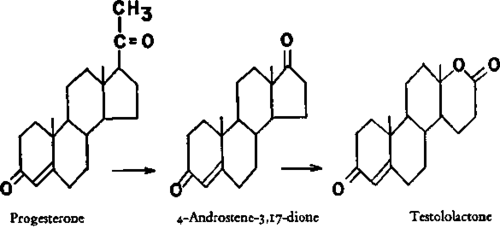
The conversion of the five-membered, ring D ketone to the six-mem-bered lactone is formally similar to the reaction described by Baeyer and Villiger (1899), who observed that peracids will react with ketones to form lactones or esters, depending on whether or not the ketone is part of a ring system. Recent studies in this laboratory have been directed toward elucidating the enzymatic mechanism of this reaction (di4). Apart from its intrinsic interest, the lactonization of steroid ring D was considered as a potential step in the degradation of the steroid nucleus by micro-organisms.
The mold Penicillium lilacinum carries out a rapid and virtually quantitative conversion of testosterone to testololactone. From the time course of this conversion, it was concluded that 4-androstene-3,17-dione is an obligatory intermediate and is the substrate for the lactone-forming enzyme system. The conversion of testosterone to 4-androstene-3,17-dione in this micro-organism is promoted by a DPN-linked 17β-hydroxysteroid dehydrogenase which catalyzes the following reaction:
Testosterone + DPN+ ⇋ 4-androstene-3,17-dione + DPNH + H+ .
This steroid-induced enzyme also oxidizes other 17β-hydroxysteroids, such as 17β-hydroxy-5α-androstan-3-one, 17β-hydroxy-5β-androstan-3-one and estradiol-17β, although at widely differing rates. It does not attack estriol, and it is inert toward various 3 a- and 3β-hydroxysteroids. The enzyme has been extracted in soluble form from P. lilacinum and partially purified. It reacts with DPN, the 3-acetylpyridine, the 3-pyridine aldehyde and the thionicotinamide analogues of DPN, but it is inactive with TPN and the deamino analogue of DPN.
A sensitive method has been developed for the assay of the lactone-forming enzyme system based on the conversion of 4-androstene-3,17-dione-4-C14 to testololactone-4-C4. The reaction products are separated into non-saponifiable (4-androstene-3,17-dione) and saponifiable (testololactone) fractions, and their radioactivities determined. With the aid of this assay it was shown that the lactone-forming enzyme system is induced by the presence of steroids in the growth medium. The activity is fully preserved in lyophilized preparations of steroid-grown mycelia and could be extracted into solution from such powders and partially purified by ammonium sulfate fractionation.
The formation of testololactone is a stricdy aerobic process. The reaction also has a specific requirement for TPNH, and neither TPN nor the oxidized or reduced forms of diphosphopyridine nucleotide could satisfy this requirement in partially purified enzyme preparations. The findings are compatible with the following stoichiometry:
4-Androstene-3,17-dione + TPNH + O2 + H+ →testololactone + TPN+ + H2O.
The reaction is insensitive to cyanide, to various metal chelating reagents, and to the addition of catalase. Hydrogen peroxide or enzymatic systems capable of generating hydrogen peroxide are unable to stimulate the formation of the lactone.
The mechanism of the lactonization reaction has been further investigated by means of oxygen18 tracer experiments. When a growing culture of P. lilacinum converted 4-androstene-3,17-dione to testololactone, in an atmosphere of oxygen enriched with oxygen18, the testololactone which was isolated contained an amount of oxygen18 approaching the equivalent of one atom per molecule. The location of this labeled oxygen was established by suitable exchange reactions between labeled or unlabeled testololactone and H2O16 or H2O18. The one atom of oxygen18 present in the microbiological product formed in an atmosphere of oxygen18 is resistant to exchange with H2O16 in acid and in base. The exchange experiments establish clearly that the newly introduced labeled oxygen atom is the ethereal oxygen atom and not the carbonyl oxygen atom at C-17.
Continue to:


My Books

