


Mechanisms Of Hormone Action. Part 4
Description
This section is from the book "The Scientific Contributions Of The Ben May Laboratory For Cancer Research", by The University of Chicago. Also available from Amazon: The Scientific Contributions Of The Ben May Laboratory For Cancer Research.
Mechanisms Of Hormone Action. Part 4
These studies have now been extended to include several other analogs of DPN and TPN, and preliminary measurements have been carried out to determine the affinities of the enzyme for these nucleotides at pH 7.3, 8.2, and 9.0. Figure 1 shows the very striking differences in the affinities of the enzyme for various analogs and includes, for comparison, a few measurements for DPN and TPN using the same enzyme preparation. The rates of oxidation of estradiol-17β with DPN, TPN, and the acetylpyridine analog of TPN are relatively insensitive to pH changes. The acetylpyridine analog of TPN is firmly bound to the enzyme (like TPN) and is reduced nearly - ten times as fast as TPN. The velocities of reduction of the acetylpyridine and the pyridine aldehyde analogs of DPN are markedly pH sensitive. At pH 7.3 and a concentration of (3 to 4) X 10-4M, these nucleotide analogs were reduced at less than one-half the rate of DPN. Upon increasing the pH to 9.0, the reaction rates of the analogs became several times those of DPN. It can also be seen from Fig. 1, that very much higher concentrations of the acetylpyridine and the pyridine aldehyde analogs of DPN were required to saturate the enzyme than of DPN, TPN, or the acetylpyridine derivative of TPN. Deamino-DPN was inert in this reaction at pH 7.3, as previously reported (112), but at higher pH values it reacted slowly (Table I). Other potential acceptors, such as the deamino derivatives of the acetylpyridine and pyridine aldehyde analogs of DPN, reacted at significant rates only at high pH (Table I).
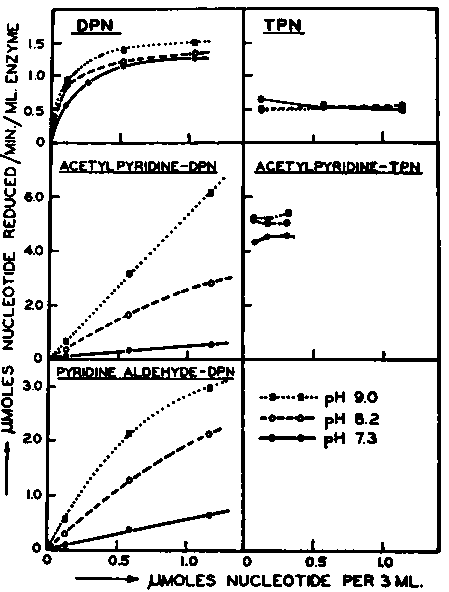
Fig. 1. Rate of oxidation of estradiol-17β by various pyridine nucleotides and their analogs catalyzed by purified 17β-hydroxysteroid dehydrogenase of placenta. The dependence of the velocity on nucleotide concentration at pH 7.3, 8.2, and 9.0 is illustrated. Experimental details are given with Table I.
b. Transhydrogenase Reaction
Demonstration of the steroid-dependent transfer of hydrogen between pyridine nucleotides or their analogs depends upon delicately balanced conditions. The ratio of the concentrations of donor to acceptor nucleotides must be adjusted in accordance with the affinities of each so that both nucleotides may gain access to the enzyme surface and participate in the oxidoreduction of the steroid. The very high affinities of the enzyme for TPN and TPNH require that only very low concentrations of these nucleotides be used for transhydrogenase experiments involving other nucleotides of lesser affinity.
Table I. Reduction Of Sluggish Or Inactive Hydrogen Acceptors Catalyzed By Placental 17β-Hydroxysteroid Dehydrogenase*
Acceptor nucleotide | Concentration of acceptor (µmoles3.0 ml.) | pH (measured) | Velocity of reduction of nucleotide (µmoles/min./ml. enzyme) |
Deamino-DPN | 1.18 | 7.4 | 0.005 |
1.18 | 8.2 | 0.024 | |
1.18 | 8.9 | 0.121 | |
Acetylpyridine | 1.15 | 7.3 | 0.002 |
deamino-DPN | 1.15 | 8.1 | 0.010 |
1.15 | 8.9 | 0.050 | |
Pyridine aldehyde | 0.93 | 7.4 | 0.000 |
deamino-DPN | 0.93 | 8.1 | 0.010 |
0.93 | 8.8 | 0.030 | |
Nicotinamide | 0.96 | 7.3 | 0.001 |
mononucleotide | 0.96 | 8.2 | 0.001 |
0.96 | 8.7 | 0.002 | |
Ribosyl | 1.02. | 7.3 | 0.001 |
nicotinamide | 1.02 | 8.0 | 0.001 |
1.02 | 8.7 | 0.005 |
* These experiments and those recorded in Fig. 1 were conducted under similar conditions. The reactions were carried out at 25° C. in systems of 3.0 ml. final volume, containing: 300 µmoles Tris buffer of pH 7.3, 8.2, or 9.0; 25 mg. crystalline bovine serum albumin; 80 µg. estradiol-17β in 0.04 ml. acetone; nucleotides in indicated amounts; and 23 units of purified placental 17β-hydroxysteroid dehydrogenase (specific activity 112 units per milligram protein). The optical density measurements were made at the wavelengths of maximum absorption of the reduced nucleotides. The results are calculated in terms of 1.0 ml. of enzyme which is equivalent to about 2300 dehydrogenase units.
References to the chemical properties, preparation, and optical constants of the nucleotide analogs are to be found in papers by Anderson and Kaplan (3) and by Siegel and colleagues (103). The following wavelengths of maximum absorption and molar extinction coefficients of the reduced compounds were assumed: DPN, TPN, deamino-DPN, nicotinamide mononucleotide, and ribosyl nicotinamide (340 mµ; E = 6220); acetyl-pyridine-DPN and acetylpyridine-TPN (365 mµ; E = 9100); pyridine aldehyde-DPN (355 mµ,; E = 9300); the deamino derivative of acetylpyridine-DPN (365 mµ-; E = 9000) and the deamino derivative of pyridine aldehyde-DPN (355 mµ.; E = 9400).
Table II shows that at pH 8.0 to 8.5, hydrogen transfer in the presence of catalytic amounts of estradiol-17β may occur from low concentrations (0.01 µmole) of continuously generated TPNH to DPN, to the acetyl-pyridine and pyridine aldehyde analogs of DPN, as well as to the acetyl-pyridine analog of TPN. The reaction with deamino-DPN was very slow, and there was no observable reduction of the deamino derivatives of the acetylpyridine and of the pyridine aldehyde analogs of DPN. Nicotinamide mononucleotide and ribosyl nicotinamide also could not serve as acceptors of hydrogen from TPNH. Of nine acceptor nucleotides, five were active and four inactive in the transhydrogenase assay. These nucleotides behaved in a corresponding manner in the dehydrogenase assays. There is thus complete agreement between the nucleotide specificities in the dehydrogenase and transhydrogenase reactions. This finding provides further evidence for the view that the same protein is involved in dehydrogenation and transhydrogenation.
Table II. Transhydrogenation From Continuously Generated TPNH To Various Acceptor Nucleotides*
Acceptor nucleotide | Velocity of reduction of acceptor (µmoles/min ./ml. enzyme) |
DPN | 20.3 |
Acetylpyridine-DPN | 13.9 |
Pyridine aldehyde-DPN | 14.2 |
Acetylpyridine-TPN | 9.9 |
Deamino-DPN | 1.0 |
Acetylpyridine deamino-DPN | 0 |
Pyridine aldehyde deamino-DPN | 0 |
Nicotinamide mononucleotide | 0 |
Ribosyl nicotinamide | 0 |
* The measurements were carried out at 25° C. in systems of 3.0 ml. final volume containing: 300 nmoles Tris (final pH 8.0-8.5), 10 nmoles disodium glucose-6-phosphate, 0.01 umole TPN, excess purified yeast glucose-6-phospbate dehydrogenase, 4 µg. estradiol-178 in 0.01 ml. acetone, and 115 units purified placental 17β-hydroxysteroid dehydrogenase (specific ativity 112 units per milligram protein). The velocities are expressed for 1 ml. of enzyme which contained 2300 units of dehydrogenase activity. Measurements were carried out at the absorption maxima of the reduced acceptor nucleotides (see Table I).
In previous experiments (112) it was shown that estradiol-17β-dependent hydrogen transfer could occur from stoichiometric quantities of DPNH to the acetylpyridine and pyridine aldehyde analogs of DPN. This reaction could be detected by differential spectrophotometry and obviated the need for auxiliary pyridine nucleotide reducing enzymes. Both these reactions are inhibited by low concentrations of TPN or TPNH (112). Consequently, DPN analogs could not serve as hydrogen acceptors from larger quantities of TPNH added directly to the reaction vessels (Fig. 2). The differences in binding constants of the enzyme for TPNH and for the

Fig. 2. Estradiol-176-mediated hydrogen transfer between DPNH or TPNH and the oxidized acetylpyridine analogs of DPN and TPN.
The reactions were carried out at 25° C. in cuvettes of 1.0 cm. light path. The systems contained in a final volume of 3.0 ml.: 300 (imoles Tris buffer of pH 8.2, indicated quantities of donor and acceptor nucleotides, 4 ug. estradiol-17β in 0.01 ml. acetone, and 69 units of purified placental 17β-hydroxysteroid dehydrogenase (specific activity 30 units per milligram of protein). The optical density was measured at 385 mµ against a control cuvette which contained all the ingredients except the nucleotides. An additional control was included in which the estradiol-17βwas omitted and TPN (5 umoles) was added. The latter control, which measured the steroid-independent hydrogen transfer, showed negligible rates with this enzyme preparation in all the systems except the transfer from DPNH to the acetylpyridine analog of DPN, in which the blank rate was 20% of the total rate. (The graph has been corrected for this rate.) analogs of DPN appear to account for the failure of this hydrogen transfer to occur at detectable rate's. Since the enzyme has a much higher affinity for the acetylpyridine analog of TPN than for the acetylpyridine analog of DPN (Fig. 1), the former could accept hydrogen from both DPNH and TPNH added directly (Fig. 2).
3. Stability, Inhibition, And Heat Inactivation
Hollander et al. (48) have investigated the pH stability of the placental system during storage at different hydrogen ion concentrations at 3° C. for 14 hours. Below pH 6 and above pH 10, both enzymatic activities were virtually destroyed. Between pH 7 and 9, the activities were almost completely retained, and there was a striking parallel between their stabilities.
Adenosine-2'-phosphate (2'-AMP) and a number of related compounds have been studied by Hollander et al. (49) as inhibitors of placental 17β-hydroxysteroid dehydrogenase and transhydrogenase. 2'-AMP is structurally related to TPN, and inhibits a number of TPN-linked dehydrogenases in a manner which is competitive with TPN (93). 2'-AMP also profoundly affects the reversibility and the apparent equilibrium of the pyridine nucleotide transhydrogenase from Pseudotnonas fluorescens (65). 2'-AMP (10-3 to 10-5M) inhibited dehydrogenase (DPN) and transhydrogenase (from TPNH to DPN) reactions catalyzed by the placental enzyme to a marked degree; the inhibition of dehydrogenase activity was usually somewhat greater than that of the transhydrogenase. Inosine-2'-phosphate was also an effective inhibitor of both functions, whereas inosine-5'-phosphate was inert and adenosine-3'-phosphate and adenosine-5'-phosphate were relatively inactive in this respect. The inhibition by 2'-AMP of the dehydrogenase, measured with TPN, was partially counteracted by increasing the TPN concentration and did not parallel the inhibition of the transhydrogenase. Differences in affinity of the enzyme for the various nucleotides may account for this discrepancy, and we would agree with Hollander that it is not necessary to postulate the existence of several enzymes.
Continue to:


My Books

