


Induction Of Mammary Cancer
Description
This section is from the book "The Scientific Contributions Of The Ben May Laboratory For Cancer Research", by The University of Chicago. Also available from Amazon: The Scientific Contributions Of The Ben May Laboratory For Cancer Research.
Induction Of Mammary Cancer
Female rats of the Sprague-Dawley strain were used in all the experiments, with 10 rats in each experimental group ; unless stated otherwise, the animals were age 50 days and weighed 140-150 gm. when the hydrocarbons were fed. They remained free from respiratory diseases.
With the aid of gentlo heating, 2 gm. of 7,12-dimethylbenz(a)anthracene (DMBA), or 1 -5 gm. of 3-MC was dissolved in 100 ml. of sesame oil. One gram of 2-AAF was dissolved in 10 ml. of ethanol and the solution was diluted to 100 ml. with sesame oil. The solutions were instilled in the stomach through a soft rubber catheter, and only a single dose was administered. The rats were examined frequently for palpable tumours for 150 days and cancers weighing 10 mgm. or more were readily detected. The occurrence of the cancers was dated from the day of feeding the carcinogen. The tumours were confirmed at necropsy when the total number of visible tumours ('active centres') was counted.
In our rat colony two 'spontaneous' mammary cancers have boon observed among about 20,000 untreated femalo rats less than eight months of age. But benign mammary tumours occur very frequently in this strain in senescence8.
3-Methylcholanthrene. A single feeding of 3-MC (100 mgm.) induced cancer in 100 female rats, aged 50-65 days, in 10 consecutive series ; no tumours were observed in 20 males treated similarly. Tho rats suffered a decline in body-weight (total loss 10-15 gm.) for 48 hr. after the feeding, but a gain in weight was observed on day 3. In these series of females, mammary cancer was observed in every rat and squamous carcinoma of sebaceous glands adjacent to the external auditory canal in two of them ; no other tumours were found. The earliest mammary cancer was detected by palpation on day 31, and tho last was observed on day 130. But in serial histological sections of the inguinal mammary glands of 10 rats, 14 days after a single feeding of 3-MC, carcinomata were found in two of the glands.

Fig. 1. Incidence of mammary cancer in groups of ten rats fed 3-MC once only. The abscissa indicates the age when the compound was fed microscopic examination. The squamous carcino-mata of sobaceous glands appeared, respectively, on days 109 and 121.
The influences of age at the time of a solitary feeding, and of the presence of the ovaries, were investigated by feeding a single dose of 3-MC (66-6 mgm./100 gm.) to rats of various ages; half the animals were intact, and the ovaries of tho others had been removed at the time of weaning. In the intact rats mammary cancer was induced by feeding the carcinogen at age 23 days and the incidence of tumours rose progressively with age until all rats fed 3-MC at ago 50 days developed cancer of the breast (Table 1). There was a decline in the incidence of mammary cancer in rats fed 3-MC at age 75 days, and cancer of the breast developed in only a small number of animals fed 3-MC at ago 100-365 days (Fig. 1).
No mammary cancer was observed in 100 rats that had been ovariectomized at age 22 days and fed a single dose of 3-MC thereafter at various ages between 23 and 100 days.
The optimal dose of 3-MC for the induction of mammary cancer after a single feeding was 100 mgm.; this dose induced 1-4 active centres in each rat. A single dose of 3-MC (2 mgm.) induced mammary cancer in ono rat and there was a progressive increase in the rate of tumour incidence and in the number of active centres with augmentation of the dose until the optimal amount was reached (Table 1).
Table I. Induction Of Mammary Cancer By Intragastric Instillation Of Polynuclear Hydrocarbons At 50 Days Of Age
Compound | Dose (mgm.) | No. with cancer* | Appearance of palpable tumours (days) | Active centres | ||
range | median | mean | ||||
DMBA | 20 | 10 | 28-59 | 41 | 42.8 ± 10† | 6-8 |
DM HA | 15 | 10 | 34-70 | 40 | 48.5±11 | 3.0 |
3-MC | 100 | 10 | 31-80 | 50 | 51.3±16 | 2-3 |
3-MC | 50 | 8 | 35-121 | 56 | 6.4 ±30 | 1.1 |
3-MC | 25 | 7 | 34-54 | 49 | 47.5 ±9 | 2.4 |
3-MC | 10 | 3 | 45-120 | 52 | 75 | 1.3 |
3-MC | 5 | 2 | 50 and | - | - | 1.0 |
133 | ||||||
3-MC | 2 | 1 | 48 | - | - | 1.0 |
2-AAF | 100 | 3 | 43-73 | 53 | 56 3 | 1.0 |
2-AAF | 50 | 3 | 51-79 | 59 | 63 | 1.0 |
* There were ten rats In each group. The animals were observed for 150 days, † Standard deviation.
A large portion of 3-MC which is fed passes through the alimentary tract. After a large dose the faeces were highly fluorescent. Our colleagues, Dr. Flesher and Dr. Sydnor, fed a single dose of tritium-labelled 3-MC (10 mgm.) to rats and recovered about 90 per cent of the administered radioactivity in the fasces, where significant quantities were detected for 7-11 days following the single feeding9.
Trace amounts of 3-MC are sufficient to induce mammary cancer. Compressed, cylindrical pellets of known weight were implanted in the spleen of 18 rats ; neoplasms did not arise in the spleen but three of the animals developed mammary cancer at 105, 148 and 199 days respectively. At necropsy, the pellets were removed from the spleen, blotted, heated to 100° for 24 hr. and re-weighed. No decrease in weight of the 3-MC pellet occurred during the long sojourn in the spleen. In one of the experiments wherein a rat developed mammary cancer at 148 days after implantation of 3-MC in the spleen, both the original and final weight of the pellet was 26-8 mgm. An amount of 3-MC too small to be detected on our balance had induced mammary cancer. Shear5 observed formation of sarcoma in muscle after implanting therein a pellet of cholesterol containing dibenz(a,h)anthracene (0-4 µgm.).
7,12-Dimethylbenz(a)anthracene. A single feeding of DMBA was highly effective in the induction of mammary cancer in female rats. DMBA (1 mgm.) induced mammary cancer, and there was a progressive rise in the incidence of cancers with increased about no significant decrease in the production of gonadotrophin by the hypophysis or in function of the ovary.
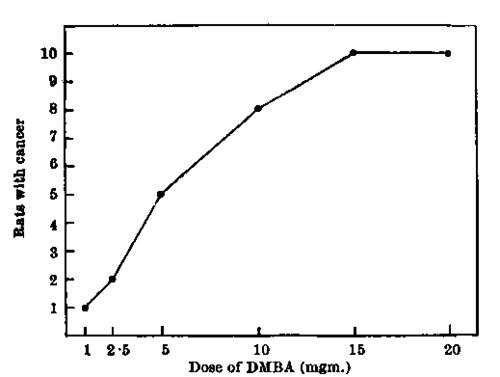
Fig. 2. Incidence of mammary cancer in groups of ten rats fed DM ISA once only dosage until the optimal dose was reached (Fig. 2). The optimal dose of DMBA (dissolved in sesame oil, 1 ml.) for induction of mammary cancer by a single feeding was 20 mgm. For : (1) every rat survived ; (2) mammary cancer developed in 40 consecutive rats without exception ; (3) the first cancer was detected by external examination at 28 days and all the rats had visible tumours of the breast bo-fore 60 days; (4) the number of active centres in individual rats varied from 3 to 21, the average being 6-8. DMBA (15 mgm.) induced mammary cancer in every rat after a single feeding, but there were fewer active centres than in rats which had received 20 mgm. (Table 1). All 10 rats which were fed DMBA (50 mgm.) died 2-28 days afterwards.
It is known that the application of large amounts of 3-MC to the skin of mice causes leukopenia10. The leukocytes of the blood of rats were counted in quadruplicate before and at frequent intervals following a single feeding of DMBA (20 mgm.) to rats 50 days old. There was no change in their number for 24 hr., but leukopenia developed shortly thereafter and it was long-lasting (Fig. 3). The steady increase in body-weight of the young rats was interrupted for two days but growth recommenced thereafter (Fig. 3). But the sexual rhythm, demonstrated in the regular recurrence of oestrus cycles, was not delayed by feeding the carcinogen; cestrus appeared every 4 15 days both in DMBA-fed and in untreated control rats. It is clear that DMBA induced cancers and leukopenia and also caused a temporary cessation of body-growth, but brought 2-Acetylaminoflvorene. Feeding single doses of 2-AAF was a relatively inefficient method of inducing mammary cancer (Table 1). Twenty rats (50 days old) were fed an alcohol-containing solution of 2-AAF (50 or 100 mgm.) and six of them developed cancer of the breast within five months ; no other tumours were observed. The chief interest of this compound was in its anaesthetic effects which were apparent after doses of 75-100 mgm. Due to its limited solubility in oil, 2-AAF was usually given in two divided doses separated by a 4-hr. interval. The rats became drowsy within 1 hr. after the first dose and were asleep within 2 hr. after the second feeding. They remained unconscious and did not move their position in tho cage for 24 hr., but most of them woke within a few hours thereafter. Control rats fed sesame oil containing 10 per cent ethanol were not anaesthetized. Moreover, anaesthesia was induced in rats by feeding a dose of 75 mgm. of a solution of 2-AAF which contained no ethanol; for reasons of solubility the solution was administered at a temperature of 43°. Likewise, profound anaesthesia was induced by a single feeding of 2-aminofluorene (150 mgm.) dissolved in sesamo oil, 3 ml., containing no ethanol.
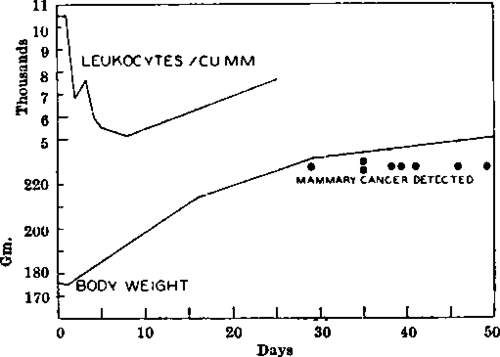
Fig. 3. DMBA (20 mgm.) wag fed at day 0 to eight rats.
Continue to:


My Books

