


Phosphonic Acids. III.1 Hydroxyl Substituted Propylphosphonic Acids 2,3
Description
This section is from the book "The Scientific Contributions Of The Ben May Laboratory For Cancer Research", by The University of Chicago. Also available from Amazon: The Scientific Contributions Of The Ben May Laboratory For Cancer Research.
Phosphonic Acids. III.1 Hydroxyl Substituted Propylphosphonic Acids 2,3
By Seymour Preis, Terrell C. Myers and Elwood V. Jensen
Received July 1, 1955
The peroxide-catalyzed addition of diethyl phosphite to iso-propenyl acetate yields diethyl β-acetoxypropylphosphonate, which on hydrolysis gives β-hydroxypropylphosphonic acid. The reaction of triethyl phosphite with epibromohydrin yields diethyl β,γ-epoxypropylphosphonate, which on hydrolysis gives diethyl β,γ-dihydroxypropylphosphonic acid. The biochemical interest in these phosphonic acids as phosphonate analogs of certain phosphorylated intermediates of glycolysis is discussed.
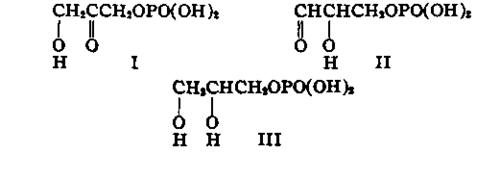
As the glucose molecule enters the living cell it undergoes esterification with phosphoric acid, and in its subsequent metabolic breakdown a large number of the intermediate products react with their respective enzymes in the form of phosphate esters. Typical examples of such phosphorylated intermediates of carbohydrate metabolism include dihydroxyacetone phosphate (I), glyceraldehyde phosphate (II) and a-glycerylphosphate (III). For the most part, the enzymatic transformations of these and other phosphorylated intermediates do not take place at the phosphate group but at some other point in the molecule. Thus it would seem that the function of the phosphate group in many instances4 may be to serve as a point of attachment to bind the substrate molecule to the enzyme. If this is true, it is possible that another similar chemical structure, such as the phosphonic acid group, could carry out the same function.
(1) Paper II, T. C. Myers, R. G. Harvey and E. V. Jensen, This Journal, 77, 3101 (1955).
(2) Presented before the Division of Organic Chemistry, 123rd Meeting of the American Chemical Society, Los Angeles, March, 1951.
(3) This investigation was supported by grants from the National Institutes of Health, Public Health Service (RG-3053) and from the American Cancer Society as recommended by the Committee on Growth of the National Research Council.
In connection with studies of the mechanism of enzyme-substrate interaction, and in the hope of developing either alternative substrates or else competitive inhibitors for the enzyme systems in question, an investigation of phosphonate analogs of some of these physiologically important phosphate compounds has been undertaken. Such phosphonate analogs of the triose phosphates include both β- and β,γ-substituted propylphosphonic acids, in which the oxygen atom of the phosphate ester is eliminated completely, and γ- and -γ,delta-sub-stituted butylphosphonic acids in which the oxygen is replaced by a methylene group. The synthesis of γ-ketobutylphosphonic acid has been reported previously.1 This paper describes the preparation of β-hydroxypropylphosphonic acid and β,γ-dihy-droxypropylphosphonic acid.
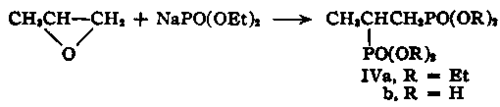
It was found that β-hydroxyphosphonic esters could not be prepared by the more common methods for introduction of the phosphonate group. For example, propylene bromohydrin is not converted to diethyl β-hydroxypropylphosphonate by treatment either with triethyl phosphite or with sodium diethyl phosphite. The reaction of propylene oxide with sodium diethyl phosphite led rather unexpectedly to the formation of tetraethyl propyl-1,2-diphosphonate (IVa) which, on acid hydrolysis, is converted to the free propyl-1,2-diphosphonic acid (IVb). In this reaction the primary product may be the expected diethyl β-hydroxypropylphosphon-ate which undergoes dehydration followed by addition of another molecule of sodium diethyl phosphite to the double bond. The addition of this reagent to a double bond conjugated with a phosphonate group is known to take place readily.5
(4) The function of the 6-phosphate (roup in the metabolic intermediate, fructose 1,6-diphosphate, appears to be the blocking of the 6-hydroxyl group so as to prevent pyranose ring formation; a. L. Lehnlnger, J. Sice and e. V. Jensen, Bioclum. Biophys. Acta, IT, 286 (1986).
A successful route to β-hydroxyphosphonic acids is afforded by the peroxide-catalyzed addition of diethyl phosphite to an enol ester. Thus a mixture of isopropenyl acetate and diethyl phosphite, when heated in the presence of catalytic amounts of benzoyl peroxide, produces diethyl β-acetoxypro-pylphosphonate (V) in high yield. Undoubtedly this reaction takes place by a free radical chain mechanism of the general type by which a large variety of substances with labile atoms are known to add to olefins.6,7 In this process, the initiating radical (R), formed from the benzoyl peroxide, abstracts the labile hydrogen atom from a molecule of diethyl phosphite to form a diethylphosphoryl radical which then adds to the double bond of isopropenyl acetate. The free radical thus formed then may undergo one of two possible reactions. It may abstract an atom of hydrogen from diethyl phosphite to yield the desired product V and a new diethylphosphoryl radical which carries on the reaction chain. Alternatively, it may add to another molecule of isopropenyl acetate to give a free radical containing two residues of isopropenyl acetate per phosphonate group; this radical then may react either with diethyl phosphite to give a 2:1 addition product or with still another isopropenyl acetate molecule, and so on. When the reaction is

(5) (a) G. Schwarsenbach, P. Ruckstuhl and J. Zuic, Heh. Ckim. Acta, m, 455 (1951); (b) A. N. Pudovik and M. M. Frolova, Zhur. Obshchcl Kkim, it, 2052 (1952); C. A., 4T, 9910 (1953).
(6) Cf. M. S. Khar Rich. B. M. May and F. R. Mayo, J. Org. Chtm., 3, 175 (1938); M. S. Kharasch, B. V. Jensen and W. H. Urry, Tail Journal, 69,1100 (1947); A. R. Stiles, F. P. Rust and W. B. Vaughan, ibid.. It, 8282 (1952).
(7) I. S. Bengelsdorf. Ph.D. Dissertation, University of Chicago, 1981 carried out with equal molar amounts of diethyl phosphite and isopropenyl acetate, the intermediate radicals apparently react in both possible ways, so that a considerable amount of the product contains two or more residues of isopropenyl acetate per phosphonate group. However, when the reaction is carried out in a 2.5-fold excess of diethyl phosphite as solvent, the intermediate radicals react preferentially with this material; under these conditions 72% of the isopropenyl acetate is converted to the 1:1 addition product while only 16% appears in the products of higher molecular weight upon warming the acetoxyphosphonic ester V with hydrochloric acid, hydrolytic cleavage of the acetate as well as the phosphonate ester linkages takes place to yield β-hydroxypropylphosphonic acid (VI), an oily liquid which was isolated as its crystalline cyclohexylamine salt.
For the preparation of β,γ-dihydroxypropylphos-phonic acid (VIII) a convenient starting material was found to be diethyl β,7-epoxypropylphosphon-ate (VII) prepared as described previously7,8 by the reaction of triethyl phosphite with epibromo-hydrin. When diethyl epoxypropylphosphonate is warmed in excess water hydrolytic cleavage of both the epoxide ring and the phosphonate ester groups takes place to yield dihydroxypropylphosphonic acid (VIII), a sirupy liquid which was isolated in the form of its barium salt.

Investigations of the effects of the foregoing propylphosphonic acids on various biochemical systems in vitro and in vivo will be described in subsequent publications.
Experimental
Materials
Diethyl phosphite and triethyl phosphite were obtained from the Virginia-Carolina Chemical Company. These materials, as well as all liquid organic reagents, were purified by distillation prior to use. Tetrahy-drofuran (du Pont) was allowed to stand with several fresh portions of solid potassium hydroxide and then distilled from sodium ribbon.
Tetraethyl Propyl-L,2-Diphosphonate (Iva)
A stirred solution of sodium ethoxide (77 g., 1.14 moles) and diethyl phosphite (157 g., 1.14 moles) in tetrahydrofuran (400 ml.) was warmed to reflux, and propylene oxide (66 g., 1.14 moles) was added slowly causing the formation of a white precipitate. The addition of propylene oxide was complete in one hour, whereupon the cooled reaction mixture was neutralized by pouring it through a column containing Amberlite IRC-50H resin (350 g.) which had been washed previously with absolute alcohol. After removal of the tetrahydrofuran, the residue was fractionated at reduced pressure. The major fractions (39 g., b.p. 120-170° (0.3 mm.)) showed a nearly constant refractive index; a high boiling residue (19 g.) remained. Redistillation of the combined major fractions gave tetraethyl propyl-1,2-diphos-phonate (35.5 g., 22%; b.p. 120-148° (0.3 mm.), n25d 1.4400). A portion of this material was distilled through a Podbielniak Heliband micro-column to obtain the analytical sample; b.p. 133° (0.9 mm.), n26D 1.4406; reported 5b b.p. 160-162° (3 mm.), n30D 1.4430.
(8) Cf. B. A. Arbuxov and B. P. Lugokvin, Zhur. ObshtM, Khim.,ii, 1103 (1952); C. A., 47, 4871 (1968), for preparation from epiiodohy-drln.
Anal. Calcd. for C„Hi,OtP,: C, 41.77; H, 8.29; P, 19.59. Found: C, 41.53; H.8.53; P, 19.72.
Propyl-1,2-Diphosphonic Acid 9 (Ivb)
A 2-g. portion of the column-distilled tetraethyl propyl-1,2-diphosphonate (IV) was refluxed overnight with 20 ml. of concentrated hydrochloric acid. The solution was then evaporated in vacuo. After several days the oily residue crystallized. Several re-crystallizations of this material from t-butyl alcohol yielded propyl-1,2-diphosphonic acid, m.p. 123°.
Anal. Calcd. for &C2H10O6P2: C, 17.65; H, 4.94; P, 30.36; neut. equiv. (to pH 4.5), 102. Found: C, 17.93; H, 5.08; P, 30.64; neut. equiv., 104.
Diethyl β-Acatoxypropylphosphonate (V)
A solution of benzoyl peroxide (5 g.) in isopropenyl acetate (93 g., 0.93 mole) was added slowly to a stirred solution of diethyl phosphite (319 g., 2.3 mole) held at 85 to 95°. When the addition was complete (3 hours) a further 5-g. quantity of benzoyl peroxide was added and heating continued for another hour. Then the excess diethyl phosphite was removed under reduced pressure. The residual oil was distilled, and the fraction boiling at 78-100° (0.5 mm.) was redistilled yielding diethyl β-acetoxypropylphosphonate, b.p. 89-93° (0.5 mm.), n26D 1.4301. The yield was 160 72%.
Anal. Calcd. for C,H„0,P: C, 45.37; H, 8.04; P, 13.00. Found: C, 45.44; H. 8.26; P, 12.96.
The higher boiling fractions contained about 25 g. of a substance containing two residues of isopropenyl acetate to one of diethyl phosphite (b.p. 100-115° (0.1 mm.), n25D 1.4461).
When the reaction was carried out using equal molar proportions of diethyl phosphite and isopropenyl acetate, the yield of 1:1 product was only 35%, and the amount of higher boiling material was markedly increased. In this case the latter material, after molecular distillation, consisted mainly of an adduct containing three isopropenyl acetate molecules per diethyl phosphite (n25D 1.4523).
Anal. Calcd. for C19H35O9P: C, 52.04; H, 8.05; P, 7.07. Found: C, 51.78; H, 7.96; P, 9.06.
(S) Propyl-1,2-dlphospbonlc acid has been described previously 5a as a non-crystalline material. Our propyldlphosphonlc add (m.p. 123) has been assigned this structure since It is not propyl-1,8-dlphosphonlc add (m.p. 172, P. Nylen, Dissertation, Uppsala, 1930) and the possibility that It is propyl-1,1-diphosphonic add seems unlikely.
β-Hydxoxypropylphosphonlc Acid (VI)
Diethyl β-acetoxypropylphosphonate (V, 4.5 g., 0.019 mole) was warmed overnight on the steam-bath with concentrated hydrochloric acid (10 ml.). The reaction mixture was evaporated in a stream of nitrogen and finally in vacuo leaving β-hydroxypropylphosphonic acid as a brownish sirup. This material was dissolved in water, and the solution was decolorized with Norit. To the colorless solution was added cyclohexylamine (1.77 g., 0.018 mole). The mixture was concentrated to about 3 ml.; a small amount of precipitate was removed by centrifugation, and the supernatant solution was concentrated to a small volume. The precipitated solid was removed by filtration, washed with a little cold isopropyl alcohol and recrystallized several times from a mixture of ethanol and tetrahydrofuran. The monocyclo-hexylamine salt of β-hydroxypropylphosphonic acid was obtained as white lustrous needles, m.p. 194-196° with decomposition.
Anal. Calcd. for C9H22O4NP: C, 45.17; H, 9.27; N,
5.85; P, 12.95. Found: C, 45.47; H, 9.60; N, 6.14; P. 13.20.
Diethyl 0,Y-Epoxypropylphosphonate (VII)
Triethyl phosphite (332 g., 2.0 moles) was added slowly with stirring to epibromohydrin (261 g., 2.0 mole) held at 135-145°. The addition was complete in four hours and heating and stirring was continued for two hours longer. During the reaction the ethyl bromide produced (169 g., 1.55 moles) was removed continuously by a gentle stream of nitrogen. On distillation of the reaction mature, the main fraction (197 g., 51% yield) consisted of diethyl epoxypropylphos-phonate, b.p. 68-72° (0.1 mm.); n25D 1.4379; reported n20D 1.4430,7 1.4405.8
Anal. Calcd. for C7H15O4P: C, 43.30; H, 7.79; P. 16.00. Found: C, 42.59; H, 7.99; P, 15.93.
The high boiling residue from the above reaction mixture (72 g.) was molecularly distilled at about 95°. The main portion of this distillate (n25D 1.4549) appeared to possess approximately two phosphonate units per propane residue.
Anal. Found: C, 40.00; H, 7.18; P, 19.4. β,y-Dihydxoxypropylphosphonic Acid (VUI).-Diethyl β,y-epoxypropylphosphonate (VII) was placed in water and warmed on the steam-bath. The oil gradually dissolved and the solution became acidic. After heating for six days, the water was removed at reduced pressure leaving the dihydroxypropylphosphonic acid as a viscous sirup (n25D 1.4971) which could not be completely freed of water, but which was isolated in the form of its barium salt by the procedure of Arbuzov and Lugovkin8 and recrystallized from water.
Anal. Calcd. for C6H16O10PBa: P, 13.85; Ba, 30.69. Found: P, 13.30, 13.10; Ba, 31.15, 31.44.
Chicago 37, Illinois
Continue to:


My Books

