


General Suggestions
Description
This section is from the book "The Art Of Dispensing", by Peter MacEwan. See also: Calculation of Drug Dosages.
General Suggestions
The Dispenser must cultivate habits of order and cleanliness in respect to his person as well as in his methods of work. Dirtiness and untidiness in dress on the part of the dispenser give an unpleasant impression. Such practices as pressing corks with the teeth, holding powder-envelopes in the mouth, shaking up mixtures with the finger over the mouth of the bottle, and breathing on pills to be silvered should be avoided. Becoming manners and decorous conduct in the pharmacy are essential; anything in the nature of joking is out of place, because if observed by customers, who usually feel that they are on a serious errand, distrust may be created. Dispensing is the most responsible part of the pharmacist's duties, and is considered to be so by doctors and patients alike; the closest attention and the most scrupulous care should therefore be manifested at the dispensing-counter.
Quality Of Drugs
The medicines employed in the preparation of prescriptions should be of the finest quality procurable for money, and official or other preparations made from them should be prepared in strict accordance with recognised methods. Second qualities of some goods may be necessary for certain purposes in other sales, but the pharmacist should not for a single moment permit the thought of second qualities in the dispensing department. Differences will occur in medicines prepared at different establishments, but always at least retain the satisfaction of knowing that these cannot result from the use of inferior drugs in your pharmacy. Let the consideration of profit gained from the dispensing of prescriptions be secondary: it will take care of itself. Dispense medicine with the feeling that an artist has in his work, and so will you make an art of yours. Ensure by occasional testing that preparations which are liable to deteriorate are of proper strength; this applies particularly to such as acid. hydrocyanic. dil. and spt. aether. nitrosi.
Although you pay the best price for your drugs, do not let that prevent you submitting them to examination before placing them in stock.
Capping Bottles
In capping bottles with leather it is a good plan to soak the leather for a short time in lime-water, or even in plain water. Crimson paper is generally used for capping (in the manner shown in the accompanying figure), but it has now largely given way to ready-pleated caps. The cap should be secured with a small indiarubber band, as it can be most readily removed in that way ; but if secured with twine, form a loop knot, so that twine and cap may be easily removed. On the whole, finishing off without a cap is better than with it, from the patient's point of view, and an embossed or printed circular address-label for the top of the cork is better than a heavy sealing-wax finish, although the latter has the more substantial appearance.
One Thing At A Time
Never have two prescriptions going at once. Of course, if there is an infusion to make, you will set that on-set the jar on one side, marking on a piece of paper what it is and the time when it will be ready; then place this label between the cover and the rim of the jar. You can then go on with another prescription. But, having finished one, clear up all disorder, and put away bottles, measures, and mortars, before beginning anything else. Indeed, bottles should be replaced, and measures and mortars set aside for cleaning, directly after being used, and should on no account be allowed to accumulate on the dispensing-counter. A suggestion to 'place together on the counter all shop-bottles containing the ingredients for the prescription' was unanimously condemned by experienced pharmacists in The Chemist and Druggist, October 1, 1906, p. 555.
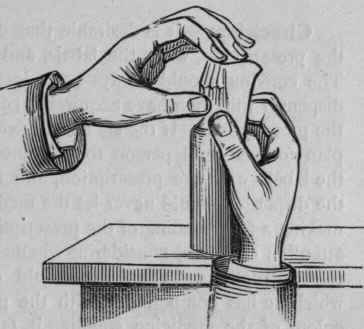
How To Make A Pleated Paper Cap Extemporaneously.
Checking
It is desirable that one person should copy the prescription, write the labels, and dispense the medicine. The copying should always precede the dispensing, and the dispenser will then have acquired a general acquaintance with the prescription. If the staff is large enough, it is a very good plan for a second person to examine the medicine, compare the labels with the prescription, and finish off. In any case, the dispenser should never let the medicine leave him without making a final reading of the prescription, concentrating all his attention on it, and considering whether he has exactly followed the instructions. Then he should compare the medicine which he has compounded with the prescription ; noting the colour of the medicine, smelling it, tasting it if that is appropriate, and observing whether there is a sediment or not. All these points are good to observe, and when they are regularly practised they are a valuable precaution. In the best dispensing houses each weighing or measuring of a poison is checked by a second dispenser.
Continue to:


My Books

