


Direct Supply. Part 2
Description
This section is from the book "A Working Manual Of American Plumbing Practice", by William Beall Gray, Charles B. Ball. Also available from Amazon: Plumbing.
Direct Supply. Part 2
Shown in Fig. 75.
The disadvantage of this job is that the cocks which stop the hot water to the bathroom are over the reservoir. While each fixture is controlled separately, by cocks in addition to its regular faucets, all the lines are not under control individually. This arrangement embraces every feature essential to good service and with the least possible material. The nickeled supply in bathroom is thus reduced to a minimum, and the chances for leakage to do damage are greatly lessened. For comparison, the kitchen work of an actual installation with separate supplies, having one bathroom and three odd fixtures, is shown in Fig. 77. This number of fixtures is considered about the limit in strictly separate supply work for residences, when all the lines radiate from one point, as they do in this case. In order that their purpose may be understood, the pipes shown in Fig. 77 are numbered. Pipe 1 carries the water from the house force-pump to the tank, and is arranged to discharge over the top of the tank. The tell-tale pipe, 2, is from the tank, and discharges in the sink, so that the person using the pump will know, when water flows from it, that the tank is full to the overflow level. The cold-water supply to the butler's sink is No. 3. No. 4 is the hot-water supply to the same fixture. Pipe 5 is the return circulation from the bathroom hot supply. To make proper circulation certain at all times, regardless of he trap in the hot-service pipe made by dropping from the boiler and running across under the sink before rising to the second floor, the hot-service pipe is continued to the attic and a return made from there, an air-pipe being taken from the highest point over the tank, to prevent its becoming air-bound. The position of the stop-cocks is such that they will drain without giving special attention to the waste water, which discharges into the sink; and the cocks are within easy reach from the floor. Pipe 6 is the cold-water supply to the bathroom fixtures. The supply to the water-closet tank is taken from pipe 9, which passes under the closet room, a cock being placed just above the floor. Pipe 7 is the hot-water supply to the bathroom fixtures. The main cold supply from the tank is pipe 8, which has a cock over the sink, and is also provided with a valve at the tank. Pipe 9 supplies cold water to the laundry, the hall lavatory, and the water-closet already mentioned. Pipe 10 supplies hot water to the laundry and the hall lavatory.
All of the service pipes, both hot and cold, above the first floor, are continued upward from the kitchen ceiling through a partition to and over the tank. This allows air to enter the pipes and drain the lines when the stop-cocks on them are turned off.
Baths do not need circulation for the same reason that lavatories do. Lavatory faucets are small in nozzle, as a rule; only small quantities of water are needed at a time; and it is annoying to have to waste time in drawing out cold, "dead" water and enough more to warm the pipe line, before warm water can be had at the faucet Where the water must be pumped by hand such needless waste is still more aggravating. Kitchen sinks are close to the hot supply source, and do not need circulation. Lavatories and other fixtures remote from the bath or main toilet room, are sometimes served from the circulating loop instead of separately.

Fig. 77. Kitchen Arrangement of a Separate Supply Tank Installation..
Hot-Water Storage. The storage cylinder for hot water is made in both horizontal and vertical types. When heated by stove connections, the vertical type, shown in Fig. 78, is best; and this type is usually employed. The only difference in the standard makes is the position of the connections. Both vertical and horizontal types are connected and operate on the same principles, and the arrangement of one may be deduced from the modus operandi of the other. The vertical type, for example, of iron or mild steel, galvanized inside and out, single- or double-riveted, heavy, and calked according to pressure designed for, is generally divided into two classes - Standard and Extra Heavy. Seamless copper cylinders, reinforced inside for heavy work, are made.
The light copper shells for light pressure, not reinforced, are collapsible under partial vacuum, and frequently do collapse when the supply is being drained, on account of the delivery failing to admit air to take the place of the water. Copper shells are also much more likely to rupture under strain than iron or steel shells. Take, for instance, a house with copper storage cylinder, with hot fire and in extremely hot water, as on wash-day; then, if the pressure is suddenly reduced by opening a faucet or otherwise, and the temperature is far above the boiling point of the water under the remaining pressure, the tendency is for the whole volume of water to turn instantly to steam. This has happened with disastrous effect in more than one instance, the copper shell being ripped and spread out almost in a plane.
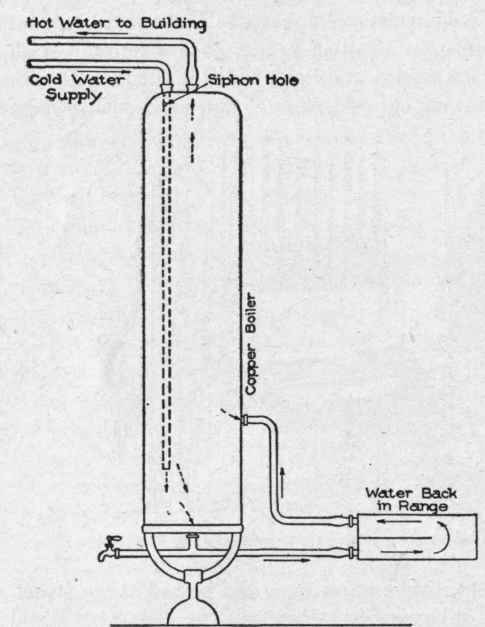
Fig. 78. Vertical Type of Hot-Water Storage Cylinder Adapted.
for Range Heating.
Rumbling noise is frequently heard in any type of reservoir. Water being heated throughout, or perhaps only at some points in the stove, to above the boiling point corresponding to the pressure, steam bubbles form in the hottest places and crowd the water-back into the main or into the air-chambers to make room for themselves. It is the concussion caused by the collapse of these bubbles forming and condensing in rapid succession, that creates the rumbling noise. This condition sometimes results from a brisk fire when the reservoir water is not overheated, and is due to air-traps in the connection, or constriction by incrustation or otherwise. Rumbling under this condition is a cause for prompt investigation.
Continue to:


My Books

