


Connecting A Kitchen-Boiler With One Or More Water-Backs. Part 3
Description
This section is from the book "Plumbing Problems", by The Sanitary Engineer. Also available from Amazon: Plumbing Problems, or Questions, Answers and Descriptions Relating to House Drainage and Plumbing.
Connecting A Kitchen-Boiler With One Or More Water-Backs. Part 3
It now and then happens that a plumber has to connect two boilers with one water-back. This, on general principles, he is opposed to doing, but it frequently happens that the maker of a range objects to putting an extra back into it, especially if he has to remove any of the fire-brick lining to do so, usually claiming that it will spoil the baking properties of his ovens, and he will allow the use of a coil or extra back only under protest.
To take out the single back and replace it with two small ones is no better than to connect the two boilers to the single back, because, as a general thing, the surface of the backs cannot be increased. Therefore the plumber is compelled by circumstances to do the best he can with the range and back as he finds them. He might, of course, tap extra holes in the back - two flow-holes at the top and two return-holes at the bottom - but then it entails extra expense and trouble and alterations in the stove to get both sets of pipes through to the boilers, and thus he is forced to connect two boilers to a single water-back.
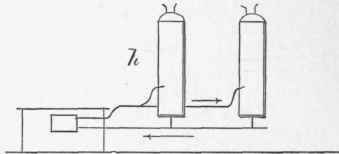
Figure 123.
Diagram h is the way it usually suggests itself for the first time. It is the simplest, and all the flow-pipes have an upward tendency toward the boiler, with a level return-pipe, or it may be that the plumber can secure a little pitch toward the water-back.
This will work tolerably well if the two boilers are very near together - that is, the first boiler will, heat fairly well, and the second one not so well, but as it is furthest from the range it is hardly to be expected of it, either in the opinion of the man who puts it up or the user; and hence the differences of temperature and the time of "warming up" are looked on as a natural result, and past correcting, at least with the majority of people. But the limit of improvement in this direction has not been reached, and it has been found that a simple change, such as that shown by diagram i, insures equal temperatures to both boilers. The flow-pipe must be carried across some short distance above the "side couplings" on the boilers, and the side couplings should be set so as to be on the same level. The flow-pipe should be made large after it leaves the range - say twice the diameter of the side-coupling connection. It should also be perfectly level beyond the point where it reaches its greatest height, just close to the range, and the branches which connect with the side couplings should be taken out in the same manner from the flow-pipe, and dropped a few inches before entering the boiler. By this method the flow-pipe has considerable capacity, and becomes a reservoir of hot water of practically the same temperature throughout. From this pipe the water to the side connections will descend by gravity, due to cooling, and the whole distance between the level of the flow and return-pipe, in a line through the boilers, forms the "down" legs of the circulation, while the "up" leg is the rising pipe from the water-back and the back itself. This method balances the conditions for both boilers, and each receives the same amount of the flow.
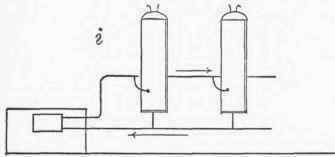
Figure 124.
By using a large flow-pipe, a very considerable distance may be maintained between the boilers, giving results so nearly equal that the difference cannot be detected by the hand. This method forms a syphon, in the head of which air or steam might lodge when they are present, and for this reason an air-cock or branch to a sink should be run from the end of the flow-pipe. Generally this will not give trouble when the air is once drawn out, and with two boilers steam can scarcely be formed with an ordinary-sized back.
Should one of these boilers be beyond a doorway, as it is very likely to be should it be in a laundry or other room, the fitter will find it necessary to run the flow-pipe above the doorway to reach the further boiler, returning under the floor. If he attempts this at all, he is very likely to run his pipes as shown in diagram j. He is likely, as he brings his pipe from the water-back, to run upward about as shown, taking a branch to the side coupling of the nearest boiler as he passes it, then run up and along the wall over the doorway, dropping as soon as possible to the side coupling of the further boiler. The return of the nearer boiler he is apt to run in the usual manner - taking it back above the floor. The return of the other boiler he is forced to carry below the floor, to prevent a stumbling-block at the doorway, and to enter the water-back with it he is most likely to connect it about as shown into the return from the near boiler.
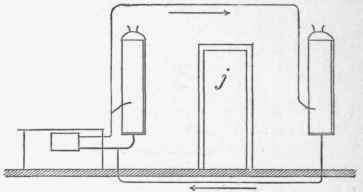
Figure 125.
The result of this is to produce a fairly rapid circulation through the first boiler, with a poor circulation in the boiler beyond the doorway. As in the first case, it is likely to be looked on as something that cannot be avoided - in fact, a natural consequence. Let us consider why it is. The distance between the boilers is a factor against the further one, but, after all, not a factor of as great consequence as is generally considered. What are the other factors for or against the circulation? Let us dismiss the idea of a "push" from the water-back, and consider only the difference of weights of the descending and ascending columns of water. The circulation to the first boiler (diagram j) is up through the flow-pipe and down to the level of the back again through the return-pipe. This makes a hot "up-leg" and a cooler "down-leg," insuring a circulation of unknown volocity, but, nevertheless, a positive circulation in the right direction, and about equal to that in an ordinarily set single boiler. The circulation to the second boiler (same diagram) is also up, making a long hot "up-leg," thence across the doorway to a "down-leg," which can be very little cooler than the "up-leg," if the circulation is to be rapid enough to maintain warm water in the boiler. If the latter is the fact, then the up and down legs of the flow-pipe to this boiler nearly balance themselves, the preponderance being slightly in favor of the down-leg. But the return-pipe of this boiler has not yet been considered. Taking it from the bottom of the boiler, it again forms a down-leg (which, in its fullest sense, is a part of the down-leg of the circulation), and has a temperature somewhat less than the boiler. Then it flows across underneath the floor, and loses more heat, until it comes to rise again near the stove, where it forms an up-leg again, which leg is cooler than an equal perpendicular height in its corresponding down-leg just mentioned, because it has traveled further. This, then, gives a greater weight in the up-leg than in the down one, and a preponderance against the circulation. If, now, the factor in favor of the circulation in the down-leg of the flow-pipe outweighs the factor against the circulation in the up-leg of the return-pipe, there will be a circulation going on in the right direction. If, on the other hand, the factor against the circulation in the up-leg of the return circulation is the greater, the circulation will stop, or be extremely slow, until such time as the water in the down-legs of the flow and return can cool sufficient to overcome the resistance of the up-leg of the return, when there will be an intermittent circulation, or a mean (average) slow circulation established, which will be of no practical use as a means of warming water.
Diagram k shows a method for getting equal circulations of practical value in both boilers when one is beyond a doorway. The flow-pipe is carried from the back, of ample size, direct to the height of the doorway, and run to both boilers. The side-coupling connections are then dropped of equal size and distance. The returns from both boilers are dropped to an equal distance below the floor and carried back in a return-pipe to the water-back, as shown, rising underneath the flow-pipe to enter the range. This gives precisely the same piping and circulation to each boiler, and prevents a "short circuit" by way of the first boiler.
To a critical examiner it may now appear that a method is put forward in diagram k for the two boilers that is very much the same as for the further boiler in diagram j, and the question is very likely to be asked, How is it that it will work on two or more boilers and not in the case of the single one? It does work in the case of the single one, but poorly: first, because the hot water makes a short circuit through the nearer boiler; and, secondly, because of the slow circulation to the further boiler, the rising legs cool more and lessen their power to ascend, and though the down-legs also cool, they do not cool in the same proportion, so as to equally increase the power to descend, for the reason that the hot pipe loses more heat per unit of surface than the cooler one, the loss being about directly as the difference of temperatures between the pipes and the air of the rooms they are in. For this reason the return-pipe beneath the floor should be covered to prevent loss of heat.
With diagram k the very hot water from the water-back goes directly to the upper horizontal flow-pipe, which should be of large diameter. In the rarity and lightness of this vertical column, nearly all of the power to circulate exists. The quick passage of the water to supply two boilers through this pipe lessens the loss of heat to the water of a single boiler - not meaning that less heat is lost per unit of pipe-surface, as that is a constant, and therefore more nearly maintaining an equal density throughout its length. On the other hand, in the down-legs of the flow-pipes and "return"-pipes, the same quantity of water is divided between two pipes, and consequently it has a slower velocity and more surface and loses more heat; therefore becoming more dense, and adding to the power to move the up-column, or whole circulation. Then, where they merge into a single pipe again, the velocity doubles, and though the loss per unit of surface is the same, the loss from the water is only half what it would be in two upward pipes. The distance dropped below the floor should be as short as possible and running in a box cut into the floor-joists, or running between them, and nicely packing with a non-conductor of heat, is more likely to insure a good circulation than using exposed pipes in a cellar, as all possible should be done to lighten the upward column in the return-pipe. It is an improvement, also, to cover the flow-pipe up to the point where it turns horizontally.
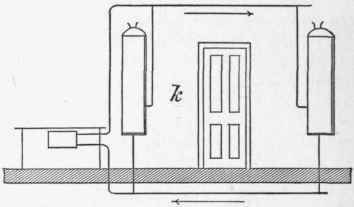
Figure 126.
Continue to:


My Books

