


Connecting A Kitchen-Boiler With Water-Backs. Part 2
Description
This section is from the book "Plumbing Problems", by The Sanitary Engineer. Also available from Amazon: Plumbing Problems, or Questions, Answers and Descriptions Relating to House Drainage and Plumbing.
Connecting A Kitchen-Boiler With Water-Backs. Part 2
The effect of this is to make a great dip or trap in the return-pipe. To have it circulate at all, the sum of the weight of water for a given height in the two flow-pipes - that is, the pipe from the lower back to the upper one and thence to the boiler - must be less than in the return-pipe, the perpendicular length of the return-pipe to be considered as just equal to the length of the combined flow-pipes; that part of the boiler below the side coupling being considered as part thereof. In this diagram (c), therefore, we have the water in the return-pipe of unknown density, but which we know to be less than in the flow-pipe between the water-backs, and greater than in the flow-pipe from the upper back to the boiler, having a power to produce the circulation, which we may illustrate this way: Assume the value or density of the water in the pipe between the two water-backs to be 100, as it is the coldest; assume the value of the down pipe to be 90, as it has not traveled so far nor through the water-back, and then assume the value of the water in the pipe from the warm back to the boiler to be 80. If we do so it will have 100 - 90=10+80=90, or just a balance, and no circulation. If, on the other hand, we can give the pipe from the hot back to the boiler a value of 70 only, it will give a combined weight to this column only of 80, and as the corresponding cold column has a value of 90, the circulation will go on. But again, if we give it a value of 85 we will have a heavier column in the up-take side than on the return side, and an irregular, spasmodic effort of the water and steam to pass into the boiler will be the result every time the water in the back gets hot enough to make steam and force itself into the boiler during the momentary change of value in the weights of the columns due to the steam. An objection to this method, should it be used for the purpose of an increased quantity of hot water, and if both the water-backs would be constantly in use, is that the water, after passing through the first back, has been warmed so much that it cannot extract an equal quantity of heat in passing through the second back, and that, consequently, two backs separately connected to a boiler will warm more water in a given time than two backs connected in continuous order, as shown in diagram c.
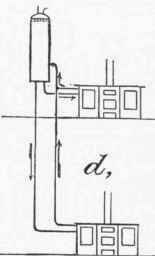
Figure 118.
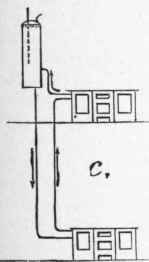
Figure 119.
Diagram f shows two ranges on the same floor connected with a single boiler. It is the usual method when there is only one side and one bottom coupling to the boiler, and when there are no doorways to pass. If the outer water-back is in a cold place there is almost always the chance of it freezing, as with b, because the inductive influence of the flow through the hot pipe from the near water-back is neutralized by the influence of the return flow in the return-pipe. A double coupling in the bottom, as shown in d, will prevent this.
Diagram e shows a method of connecting two ranges with the same boiler when a doorway has to be passed. It is not absolutely necessary that the flow-pipe from the first water-back should be connected as shown, as It may enter the usual side-coupling which is on all boilers, but it is necessary that the flow-pipe from the range beyond the doorway should enter the boiler as high as where it passes the doorway. Should this pipe be carried down to the side coupling, the chances are the circulation will be spoiled by an accumulation of air in the top of the syphon, or very much checked in its speed by the too nearly equal weights of the rising and falling columns.
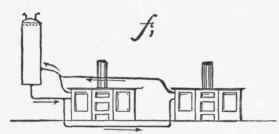
Figure 120.
The higher the flow-pipe from a water-back can rise before it enters the boiler - provided it is not exposed to the influence of cold air - the more rapid the circulation will be and the more water that can be warmed in a given time, the water - backs being equal in every other respect.
The same laws that are true of circulation in a hot-water house-heating apparatus are also true of boiler circulations.
With diagram e it would be better to have one side-coupling at the top of the boiler, and two bottom-couplings, with a separate return. This would insure an inductive movement of the water in the range not in use and give the maximum effect in warming water. But this not only applies here, but to all boilers. The side-coupling of the ordinary boiler is too low down, if one desires to secure the best results with a given size of water-back. The rapidity of circulation depends on the difference in weight in the two columns. The longer these columns are the greater the difference will be. Again, the power of a water-back to absorb heat increases in a proportion nearly equal to the increase of velocity of the water up to a point which can never be obtainable with any but mechanical or forced circulations.
Diagram g shows a method used to connect a large kitchen-boiler with more than one water-back in a long range, such as is sometimes used in a large institution or hotel kitchen, where much hot water is required, but there is no means of making it with steam. This shows the ordinary coupling arrangement, and it is probably the best connection that can be made with two couplings with the minimum of pipes. But the dotted lines show a method which will warm water much more rapidly.
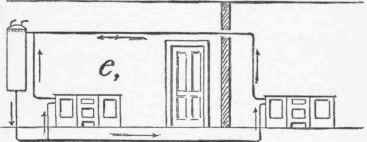
Figure 121.
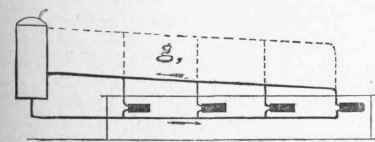
Figure 122.
Continue to:


My Books

