


Dovetailing
Description
This section is from the book "Woodworking For Beginners: A Manual for Amateurs", by Charles G. Wheeler. Also available from Amazon: Woodworking For Beginners.
Dovetailing
This is an operation requiring considerable skill to do well and, with the exception of an occasional single dovetail, is not frequently required in the work of the beginner. It is, however, a valuable, workmanlike accomplishment and a thoroughly scientific method, of which the amateur should have some understanding, even if he should never use it.
The common form, such as is used in joining the sides of a box (Fig. 512), can be done as follows: Mark the lines ab (Fig. 513) completely around each piece, at a distance from the end equal to the thickness of the stock. Lay off the lines cd on the end of the piece A. Lay off the oblique lines ec on both sides of the piece. With the back-saw cut by these oblique lines (ec) to the lines ab. Fasten the piece in the vise, end upward, for the sawing. With the chisel, cut out the parts to be removed (marked m), as in cutting a mortise (see Mortising), undercutting very slightly at the end (Fig. 302). When this cutting has been cleanly done, lay the piece A on the end of the piece B in the way it is finally to go, so that the pins just cut will rest exactly in position across the end of the piece B. Mark around the pins, forming the oblique lines fg, from the ends of which square the lines gh on both sides of the piece. Remove the wood as before, taking care not to cut on the wrong sides of the lines which mark the pins, or the dovetailing may come together too loosely. When exactly fitted, apply glue, fit together, and when dry smooth off with plane, scraper, and sandpaper, as may be required.

Fig. 512.

Fig. 513.
Lap or drawer dovetailing (Fig. 514) is similar to the preceding form, but the ends of the pins or dovetails on the piece forming the side of the drawer are shortened, and the recesses in the front piece which are to receive them are not cut through. First the side piece A (Fig. 515) is marked and cut on the principle just shown, the pins being shorter; then the piece B is marked and cut to fit.
Practised workmen in dovetailing usually (unless symmetry of the pins is required) determine the bevels for the pins of the first piece by eye, but the beginner would best not attempt to lay off angles or saw by eye.
Mitre dovetailing {blind or secret dovetailing) is used in cases where it is desired to conceal the dovetails, the result looking like an ordinary mitred joint, but this is difficult work for the beginner.

Fig. 514.
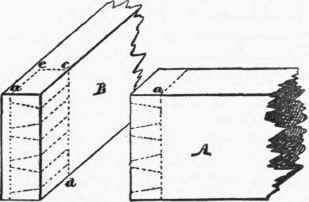
Fig. 515.
Continue to:


My Books

