


Drawers
Description
This section is from the book "Woodworking For Beginners: A Manual for Amateurs", by Charles G. Wheeler. Also available from Amazon: Woodworking For Beginners.
Drawers
The making of well-fitting and smoothly running drawers is an operation requiring much skill - more skill than can be expected of the beginner, or, in fact, than is attained by the average workman. The beginner should, however, have some understanding of the work, even if he does not attain a high degree of skill in its execution.
Bear in mind that it is much easier to make a drawer which is narrow and long (from front to back) run smoothly than one which is wide across the front, but shallow from front to back.
The more accurately the case which holds the drawers is made, the easier it is to make smoothly running drawers. In good work having more than one drawer, a horizontal frame is fitted beneath each drawer for it to run on. These frames, as well as the whole case, should be free from winding, and it is also important that the stock for the drawers should be true. The front and sides of a drawer should be got out to fit very snugly in their places. The piece for the back is narrower than the front piece, to allow for the bottom (Fig. 521), and is often cut off at the top also.
The front, sides, and back can be put together with any suitable form of joint. Dovetailing is by far the best way, but it is diffic u 11 for the beginner
(see Dovetailing). The joints shown in Fig. 519 can very well be used for ordinary work. These can be quickly made by machinery (see joints). See also Gluing and Clamps.
A groove for the bottom must be cut on the inside of the front and of the sides (Fig.
520). The insides of the pieces must be smoothed before putting the drawer together. When these parts are fitted, slip the bottom (previously fitted) into place. It should be got out with the grain running across the drawer, or parallel with the front (Fig. 521), and should be glued at the front edge only, the rest being free to swell and shrink, which saves the drawer from injury.
Be sure that the drawer is rectangular (putting in the bottom will assist in this) and free from winding. When put together and dry, carefully smooth the front and the sides. A little trimming with the plane may be required to make the drawer run freely, but care should be taken not to plane away too much. A drawer which is a trifle larger at the back than at the front will run better than if larger in front, as it will be less likely to bind or catch. Small slides, between which the drawer runs, are fastened at each side outside the drawer, at the bottom, and must be adjusted carefully.
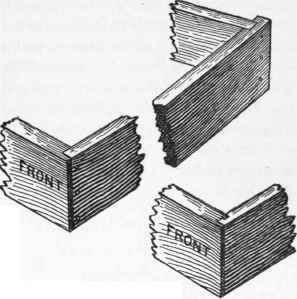
Fig. 519.
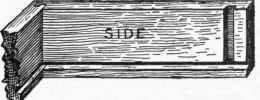
Fig. 520.

Fig. 521.
Thin blocks or " stops " can be fastened on the cross-frame so that the inside of the drawer front will strike against them when the drawer has been pushed in as far as it should go, or the drawer can be stopped at the back.
A simple way to attach a drawer under a shelf, bench, or table is shown in Fig. 143. The contrivance shown in Figs. 141 and 142 can sometimes be used in place of small drawers.
Bayberry tallow is excellent to rub on the sides of drawers.
Continue to:


My Books

