


Rounding Sticks
Description
This section is from the book "Woodworking For Beginners: A Manual for Amateurs", by Charles G. Wheeler. Also available from Amazon: Woodworking For Beginners.
Rounding Sticks
It is often required to round sticks for poles, masts, spars, arrows, and a great many other purposes.
First plane the piece until it is as nearly square, in section, as you can make it. Then use the form shown on page 95, which will hold the squared stick firmly while you plane off the corners, making it eight-sided. Be careful not to plane the corners off too much, for the eight sides of the stick should be as nearly alike as possible. Next, if the stick is large enough, plane off each of the eight corners so that it will be sixteen-sided. This is about as far as you can go in this way, unless the stick is very large. Set the plane quite fine for taking off these corners or you may plane off too much before you know it. The rest of the rounding you must do with light, fine strokes, testing by eye and by passing your hand over the work (for you can judge a great deal by the sense of touch). The rasp and file can often be used to good advantage. The spokeshave is good for the final smoothing, followed by the scraper or glass (both of which can be curved) and sandpaper. The latter can be used crosswise as well as lengthwise. Cut it in strips and pull it back and forth around the stick, much as bootblacks put the final polish on shoes with a strip of cloth (Fig. 648).
To hold large sticks for this final shaping and smoothing you can put them in the vise, but if there are several, and large, it is better to contrive some way to hold them after the fashion of the centres of a lathe. For one centre, drive a nail or screw through a block or stick of wood and screw the block in the vise (Fig. 649). Make the other centre in the same way and fasten it at such a distance from the first centre that the stick will just fit in between the two. Just how to fasten this second centre will depend on the length of the stick to be rounded and the arrangements of your shop, but you can easily contrive some way to hold it. The stick held between these centres will be clear of everything and can be turned around without trouble. The middle can be supported, if necessary, by a piece of board or a strip lightly nailed to the bench-top.

Fig. 648.
Masts and spars should be "natural sticks," if possible, and the final shaping and smoothing will be all they will require, for which some such apparatus as that just described will save time and trouble.
To round small sticks, as spars for model boats, arrows, etc., the same process should be followed so far as the small size of the sticks will allow, as you can of course shave more accurately with the plane, on account of the long guiding sole, for the same degree of effort, than with any " free-hand " tool like the knife. But when the stick is quite small it is hard to hold it firmly, and it is also too much covered by the plane. In such cases turn Japanese. Fasten the plane bottom-up in the vise (or even hold it in your lap if you have no vise) and pull the stick along the sole of the plane instead of pushing the plane over the stick. But look out for your fingers when you do this, for a plane-iron in this position has a great appetite for finger-tips.
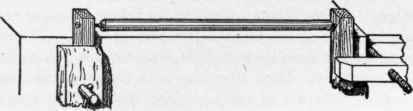
Fig. 649.
In filing a short, round stick, one end can often be rested on the bench and the stick turned around towards you as you file.
A good way to finish the shaping of such small sticks is to hold your knife with the edge downward close against the side of your leg just above the knee. Then pull the stick up steadily between your leg and the knife. The leg acts as a sort of gauge to steady both the stick and the knife and with care you can cut a very even shaving in this way.
One very important thing to bear in mind in all these rounding operations is that you will rarely find wood with absolutely straight grain, except in "rift" stock or natural sticks (and in these there are often seemingly unaccountable twists and crooked streaks); so you need to keep constant watch of the direction of the grain, for even a slight turn of the stick will often bring the grain wrong with relation to your tool, and one false cut running in too deep, or even across the stick, will spoil the work.
Continue to:


My Books

