


How To Determine The Curve Of Equilibrium
Description
This section is from the book "Elementary Principles Carpentry", by Thomas Tredgold. Also available from Amazon: Elementary Principles Of Carpentry.
How To Determine The Curve Of Equilibrium
63. Let AC represent a portion of a curve of equilibrium (Fig. 36), 0 being the vertex of the curve, and GE a vertical line passing through the centre of gravity of the load resting upon the part between A and C.
Then by similar triangles A E: G E ( = CB)::AB: BD:: horizontal thrust to the weight. Therefore,
CBxAB/AE = B D. But B D is the subtangent of the curve, consequently when it agrees with that of any known curve, that curve is the curve of equilibrium.
64. Example 1. - Suppose the load to be uniformly distributed over the framing, then the centre of gravity of the load over any portion A C will be over the middle of A B, and A E will be equal 1/2 A B. Consequently, B D = 2 B C, a property of the parabola. Therefore when the weight is uniformly distributed the curve of equilibrium is a parabola. A simple method of describing a parabola will be found in the section on Roofs. Various other methods are given by writers on Conic Sections; particularly in Emerson's ' Conic Sections,' book iii., props. 59 and 60; and an easy method is given by Nicholson in his ' Carpenter's Guide,' p. 11.
As in bridges and roofs the weight is very nearly uniformly distributed, it will generally be near enough for practice to use the parabola as the curve of equilibrium; where greater accuracy is required, it may be found by Art. 68.
65. Example 2. - Let the weight on any part of the framing be proportional to its distance from C, the middle of the span.
Then the distance A E will be equal to 1/3 A B . because the distribution of the weight may be represented by a triangle, with the vertex at C, and base at A B. In this case BD = 3BC, a property of the cubic parabola. Hence, when the weight is distributed in proportion to the distance from the centre, the curve must be a cubic parabola. To describe this curve, put s = half the span, and h = the rise of the framing; x the absciss, and y the corresponding ordinate. Make x = nh; then s n1/3 = y.*
Fig. 36.

The curve may also be constructed by the following method: -
Divide the rise B C (Fig. 37) into eight equal parts, and draw the horizontal lines a 1,b 2, c 3, etc. Then the distance
Fig. 37.
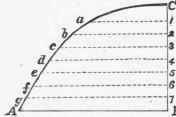
A B multiplied by 0.5 will be equal a 1. | ||||
AB | " | 0.63 | " | 6 2, |
AB | " | 0.721 | " | c3, |
AB | " | 0.7937 | " | d4, |
AB | " | 0.855 | " | e5, |
AB | " | 0.9085 | " | f6, |
AB | " | 0.956 | " | g7. |
Through the points a, b, c, d, e, f, g, draw the curve, and it will be the cubic parabola sufficiently near for practice.
66. Whenever the distance of the centre of gravity from
A (Fig. 36) is expressed by the equation A E = 1/m A B, the curve of equilibrium will be a parabola of which the equation will be a x = ym and the subtangent = mx.†
67. It is useful to know the subtangent of the curve of equilibrium, because it gives the tangent, and consequently the direction of the pressure at the abutment. In any case, where the equation of the curve of equilibrium is a x = ym, the pressure on the abutment will be in the direction of a line, which makes an angle with the horizon, of which the tangent is mh/s; where s = half the span, and h = the rise. And also, when we make w = the weight of half the framing, we have sw/mh= the horizontal thrust,
* For by the property of the curve, ax = y3; and when x = h, and y = s,ah - s3, or a = - s3/h; therefore s3x/h = y3, or s (x/y)1/3 = y =sn1/3 when x = nh.
† Emerson's ' Fluxions,' p. 203.
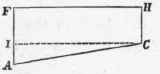
68. Example 3. - When the weight is distributed over a piece of framing, a bridge for example, so that the weight on any portion from the middle towards the abutment shall be represented by a trapezoid A F H C (Fig. 38), put H C = a which will represent the weight at the middle of the arch; and let
I C: IA:: 1: n; then a y + 1/2 n y2
= the weight on any portion of the arch, whose horizontal ordinate is y. Put A B = y (Fig. 36) and C B = x, and we have to determine the curve of equilibrium for a cupola or Dome.
3x(ny+2a)/ny+3a =BD the subtansent of the curve. Consequently, when the point A is at the abutment, and y = s = half the span, and x = h, we have3h(ns+2a)/s(ns+3a)= tangent of the angle which the direction of the pressure on the abutment makes with the horizon. And s2/6h (3a+ns) = the horizontal thrust at the abutment.
The curve may be constructed from its equation in which H is equal to the horizontal thrust.
Fig. 38.
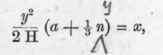
This equation will be sufficiently accurate for determining the form of the curve for most cases; as the expression for the weight will nearly agree with the distribution most commonly occurring in practice. The absciss x, and ordinate y, become h, and s, at the abutment, and these being always given, we have H = s2/2h (a+1/3ns) and, H being determined, the ordinates of the curve may be easily calculated.
The curves that apply to such cases as usually occur in practice are evidently of a parabolic kind; and the same observation applies to those curves which are proper for cupolas, or domes, to which we must now proceed.
69. Conceive the dome to be generated by the motion of the curve A C (Fig. 36) round C B an axis; then the same relations will obtain as in the case of an arch (Art. 63), that is
CBxAB/AE = B D = the subtangent of the curve of equilibrium. Let AI be the plan of the dome (Fig. 39), and let it be divided at the circumference into any number of equal parts, of which H F is one; then, whatever form is necessary to equilibrate the sector HFC, must be equally requisite for every other part of the dome. Let A C B be a section through A' C the middle of the gore HFC.
70. Example 1. - When the weight is uniformly distributed. In this case the weight on any part of the gore is proportional to the distance from the centre; consequently, the centre of gravity is 1/3 A B from A: and the curve is a cubic parabola, the same as in Example 2, Art. 65; and may be described in the same manner.
Fig. 39.

71. Example 2. - Let the weight be distributed so that the weight on any portion A C (Fig. 39) is = y a + πby3/3, where y is equal the ordinate A B, a the depth of an uniform weight; and 1: b the ratio of increase of another part of the load, which increases regularly from the centre to the circumference: also π = 3.1416.
And as in Art. 68, we obtain x = y2/2H(a+1/3πby2); where x = B C the absciss; and H = the horizontal thrust.
Hence, when the rise and radius of the base of the dome are given, the rise or height being h, and the radius r, r2/2h(a+1/3πbr2) = H
The most useful cases of domes will be determined by this equation, from which it is easy to find a sufficient number of points in the curve to design the framing upon. It is scarcely necessary to remind the reader that in domes, as in arches, the curve of equilibrium must pass through the middle of the framing.
72. Example 3. - Suppose the curved part of the dome (Fig. 40) to be uniformly loaded, and a lantern on the top, the space C D being open.
Let W bo the weight of the lantern, and wπy (y + r) = the weight pressing on the curved surface AC, where y = AB,r = CB the radius of the lantern.
Fig. 40.
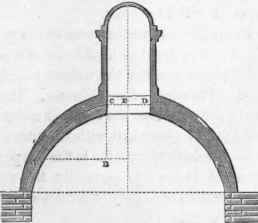
The whole weight is w π y (y + r) + W, and the equation of the curve of equilibrium is y/H (1/3wπy2+1/2wπry+W) = x.
Let the radius of the base of the dome be R + r, and h the height of the base of the lantern. Then,
R/h [wπ (1/3 R2 +1/2R r) + W] = H = the horizontal thrust.
73. From the equations in the two preceding articles, the proper curve for a dome may be obtained; but it may be remarked, that so long as the curve is not more convex towards the external surface than the proper curve of equilibrium, the form may be changed at pleasure; because every part of the framing may be strutted so that it cannot press inwards.
The curve of equilibrium is not the weakest form for a dome, as Dr. Robison states it to be,* but it is the limit that should never be exceeded. The curvature of the line passing through the middle of the framing may be of any form within the middle, and be stronger; but if it be without the dome, it will be weaker.
From the mutual tendency of the parts to the axis, a dome admits of an opening in the centre; but it is not a matter of indifference whether the weight be omitted or not in determining the curve of equilibrium. The reader will, however, easily perceive that the external covering may have any form that is most consistent with the other parts of the building, as these calculations refer to the supporting frame only. The strongest forms are generally the most beautiful, but the consideration of beauty of form does not come within the plan of this work.
* ' Encyclopaedia Briitannica.'
Continue to:


My Books

