


76. Circular Gutters
Description
This section is from the book "Constructive Carpentry", by Charles A. King. Also available from Amazon: .
76. Circular Gutters
Circular Gutters. Circular gutters and moldings may he made by three different methods, one of which, and perhaps the most common, is to saw a plank of the right thickness to the desired sweep, and work the molding around it. This is done usually at the planing mill, but the objection to this method is that the pieces upon ordinary towers are very short, and as they are cut out of wide plank there is considerable waste of material.
If this method is used, the joints must be doped, and the work well painted. Only thoroughly seasoned stock should be used upon this kind of work, as in seasoning the sweep will change, and the molding may check badly.
Another way of treating moldings which have to be carried around curves of any common radius is to select enough straight-grained, perfect pieces of molding to reach the entire distance twice, with allowance for waste. These should be taken to a mill and cut with a sharp, smooth-cutting circular saw, as shown in Fig. 110, alternating the cuts in the different pieces, in order to replace the saw cut, so that when the work is done there will be one piece of molding sawed into thin strips which will bend around any ordinary sweep, as the pieces may be sawed to any thickness. They are then put into place upon the building, each piece being nailed upon the one under it and each joint plentifully doped with white lead.
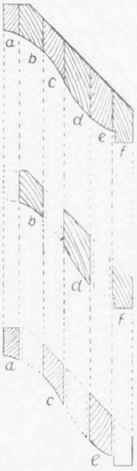
Fig. 110. -- Curved Moldings.
If this is done accurately and the work well smoothed and painted, it is difficult to discover from the ground how the work was done.

Fig. 111. - Scarfing a Molding for Bending.
Another method, adaptable to small moldings, is to saw into them, as in Fig. 1ll (see Topic 22, A, of "Inside Finishing"), though this method is not recommended upon work which is to be exposed to the weather, as there is so much short wood between the cuts that may drop out after the work has been in place a few years. The cuts may be made either square, as at a, or at an angle, as at b; if made in the latter way, the wood will bend more evenly.
Continue to:


My Books

