


80. Dome Roof
Description
This section is from the book "Constructive Carpentry", by Charles A. King. Also available from Amazon: .
80. Dome Roof
Dome Roof. In boarding a dome roof, it is the usual custom to lay the boards vertically, as shown in Fig.117, as it is more economical than to cover it horizontally, since by the latter method each course of boards has to be cut to a different sweep, causing a great waste of material, and since it is difficult to bend the boards to the shape of the roof as the top is approached, unless boards are used which are too thin to hold the nails by which the roofing is fastened on.
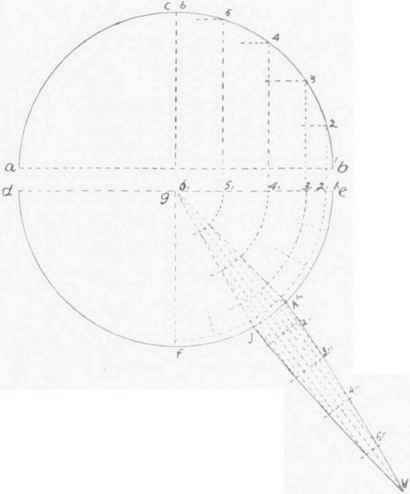
Fig. 117. - Boarding A Dome Roof.
In laying out the boarding for a dome roof vertically, the elevation of the dome, acb, should be drawn, and points 1, 2, 3, etc., marked at any convenient distance upon the surface of the dome. These points should be projected to the diameter of the semi-circular plane de, and one quarter of the circle ef, divided into any number of equal parts, say six, denoting the width of the boards at the base of the dome. Connect two adjacent points, as j, k, with g by straight lines. Draw an indefinite center line between j and k, from g toward b"; space from jk, toward b" the distances 1, 2, 3, etc., of the elevation, and mark them 1", 2", 3", etc.; upon these lay off the corresponding distances from arcs 1', 2', 3', etc., working from the center line. Connect b" with j and k, by a curved line drawn through these points; this gives the shape of the roofing boards, of which there will have to be four times as many as were laid off in the quarter from which the drafting has been done.'
Upon full-sized work, this curve should be marked by a batten, a thin piece of wood which will bend easily. The method described above is sufficiently accurate for practical purposes, but, as the length of the boards will be a little more than the result obtained, the butt or wide end of the board should not be cut to its neat length until it has been tried in its place and the length accurately marked. This is necessary on account of the rise in the surface of the dome between the points 1, 2, 3, etc. The edges of the boards should be cut under enough to allow them to come to a joint upon the surface.
Suggestive Exercises
70. What is the difference in the methods of finishing the walls of a house in the colder Northern States, and in the South? How should a heavy building be boarded in? What is a safe method of boarding in an ordinary house? Which is the more expensive method of boarding in? Why? How may the braced corners of a house; be boarded to add to the strength of the house? What is the warmest way to sheet a roof? What is the objection to it in a damp climate? Describe a method better suited to a warm climate. Compare the two methods.
71. Describe an open cornice. The box cornice. Which is the cheaper form? Compare the two for warmth and durability. Describe different forms of eaves troughs. What should be the pitch of a gutter to allow the water to run off easily? How should the joints of a gutter be treated?
72. What should be the relation between the finish of the gable and that of the sides? How may the gables be treated to add to the appearance of the house? What should be guarded against in designing the ornamentation of the gables?
73. What should be the qualities of lumber suitable for outside finish? Name several woods. What is the most important thing to do after a house is boarded in? What has to be done before the roof can be put on? Why should a house be covered as soon as possible? Why is it economy to spend time in securing accuracy in the framing of a building, and in putting on the casings and corner boards? What is the advantage of narrow corner boards and casings? Where two boards are lapped together, is there any preference as to which side the lap should come upon? How should a joint be cut to insure a perfect fit upon the face? Should moldings and butt joints in the finish be made square? Is it best to put anything upon the joints? Is it the common practice? How much is siding usually laid to the weather? Describe the different forms of siding commonly used. Compare the methods of siding generally used in the east and in the west. What is gained by the use of sheathing paper? How is it put under corner boards and other finish?
74. How :are conductors usually made? Which is the best form? Why?
75. For what are finials used? How are they generally made? How is a wooden finial sometimes used in framing a tower roof?
76. Describe the method of getting curved moldings out of plank. What is the objection to this method? Describe two other methods of getting out sweeps. Compare the three.
77. Describe the method of finding the shape of rake moldings. How are they usually made? Describe a miter box for making the cuts for a rake molding. How may a roof be finished without using a rake molding?
78. Can straight siding be laid upon a circular tower? Describe the method of finding the sweep of the lower edge.
79. What is meant by "scribing"? In fitting a piece of ceiling against a rough brick wall, what is the first step? At what place should the dividers be set? How should prominent points be marked upon the ceiling? What tool is preferred for scribing by many workmen to a pair of common dividers?
80. Describe the method of boarding a circular dome roof.
Continue to:


My Books

