


Boring Tools
Description
This section is from the "Educational Woodworking For Home And School" book, by Joseph C.Park . Also see Amazon: Educational Woodworking For Home And School.
Boring Tools
42. Auger
An auger is a tool used in boring a hole in wood. Augers are made of the best grade of cast steel properly tempered. The blade is twisted in such a way that a perfect spiral groove is formed by means of which the chips are discharged. There should be at least one set of augers in the shop equipment, consisting of one handle and one bit of each of the following sizes: 1/2", 5/8", 3/4", 7/8", 1", 1 1/8", 1 1/4", l 1/2", 1 3/4", and 2". For rapid boring a boring machine like the one shown in Fig. 70 is sometimes used. It is used more by the builder than by the bench worker.

Fig. 70. Snell boring machine.
43. Auger Bits
Auger bits are used for lighter work than the auger. The cutting parts are constructed like the auger, in fact an auger bit is an auger having a tang that will fit a bit brace. One of the best makes of auger bits and perhaps the most extensively used is the Russell Jennings Auger Bit, which was patented by Russell Jennings in 1855. There are, however, many other excellent bits on the market. There are also very many cheap bits on the market at the present time.

Fig. 69. Auger, a, shank; b, blade; c, tang.

Fig. 71. Auger bit. a, shank; b, blade; c, tang; d, nib; e, lips; f, spur.
44. Short Auger Or Dowel Bits
These bits are used with great success in working with thin woods. As their name suggests, they were designed to be used in boring holes for dowel pins. For doweling a 1/4" bit is used more than any other size, for the standard size of doweling is quarter-inch. Dowel bits are easily centered and are not so liable to break or bend as a longer bit. They range in sixteenths in size from 3/16" to 1".

Fig. 72. Short auger or dowel bit.

Fig. 73. Brace dowel bit drill.
45. Wood Drills
For small holes in hard woods the wood drills are very good. They are rapid cutting and when well made are very efficient. They are graded in thirty-seconds and range from 2/32" to 1" in size.

Fig. 74. Bit-stock drill for wood.
46. Gimlet Bit
The gimlet bit is used, like the wood drills, in boring very small holes. In using any small bit great care must be exercised not to break the bit.

Fig. 75. Auger bit gauge.
47. Auger Bit Gauge
The auger bit gauge is a device to be attached to an auger bit to regulate the depth of the hole. It can be used on any bit up to 1" in size.
48. Countersink
After a hole has been bored for a screw the countersink is used to rim out the top of the hole to allow the screw head to fit down into the wood closely, thereby causing the screw to hold more tightly. Sinking the head of a screw even with the surface or below the surface of the wood is called countersinking.

Fig. 76. Countersinks, a, rose countersink; b, adjustable countersink.
49. Brace, Or "Bit Brace"
The brace is a tool made to hold an auger bit or other boring tool and is used in driving those tools. It has a steel frame which is either polished or nickel-plated. The head (b) is usually ballbearing that it may turn easily when pressure is brought against it. The wood part of the head and handle is made from some hard wood and is highly polished. The tang of the bit fits into the jaws of the chuck and by tightening the sleeve the bit is held firmly while being driven. To insert a bit, grasp the sleeve firmly with the left hand, turn the handle backward until the jaws open enough to receive the tang of the bit, then turn the handle, forward until the sleeve draws the jaws tightly together. There are three types of chucks used on braces. They are the "Spofford Style," which has a split socket with a thumb set screw; the "Fray Style," having two revolving sleeves; and the "Barber Style," having two jaws regulated by a sleeve. The Barber brace (Fig. 77) is used more than any other style. The diameter of a circle described by the handle (c) in making a complete turn is called the sweep of the brace. The sweep of braces varies from 4" to 14". The larger the sweep the easier the work can be done because of the greater leverage. For boring holes near walls or obstructions where a complete sweep cannot be made, ratchet braces are used. A ratchet brace has a forward and a backward movement. The bit turns with the forward movement of the brace, but remains at rest while the brace is being turned backward.

Fig. 77. Brace, a, crank; b, head; c, handle; d, sleeve; e, jaws; d and e (together), chuck.

Fig. 78. Screw-driver, a, blade; b, handle; c, ferrule.
50. Screw-Driver
A screw-driver is used in driving screws. The blade is usually made of round steel which is forged on the end to fit the head of a screw. The blade is driven firmly into the body of the handle so that it hangs true. The handle is made of hard wood and is usually fluted to enable one to get a good grip with the hand. Screw-drivers range in size, according to the length of the blade, from 2 1/2" to 18".

Fig. 79. Screw-driver bit. a, blade; b, tang.
51. Screw-Driver Bit
A screw-driver bit is a bit to be used in a brace in driving a screw. It is intended for driving large screws where great pressure and force are required. With this tool screws can be driven more rapidly and with greater ease than with an ordinary screw-driver. Screw-driver bits are made of cast steel and in assorted sizes for different sizes of screws. They are not intended to be used on very small screws.
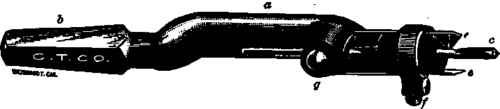
Fig. 80. Screw and plug bit. a, shank; b, tang; c, drill; e, knife; f, set screw for knives; g, set screw for drill.
52. Screw And Plug Bit
In finishing fine work like the top of an oak table it is sometimes desirable to drive a screw down through the top of the table and then cover the head of the screw. In such a case the screw and plug bit is used to bore a hole for the shank of the screw and at the same time to bore a hole for a wooden plug which will cover the head of the screw. As will be seen in Fig. 80, the knife and drill are adjustable as to the depth of the cuts.

Fig. 81. Plug cutter, a, knife; b, collar.
53. Plug Cutter
This is a tool to accompany the screw and plug bit. It is used in cutting a plug across the grain of thin wood to fit a hole made by the plug bit. The plug thus made is coated with glue and driven into the hole to cover the head of the screw. When this work is well done, it is hard to detect a plug in the finished piece.
The screw and plug bit and the plug cutter are made in 1/2", 9/16, and 5/8" sizes. In cabinetmaking these tools are very useful.
Continue to:


My Books

