


Wood Turning Exercises
Description
This section is from the "Educational Woodworking For Home And School" book, by Joseph C.Park . Also see Amazon: Educational Woodworking For Home And School.
Wood Turning Exercises
Wood Turning Exercise No. 1
Stock
1 (2" x 2" x 9") whitewood or pine.
Directions
1. Lay out your tools.
2. Oil your lathe.
3. Center the block of wood to be turned. If the block is approximately true, draw the diagonals on the square ends. This will locate the center on each end.
4. Adjust the tail stock to accommodate the length of the wood and clamp it in place. Drive one end of the block into the spurs of the live center, using a mallet.
Fit the other end to the cup center and tighten, then loosen until the block turns easily in the lathe.
5. Adjust the tee rest. This should be as close as possible to the work, and for nearly all of the exercises the top should be nearly on a level with the centers. As a rule the tee rest should be a little higher when using the skew chisel than when using a gouge or parting tool.
6. Start the lathe by means of the shifting lever and rough. down the block. This is done by means of the gouge, as shown in Fig. 210 (the cutting point being at A, when the gouge is moving in the direction of the arrow). Cut the block down to nearly 1 3/4", getting a uniform diameter.
7. The finishing cuts are made with the skew chisel held as shown in Fig. 211. Cut the block down until a perfectly cylindrical block I 3/4" in diameter is produced. Measure with calipers.
8. With rule and pencil lay off 7", leaving about 1" waste at each end of the block.
9. With parting tool cut to these lines so that when you get through the block is exactly 7" long. Cut nearly to the center of the block.
10. Stop the lathe, remove the block, and with back saw saw off waste ends.

Fig. 209. Turning exercises. - No. 1 and No. 2.

Fig. 210. Showing the position of gouge in roughing down the work.
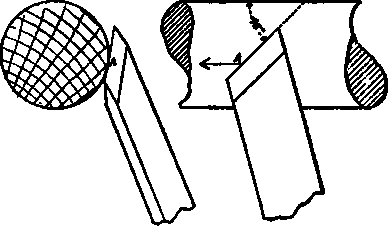
Fig. 211. Showing the position of chisel in making a finishing cut.

Fig. 212. Turning exercises. - No. 3 and No. 4.
Wood Turning Exercise No. 2 - 5
Exercise No. 2
Stock
1 (2" x 2" x 9") whitewood or pine.
Directions
Proceed as in Exercise No. 1 until the block is roughed down to the approximate size, then finish with the skew chisel. Cut the ends down first, moving back towards the middle of the block at each stroke. Finish by cutting from the middle towards the ends. Learn to work rapidly at the lathe, yet work very carefully and accurately. Become efficient as soon as possible.
Exercise No. 3
Stock
1 (2" x 2" x 9") white wood or pine.
Directions
Proceed as in Exercise No. 1 until the block is reduced to 1 3/4" in diameter. Beginning near the middle of the block, lay off the 2" length. With parting tool cut down to the required depth on the outside edge of these lines, so that exactly 2" remains between these cuts. With gouge and then with skew chisel remove the waste wood out to the ends to 1 3/8" diameter. In a similar way cut down the 1 1/4" lengths at the ends to 1" in diameter. Use no sandpaper in these practice exercises. The end wood of the shoulders is finished with the skew chisel held as shown in Fig. 213.
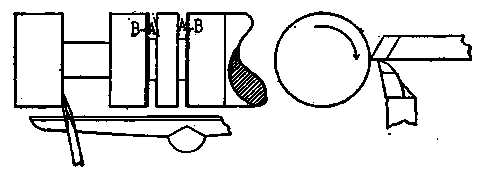
Fig. 213. Showing position of chisel in finishing a shoulder, also cuts made with parting tool.
Exercise No. 4
Stock
1 (2" x 2" x 9") whitewood or pine. Work this exercise according to your experiences already gained.
Exercise No. 5
Stock
1 (2" x 2" x 9") whitewood or pine.
In working this exercise, turn the block down to the required diameter. With dividers set accurately, lay off the required lines. In cutting the concave curves, hold the gouge as shown in Fig. 214. In making the straight cuts at an angle of 45 degrees, hold the skew chisel as shown in Fig. 215.
Continue to:


My Books

