


Gauges
Description
This section is from the "Elementary Turning" book, by Frank Henry Selden. Also available from Amazon: Elementary Turning.
Gauges
For determining the horizontal distances on work in the lathe, many forms of gauges and templets are used. For most work, when but a few pieces of a kind are to be turned, a rule and a pencil
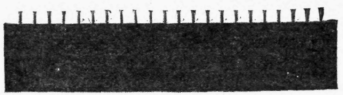
Fig. 280. Gauge.
(Fig. 19) or a rule and a chisel point (Fig. 31) are sufficient.
One of the most common forms of gauges for use in turning is shown in Fig. 280 and in use in Fig. 36.
These gauges may be made of various styles, either from the drawings or from the model piece.
The edge of the stick or bar may correspond

Fig. 281. Chair Leg Gauge.
with the general outline of the pattern, as shown in Fig. 281.
After the bar has been shaped, drive brads or nails into the edge. Be careful to place each one exactly opposite the point which is to be lined. Cut off the heads and adjust each one to length.
By making the spurs of the correct length they may help to indicate the size, as their points may be made to cut each time to the same depth. File the spurs to a wedge-shaped point, being careful that the point is in exactly the correct place. The points may be sprung with a hammer, but are liable to gradually spring back. See that they are driven well into the wood, for the revolving of the work against them tends to move them.
Unless there are many pieces of a kind to be turned, it is better to use the pencil and rule, or compasses rather than to take the time to make a gauge of this kind.
Often a wooden tee rest is used and the pattern marked on its edge so that no other measuring is required.
Continue to:


My Books

