


Elementary Turning | by Frank Henry Selden
The series of exercises given in this text is the result of the author's experience in teaching turning. Each model has been developed for the purpose of teaching a correct use of the tools, so that pupils can do excellent work without the long drill to acquire skill or the necessity of scraping where cutting tools should be used. If turning lathes are to be used in the school, they should be used properly. It is the hope of the author that this manual will aid such instructors as are trying to teach a rational method of turning.
| Title | Elementary Turning, For Use In Manual Training Classes |
| Author | Frank Henry Selden |
| Publisher | Rand, Mcnally & Co., Publishers |
| Year | 1907 |
| Copyright | 1907, By Rand, Mcnally & Co. |
| Amazon | Elementary Turning, For Use In Manual Training Classes |
Elementary Turning
For Use In Manual Training Classes
By Frank Henry Selden
Author of "Elementary Woodwork For Use In Manual Training Classes" and "Elementary Cabinetwork"
Fully Illustrated
Chicago - New York Rand, Mcnally & Co., Publishers
Copyright, 1907, By Rand, Mcnally & Co.
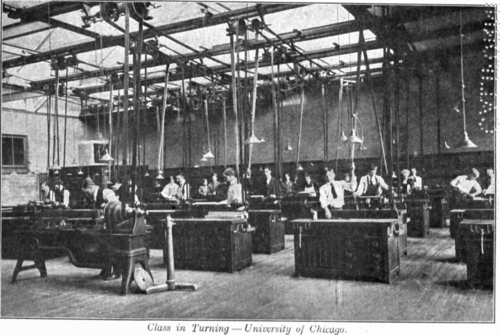
 Preface
- THE series of exercises given in this text is the result of the author's experience in teaching turning. Each model has been developed for the purpose of teaching a correct use of the tools, so that p...
- Part I. Introduction
- This course in turning is intended to give elementary exercises only. Each model in Part I is given with a definite purpose and should not be omitted. There will be little need for class demonstration...
- Equipment. Personal Equipment
- Each pupil must provide himself with a pocket-rule, two-foot, four-fold; a lead pencil, one combination, India oilstone, one hard Arkansas oilstone slip. The apron used in joinery may be used. A ju...
- Lesson I. Placing Work In The Lathe
- There are several good methods of centering pieces which are to be placed between the lathe centers. A method seldom used is to draw diagonals across the end, as shown in Fig. 2, and also in Figs. 230...
- Lesson II. Cylinder
- The stock for this and the nineteen following exercises should be 8 inches long by 1 3/4 inches square. This exercise is to teach the use of the roughing Fig. 10. Stopping the Lathe and T...
- Lesson III Stepped Cylinder
- Use the piece worked to a cylinder in Lesson 2. Set the rest close to the piece, and with the rule and Fig. 18. Stepped Cylinder. pencil, as shown in Fig. 19, make a mark, while the la...
- Lesson IV Left-Hand Semi-Bead
- This exercise is turned in the same way as the stepped cylinder, and then the curves are cut to the shape shown in Fig. 22. To work these curves, the skew chisel is laid on the piece the same as in sm...
- Lesson V. Right-Hand Semi-Bead
- This exercise is the same as Lesson 4, except that the curves are in the opposite direction, and the last division is omitted to avoid hitting the live-center. If in turning the second exercise the...
- Lesson VI. Half-Inch Left-Hand Semi-Bead
- This piece should be of the same diameter at both ends. It is not necessary to caliper it, but judge its size carefully by examining it with your Fig. 28. Half-inch Left-hand Semi-bead. ...
- Lesson VII. Half-Inch Right-Hand Semi-Bead
- This is the same as Lesson 6, except that the curve is in the opposite direction. The same diffi- Fig. 30 Half-inch Right-hand Semi-bead. culties are met as in Lesson 5. Great care...
- Lesson VIII One-Inch Bead
- Be careful to work this piece to correct size. If a lead pencil line is made at the center of each bead Fig. 32. One-inch Bead. (Fig. 32), the turning of the bead is apt to be more...
- Lesson IX. Half-Inch Bead
- This exercise is based on the same principle as is given for the one-inch bead. The curves are Fig. 34. Half-inch Bead. somewhat steeper, and should be turned with greater c...
- Lesson X. Three-Eighths-Inch Bead
- Fig. 35. Three-eighths-inch Bead. This exercise is worked the same as the 1-inch beads and the 1/2-inch beads. The 3/8-inch beads may Fig. 36. Using a Gauge Stick. ...
- Lesson XI. One-Inch Cove
- Fig. 37. One-inch Cove. This exercise introduces the turning gouge. For directions for grinding and whetting gouges see Part 3. Be sure that the gouge is in proper condition before attempt...
- Lesson XII. Three-Fourths-Inch Cove
- This exercise is similar to that given in Lesson 11. The difference being that the coves are but 3/4 inch. The spaces between the coves are each 1/2 inch. The straight parts between the coves are not ...
- Lesson XIII. Half-Inch Cove
- In this piece the coves and the spaces between them are each 1/2 inch. The work required in making 1/2-inch coves is the same as given in Lessons 11 and 12 for making the Fig. 48. Hal...
- Lesson XIV Three-Eighths-Inch Cove
- The piece for the 3/8-inch coves should be turned with the greatest care, as it is the last of the cove exercises. Be sure that the cylinder is of full size, and that it is also very smooth and straig...
- Lesson XV. One-Inch Bead And Cove
- Turn first the coves as indicated by the dotted lines of the drawing (Fig. 51), cutting straight down to the point where the curves will be joined when the bead is turned. Be careful to finish the cov...
- Lesson XVI. Half-Inch Bead And Cove
- This exercise is similar to the previous one. The coves and beads are each 1/2 inch. If the coves are Fig. 55. Half-inch Bead and Cove. made 1/2 inch deep, the curves will all b...
- Lesson XVII Spindle With Cones
- Fig. 57 indicates the shape of the spindle with cones, but the size of the various parts may be modi- Fig. 57. Spindle with Cones. fied to suit the judgment of the individual student ...
- Lesson XVIII. Sandpapering
- For the work in turning, several grades of sandpaper are required. For smoothing the exercises given in Lessons 17 to 25, No. 1/2 or No. 0 should be used. To produce a very fine finish, use coarse pap...
- Lesson XIX. Shellacing
- Shellacing of turned pieces may be done with either a brush, or with a polishing pad or a cloth. When the brush is used, the principles involved are the same as those in using the brush on hand-work. ...
- Lesson XX. Beaded Spindle
- Fig. 66. Beaded Spindle. After roughing this piece, locate and turn the central bead, as shown in Fig. 67. Do not make Fig. 75. Marking Spaces. ends, it should b...
- Lesson XXII. Square-End Spindle
- Fig. 74. Square-end Spindle. This lesson introduces the combination of round and square elements on the same piece. In using the rule to measure spaces on a piece having square ...
- Lesson XXIII. Curved Spindle
- This piece should first be roughed to a cylinder, and then the ends of the curves at the center should Fig. 84. Curved Spindle. be finished (Fig. 85). Next the piece should be ...
- Lesson XXIV. Tapered Spindle
- Fig. 89. Tapered Spindle. This is a form often used in architectural work. The square part of this piece is the lower end or base. First turn the curve at the square end and sha...
- Lesson XXV. Porch Spindle
- This pattern of spindle is often used on porches, and should be made of pine or other soft wood. The usual lengths of such spindles are 8 inches and 10 inches. The square portion at the bott...
- Lesson XXVI. Plain Box
- Select a piece of stock enough longer than the height of the box to allow for waste. For boxes made from 1 3/4-inch squares, there will usually be about 1 1/2 inches of waste. Center the poorest en...
- Lesson XXVII. Box With Knob
- This box is worked in the same manner as the one not having a knob, except that in cutting the cover off, the parting tool is held at an angle, as shown in Fig. 110. This is to save material for the k...
- Lesson XXVIII. Plain Goblet
- For turning a small goblet the blank is secured to a screw chuck the same as the blank for the box (Lesson 26). Usually the blank is just long enough for the goblet, so that the end of the blank ne...
- Lesson XXIX. Goblet With Rings
- If rings are to be turned about the stem of the goblet, they are worked from the material that is ordinarily cut away. In turning the outside of the bowl leave as much material for the rings as you ca...
- Lesson XXX. A Rosette
- Rosettes are made in many designs. They are usually held on a screw chuck while being turned. Fig. 124 illustrates the blank in place, and the turning gouge cutting the outer edge. If the blanks have ...
- Supplementary Exercises. Part II. Introduction
- The thirty lessons cover substantially all the ordinary uses of wood turning tools. More difficult problems are easily suggested, yet, for the time usually devoted to turning, it is not advisable to u...
- Number I. Tool Handle
- Tool handles may be made from pieces which are too small for regular exercises, or out of pieces which have been accepted as exercises and then discarded. Usually the piece is turned with t...
- Number II Gavel
- The essential features of a gavel are that the ends of the head should be rounding in shape, and that it be made of wood from a hard, sonorous variety, and of a pleasing design. Fig. 136. ...
- Number III. Gavel Patterns
- These patterns represent a variety of possible forms for gavels. Study them carefully, and then work out a design of your own. Follow the plan outlined in making number 136 by first planning the lengt...
- Number IV Carpenter's Mallet
- The carpenter's mallet is worked in the same manner as the gavel (Fig. 136). Such mallets vary greatly in size. The one shown in Fig. 149 is 5 inches long, and 2| inches in diameter. The handle is 10 ...
- Number V. Carver's Mallet
- Figs. 151 and 152 show two designs for carver's mallets. The usual sizes are indicated by the drawing, Fig. 153. No special directions are required for making them. The bottom or large end should be s...
- Number VI. Molder's Rammer
- Fig. 154 illustrates a molder's rammer. This should be made from hard wood, maple being one of the best for this purpose. Cheaper woods, such as beech, may be used. The sizes given in the drawing (Fig...
- Number VII. Darning Ball And Darning Hemisphere
- The darning ball (Fig. 157) and the darning hemisphere (Fig. 159) should be finely finished, especially on the large hemispherical ends. The sizes may vary. Those given in Fig....
- Number VIII. Glove Mender
- Fig. 161. Glove Mender. to fit the glove fingers, smoothed. This glove mender should be made from hard wood, and about 4 1/2 inches long. The ends should be of a size It should be very c...
- Number IX. Plain Ring
- This exercise is given to show a method of making a ring without the use of special tools. Fig. 163 shows a piece which was cut from the bottom of a box. A 5/8-inch hole was bored through the cente...
- Number X. Napkin Ring, First Method
- Napkin rings may be made of many shapes and sizes. The scraps of wood left from regular exercises, boxes, etc., can be used for making them. The larger sizes are made about 2 inches in dia...
- Number XI. Napkin Ring, Second Method
- Instead of screwing a blank on to a screw chuck, it may Fig. 173. Napkin Ring. Fig. 174. Napkin Ring Blank. be placed on an arbor the same as the plain ring, Fi...
- Number XII. Vise Handle
- Select a piece of straight grained hardwood, 12 1/2 inches long, and turn the end, as shown in Fig. 179. Move the rest and turn the other end, as shown in Fig. 178. Vise Handle. Fig. ...
- Number XIII. Wooden Screw
- For wooden hand screws, two kinds of screws are required. The back screw, shown in Fig. 1C2, and the shoulder screw having a square shoulder next the handle, as shown in Fig. 183. * Fig....
- Number XIV Large Box
- This box differs from those shown in Figs. 99 and 109, not only in the shape of outline, but also in the fitting of the cover. The cover is turned in a manner Fig. 185. Box. ...
- Number XV. Boxes
- There is opportunity for a very great diversity of form and size in the designs of boxes. Some may have their covers tightly fitted as shown in Figs. Fig. 190. Box. Fig. 191. ...
- Number XVI. Candlesticks
- Although candlesticks of wood are not very useful, yet they are excellent exercises in turning. They may be supplied with a metallic top. Usually, in making the candlestick it is more convenient to...
- Number XVII. Designs For Candlesticks
- Fig. 200. Fig. 201. Fig. 202. Fig. 203. By studying the four designs on the preceding page, and Nos. 194 and 199, you ought to be able to make an original...
- Number XVIII. Hat Rests
- The hat rest, shown in Fig. 204, may be made by turning the base on a face-plate, the same as the base of the candlestick, Fig. 195. The top should be turned on an arbor, similar to the napkin ring...
- Number XIX Combining Woods
- To combine woods for ornamental turning does not require a great deal of skill. The object should be to combine them so that the effect will be pleasing rather than novel. There are two ways usuall...
- Number XX. Designs For Goblets
- Although the wooden goblet is more ornamental than useful, yet as a turning exercise, it is quite valuable. The following designs will suggest many others. Fig. 216. Goblet. ...
- Number XXI. Knife And Fork Rest
- This article is a very good exercise to illustrate the use of a templet. Read what is said in Part 2 in regard to the making of templets, and make one for the piece you are about to turn. If you ha...
- Number XXII. Pin Tray
- The making of the pin tray illustrates a method applicable to the making of many small articles. The reason for using a spur chuck, Fig. 275, instead of a screw chuck or of gluing a piece to the c...
- Number XXIII. Turned Frames
- Frames, either square, as shown in Fig. 228, or round, as shown in Fig. 229, may be turned on the face-plate. They should be securely fastened by using four screws the same as in securing the wooden f...
- Number XXIV. Chair Legs
- Fig. 236 illustrates a typical form of chair leg. The principles involved in turning chair legs do not differ any from those learned in turning the first Fig. 236. Square-topped Chair Le...
- Number XXV. Chair Rungs And Spindles
- The lighter parts of chairs, such as rungs or stretchers and spindles are somewhat difficult to turn, because they spring so easily. To avoid the Fig. 242. Chair Rung. springing, f...
- Number XXVI. Footstool Legs
- In designing footstool legs as in all other designing, try to have a fair idea of the form which you wish to make before commencing to shape the material. You should, if possible, have a ...
- Number XXVIII. Footstool
- Fig. 254 illustrates a footstool completed, except the upholstering. The length of the side rails as well as the height of the legs may be changed to suit individual requirements. Figs. 248 to 253 ...
- Number XXIX. Turned Piano Stool
- The usual sizes for such a stool are: top, 14 inches in diameter by 1 3/4 inches thick; legs, 1 3/4 inches in diameter by 19 inches long, to the under side of the top. As they enter the top 1 inch, th...
- Number XXX. Turned Stool
- The top of this stool is 14 inches in diameter by 1 3/4 inches thick. The legs are but 18 inches long, which includes the 1-inch tenon entering the top. The crosspieces are 10 1/2 inches above the flo...
- Number XXXI. Group Of Fancy Turnings
- These designs may be used for suggestions or in place of those given in the text. Fig. 257. Group of Fancy Turnings. ...
- Number XXXII. Turned Molding
- Sometimes it is necessary to make circular pieces of molding to be used at rounded corners or at semi-circular ends. This is done by turning a complete circle, and then cutting from it such segment...
- Tools And Fittings. Part III. Introduction
- This part describes such tools and materials as are required for the work in this course, except such tools as the pupil has become familiar with in his use of the author's previous publication, entit...
- Arbors
- For the ordinary work of a wood-turning lathe only the simple wooden arbor is required. Such arbors are shown in use in Figs. 163, 172, 174, and 206. They should be made of bits of waste material. Usu...
- Calipers
- Fig. 261 illustrates one form of outside calipers, and Figs. 58 and 132 show how the outside calipers are held. Fig. 262 illustrates inside calipers. Fig. 263 shows how the inside calipe...
- Chisels
- The turner's chisel, called the turner's skew chisel, and shown in Fig. 265, is used on nearly every piece of work. It differs from the common firmer Fig. 265. Skew Chisel chisel by h...
- Chucks
- There is scarcely any limit to the number of styles and sizes of chucks which can be used for wood turning. For elementary work only a few are required. The screw chuck, as shown in Fig. 268, is th...
- Screw Chuck
- There are many kinds of screw chucks. The beginner can easily do all his work with the common style, such as is shown in Fig. 268. This chuck is made by attaching a piece of wood to the ordinary face-...
- Spur Chuck
- Pieces of some shapes that cannot be screwed on to the screw chuck can be held on a spur chuck (Fig. 275). This chuck is simply a wooden facing, having two or more short spurs in its face side and sec...
- Compasses
- The plain compasses, shown in Fig. 276, are sufficient for much of the spacing work in turning. At times the wing compasses, used by joiners, are better. If one set is to be used for both joiner...
- Dead-Center
- The dead-center should be of hardened steel and shaped as shown in Fig. 277. The central point should be removable so that it may readily be replaced if broken. The rim and Fig...
- Face-Plates
- Face-plates are usually of the form shown in Fig. 278. See also Fig. 269. These screw on to the outside of the end of the lathe spindle. Fig. 279 illustrates a style which is fastened to a pl...
- Gauges
- For determining the horizontal distances on work in the lathe, many forms of gauges and templets are used. For most work, when but a few pieces of a kind are to be turned, a rule and a pencil ...
- Gouges
- Fig. 282 illustrates an ordinary turning gouge. The curve at the cutting edge varies greatly for use in different kinds of work. The end is shown from different angles in Figs. 44, 47, 126, and 232. ...
- Lathes
- Fig. 287 illustrates a modern all-metal lathe for wood turning. Such lathes may be adapted to the working of brass and soft metals. In elementary turning, all you have to deal with is the adjustmen...
- Oilstones
- The oilstones used for sharpening lathe tools do not differ from those used in sharpening joiners' tools. Both should cut freely and smoothly. If the tools are rubbed on a strop after whetting, the ed...
- Parting Tools
- Fig. 289. Oilstone Slip. Fig. 290. Parting Tool. The parting tool, shown in Fig. 290 and in use in Figs. 106, 110, and 122, is for cutting deep recesses or for cutting pieces...
- Scraping Tools
- Fig. 291 shows an ordinary right-hand scraping tool which was made from a worn-out turning chisel. Fig. 291. Scraping Tool. Fig. 292 shows the shapes of the ends of the ordinary scrap...
- Ring Tools
- The ring tools shown in use in Fig. 198 are special forms of scraping tools. The hook-like ends Fig. 293. Right-hand Ring Tool. Fig. 294. Left-hand Ring Tool. Fi...
- Sizing Tools
- The turner's sizing tool shown in Fig. 296 is used for sizing tenons in the lathe. It is held as shown in Fig. 245. The place to be sized should be of nearly the desired dimension before applying the ...
- Spur Center
- The spur center is a very important part of the lathe. It should be shaped so it will enter the wood easily and hold securely. The one shown in Fig. 297 is a good design. The center point shoul...
- Templets
- Templets are thin pieces of wood or metal, so formed as to determine the outline of another Fig. 298. Templet. piece. The one shown in Fig. 298 and in use in Fig. 222 re...


My Books

