


Lesson XI. One-Inch Cove
Description
This section is from the "Elementary Turning" book, by Frank Henry Selden. Also available from Amazon: Elementary Turning.
Lesson XI. One-Inch Cove

Fig. 37. One-inch Cove.
This exercise introduces the turning gouge. For directions for grinding and whetting gouges see Part 3. Be sure that the gouge is in proper condition before attempting to use it.
Turn the piece to a smooth, straight cylinder. Lay off the spaces as indicated by the drawing


Fig. 39. Cutting with Point of Skew Chisel.
Fig. 38. One-inch Cove.
(Fig. 38). Start the coves by making cuts with the point of the skew chisel, as shown in Fig. 39. For turning coves of this size and smaller sizes, includ-

ing 1/2-inch, the 1/2-inch turning gouge should be used.
In first attempting to use the gouge for working coves, it is better to start the opening
Fig. 40. Starting Coves with Gouge.
by cutting out a small amount of waste material, as shown in Fig. 40.
The gouge is here held in the opposite position to that in which it is used while cutting the cove. This

Fig. 41. Turning a Cove.
is to make an opening in the surface so that it will not be so difficult to keep the gouge from cutting back of the line and spoiling the work. After the space has been started in this manner, it will appear as in Fig. 40 or 42. To finish the cove, hold the gouge as shown in Figs. 41 and 42, and gradually move it forward and upward, until it has the position shown in Figs. 43 and 44. Then place the gouge at the other side of the cove, and move it in the same manner.
Continue to repeat these movements, cutting a shaving alternately from each side, and each time making the cove a little deeper, until it is of the proper depth. Always strive to have the shavings from each side meet at the center, so that there will be no unevenness where they come together. This is really the most difficult part of the work in turning coves. If the gouge is used properly, the finished piece will have the appearance shown in Fig. 37.
If the gouge passes beyond the center it will scrape the wood instead of cut it, and will be soon dulled.
If the gouge catches in starting, it is probably caused by not holding it so that it cuts at the extreme point, as indicated by the sketch Fig. 45, and illustrated in Fig. 47.

Fig. 42. Turning a Cove.
The common mistake in the use of the gouge is the failure to lower the handle so that it will cut near the top of the piece as it reaches the center of
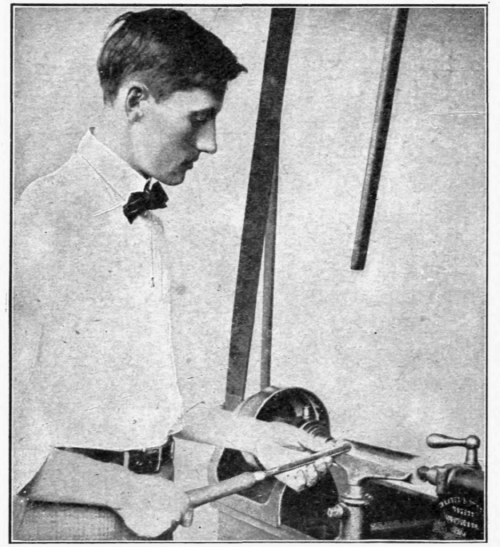
Fig. 43. Turning a Cove.
the cove. If the handle is not lowered but rolled, the gouge will scrape instead of cut. It will be quickly dulled if it scrapes, and the cove will be rough instead of smooth and bright.
The correct shape of the cove may be secured by this scraping motion, but it will not be good work, and it will be easily distinguished from work which has been properly done. There is no reason why this work should be done by scraping, as it is not a difficult matter to learn how to do it properly; and when the proper way is once learned the work can be done much faster in the right way than it can be done in the wrong way.

Fig. 44. Turning a Cove.
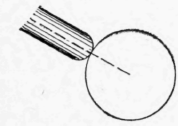
Fig. 45. Starting Gouge
Continue to:


My Books

