


Lesson XVII Spindle With Cones
Description
This section is from the "Elementary Turning" book, by Frank Henry Selden. Also available from Amazon: Elementary Turning.
Lesson XVII Spindle With Cones
Fig. 57 indicates the shape of the spindle with cones, but the size of the various parts may be modi-
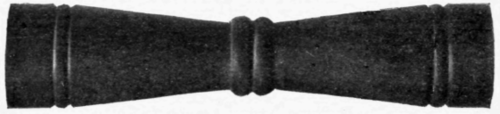
Fig. 57. Spindle with Cones.
fied to suit the judgment of the individual student The general plan of the illustration should be followed. There should be the same number of beads, and they should be similar in size and location. The two halves should be exactly alike, and the parts between the two center beads and the two end beads should be perfect tapers.
As the two ends are to be exactly the same size, you should measure their diameter with the calipers.
Adjust the calipers, as directed in Part 3. Hold them as shown in Fig. 58.
Do not force them on to the piece. They should simply touch the two sides so lightly that they will not mar the surface. At first, you had better stop the lathe while using the calipers. After you have become accustomed to using them, you can do so while the lathe is in motion, if the ends of the calipers are of proper shape.
Before using the calipers read what is said in
Part 3, about shaping the ends for use in wood turning.
Turn the entire piece to a cylinder with the roughing gouge', and carefully smooth the surface near each end with the skew chisel. Turn one bead at each end, as shown in Fig. 59.
This piece is to be finished with two coats of shellac, applied with a brush, and, therefore, there

Fig. 58. Using Calipers.

Fig. 59. Two Beads Turned.
must not be any sharp corners which will be rubbed white when sandpapering for the second coat of shellac. Care must be taken that there is no mark left by the point of the obtuse corner of the chisel at the bottom of the grooves or on the sides of the beads. The upper corners of the small spaces at each side of the end beads should be carefully rounded, and the spaces should not be too deep to be smoothed with sandpaper. If there is any space that will gather the finishing material, and is so narrow that the finish cannot be rubbed out, it will injure the appearance of the piece.
Keep in mind as the plan is made for the beads and curves, just how the various angles will be sandpapered and finished. After each end has been finished, turn the piece small at the center, as shown in Fig. 60. Use the roughing gouge for doing this. The size at the center should be the diameter of the two center beads. Turn the center beads, finishing them smoothly at each side, being careful not to cut the groove between them too deep (Fig.61). Finish the piece by turning the conical part at each side, finishing with the skew chisel.

Fig. 60. Center Sized.

Fig. 61. Center Beads Turned.
The surface of these two cones should be very smooth and straight. The appearance of the finished piece should be as shown in Fig. 55.
Continue to:


My Books

