


Lumbering And Varieties Of Wood. Part 2
Description
This section is from the book "Elements Of Woodwork", by Charles A. King. Also available from Amazon: Elements Of Woodwork.
Lumbering And Varieties Of Wood. Part 2
(J.) In modern large lumbering operations, the timber to be cut is selected by trained foresters, thus insuring a per manent supply, and in the near future all extensive lum bering operations will, beyond doubt, be conducted upon a scientific basis, as it is apparent that unless lumbering is carried on differently than it has been in the past, the supply for the future will be entirely inadequate for the demand.
(K.) In the smaller sawmills, the logs are usually sawed into lumber of various dimensions by a circular saw (Fig. 13); but in the larger mills, the band saw generally is used. Figure 14 illustrates a double cut band sawmill, in which it will be seen that the saw makes a cut each time the log is carried either way.
9. To saw lumber of irregular dimensions. - (A.) Be sides sawing dimension timber, joists, scantlings, boards, and planks of differ ent thicknesses are sawed, as follows:
1 ", 1 1/4", 1 1/2", 2", 2 1/2", 3", 3 1/2", 4"; and thicker, if desired.
(B.) If lumber is cut again from its original dimensions, it is said to be re sawed. When boards or planks of the above dimensions are dressed on both sides, they will be about \"thinner; thus, a board sawed 1" thick will, when seasoned and dressed, be but 7/8|", and a 2" plank will be but 17/8" or 13/4", though still classed by their sawed dimensions.
Thicker lumber than that above-mentioned usually comes under the head of dimension timber, which is not used to the extent that it was formerly, as steel and con crete are replacing it upon heavy work.
If 1/2" boards are wanted, 1" or "five quarter" lumber is usually resawed to furnish it, and after resawing, is planed upon each side to the desired thickness. Boards for box stock and other special purposes are sometimes sawed as thin as 1/4".
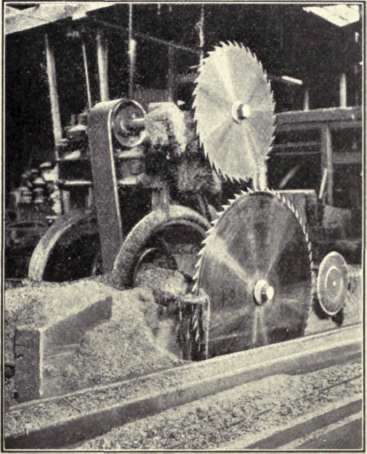
Fig. 13. - Circular Saw.
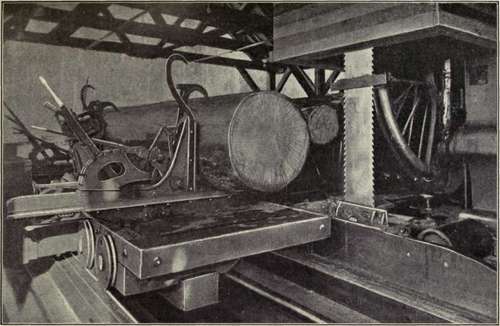
Fig. 14. - Double Cut Band Saw.
(C.) The method of cutting a log illustrated by Fig. 15 is known as plain, slash, or bastard sawing, and is the cheapest way to cut logs, both as to time and waste. The log is first squared to secure a bed upon which it may lie while being sawed, which also makes it un necessary to run each board by the edging saw to straighten the edges. The slabs at a are sawed into boards as the log is squared, and the bark, or "live edges," sawed off afterward. These make an inferior grade of boards, as they are nearly all sap, but they are well worth saving, if large logs are being cut.
In sawing dimension timber, or "bill stuff," good judg ment is necessary to cut a log so that the greatest amount of marketable lumber can be made from it. This is done by cutting various sizes from a log, if it will not cut all of one size without too much waste.
(D.) In cutting woods which have prominent medul lary rays or silver grain, the log is sawed by one of the methods shown in Fig. 16, the object being to bring the rays as nearly parallel to the surface of the board as possible, thus giving the broad silver, or quarter, grain which is so highly prized.
The best results are obtained from sections a, b; this method also gives the most waste. In plain sawed lumber, the boards from the middle of the log will have the quarter grain; these are usually culled and sold as quarter-sawed.
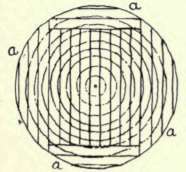
Fig. 15. - Plain, Slash, or Bastard Sawing.
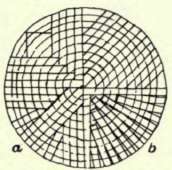
Fig. 16. - Four Methods of Quartering.
Neither of these methods results in economy of time or material, as about 25 per cent of each is used in excess of that required in plain sawing; hence, quarter sawed lumber is more expensive than the plain, or bastard, sawed.
(E.) Quarter-sawed lumber (Fig. 16) is preferred not only on account of its handsomer grain, but because it holds its shape better than lumber sawed in any other way, as the annual layers are approximately square with the surface of the board. As the board shrinks in the direction parallel with the annual layers, and very little from the center to the outside of the tree, it is obvious that there is much less shrinking and warping in quarter-sawed lumber than in that which is sawed plain.
The best grades of flooring are quarter-sawed, and stand usage without the surface splintering much better than does the common plain sawed material. Quarter-sawed lumber is known also as "rift-sawed," "vertical grain," and " comb grained."
1o. The grading of lumber. - Custom varies some what in different localities as to the grading of lumber, but there are generally four grades, which are often subgraded into qualities suitable for various uses.
"Number 1" lumber should be practically perfect, though in large dimensions, small and unimportant blem ishes may be allowed. These blemishes in a board are usually restricted to not more than one inch of sap, a small sound knot, or small discoloration, and but one blemish to a board is allowed.
"Number 2" lumber is generally allowed two sound knots, an inch of sap, and one other blemish.
"Common boards" are allowed three or four sound knots, but two thirds of one side must be clear stock.
"Culls," the lowest grade; are used only upon the cheapest work. One half of the board must be usable.
In many cases the boards are graded by the width of clear stock which can be taken out. There are tables published by the different associations of lumber manu facturers which give the gradings under which their lum ber has been measured and shipped, but as these vary from time to time no permanent list can be given.
Continue to:


My Books

