


Lumbering And Varieties Of Wood. Part 3
Description
This section is from the book "Elements Of Woodwork", by Charles A. King. Also available from Amazon: Elements Of Woodwork.
Lumbering And Varieties Of Wood. Part 3
The principal reason why there can be no permanent grading of lumber is that the forests from which the finest timber can be cut in marketable quantities are being destroyed faster than they can be replaced by nature. In anticipation of this condition, the Division of Forestry of the Department of Agriculture is actively engaged in organizing government forest preserves, in educating the people, and in promoting legislation aimed at the husband ing of our forests. When we consider the abundance of high grade lumber a few years ago, and the fabulous prices which the same grades now bring, it is evident that this movement should have begun during the days of our grandfathers, instead of waiting until nearly all the best lumber in the great forests east of the Mississippi had been cut, and inestimable damage wrought by forest fires.
ii. The testing of lumber. - (A.) Dry, sound stock, if struck with the knuckles or with a hammer, will give a clear ringing response, while a wet or decaying piece will give a dull response to the blow.
(B.) Every kind of lumber has its peculiar odor, by which, as well as by the grain, the student should learn to distinguish the woods in common use. This may be more easily done before the wood has been thoroughly seasoned. Wood in general has a sweet and pleasing odor; if a sour or musty smell is perceptible, it indicates that decay is present.
(C.) If there is much variation in the color of timber, or black and blue spots, the stick is probably diseased.
(D.) Decay is a disease, which may be prevented by dryness or ventilation, and frequently may be cured by soaking the wood in water for several days, or by steam ing. The disease of decay is cured also by chemical pre servatives being forced into lumber by pressure; this at the same time prevents insects from boring into the tree.
Alternate wetting and drying will produce rot, but most lumber, if permanently submerged or if kept perfectly dry, will last almost indefinitely. Dry rot spreads to adjoining timbers, and even to those which have no connection with the one originally infected.
12. Surveying or estimating lumber. - (A.) It is the custom to consider any board less than one inch in thick ness as an inch board, and anything over one inch is measured as so many inches and fractions of an inch. For instance, a board 3/4" thick is surveyed as a full inch, while one which is sawed 11/2" in thickness is estimated by obtaining its surface measure, and increasing it by one half. Thus, a plank 12' long, 8" wide, and 11/2" thick would have twelve feet board measure in it.
In some localities there is a sliding scale of prices which varies with each quarter inch in thickness of resawed lumber, but this is not universal.
(B.) In surveying joists or scantling, it is customary to obtain the fraction of a foot, board measure, for each lineal foot. Thus, a piece of 2 x 4 (inches understood) has two thirds of a foot for each foot in length; a 2 x 6 has one foot, and a piece of 2 x 8 has one and one third feet of lumber for each foot in length of lumber measured. If a joist is 2 x 12, doubling its length gives the number of square feet, board measure, that the joist contains.
(C.) In measuring a common board, the widest parallel piece which can be cut from it is the width of the board being measured; therefore the board should be surveyed at the narrowest place. In measuring more expensive lumber, it is customary to average the width of the board.
(D.) In estimating all kinds of lumber in common use, the lumber scale shown in Fig. 17 is used. It is made of thin, cleft hickory, about three feet long, with one end large enough for a suitable handle; on the other end is a metal head, which is held against the edge of the board while the scale is being read.
The length of the board is marked near the handle, and at the end of the socket of the metal head, as at a.
In using this scale, the hooked end, or head, is held against the edge of the board, as at b; the eye follows along the same line of figures upon which the length of the board is found, reading those figures nearest the width of the board. Thus, a scale laid upon a board 16' long would, without further measuring or calculating, show that the board contains 17' board measure. If the board were
12' long, it would contain 13'; and if 14' long, by reading the middle line of figures, the board would be seen to con tain 15'.
In using this scale, it is customary to read to the nearest figure, and when there is no difference, to alternate be tween the lower and the higher figures upon different boards. Thus, a board 12' long and 83/4" or 91/4" wide would be read as having 9' board measure in it. Two boards 81/2" wide, of the same length as the above, would be measured as having 8' and 9', respectively, in their surfaces. In short, the fractions of a foot are not consid ered in surveying the lumber in common use.
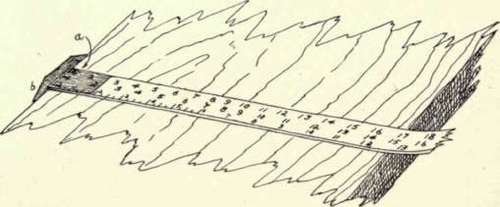
Fig. 17. - Lumber Scale.
13. Qualities of wood. - (A.) Certain kinds of wood are adapted for some purposes better than are others; the wood-worker, therefore, should be familiar with the qualities which conditions demand, and the kinds of woods which have these qualities.
Lumber for framing should be strong and durable; it should be cut from trees which grow to a size that will allow large dimensions to be cut from them.
For outside finish, the material should be wood which will stand the weather, can be easily worked, and will hold its shape well.
Timbers that are to be buried must possess the quality of durability, and should be of sufficient strength to resist the strain which will be put upon them.
Flooring should wear well, hold its shape, and be of good appearance. In providing lumber for inside finish, care should be used that it has good grain and color, is not too soft, and that it will hold its shape well. Al most any wood may be used as far as strength is con cerned, but lumber which shrinks and warps badly is unfit for finishing.
Continue to:


My Books

