


Chapter IV. Metal-Turning With Hand Tools
Description
This section is from the book "Turning Lathes", by James Lukin. Also available from Amazon: Turning Lathes: A Guide to Turning, Screw Cutting, Metal Spinning and Ornamental Turning.
Chapter IV. Metal-Turning With Hand Tools
THE principle of the cutting action of all tools is the same. They are thin wedges, which force apart the substance of the material upon which they are engaged; they must, consequently, be harder than such substance, and their edges must be as thin as is consistent with the necessary strength. They must also be held in the position most favourable for the operation.
The resistance which has to be overcome by a cutting tool is twofold: first, the hardness of the material which it has to penetrate; and secondly, the rigidity of the shaving which has to be separated, and which must be capable of curling away as it is cut, and escaping from the upper surface of the tool. If too deep a cut is attempted, so that the shaving is too thick to curl away and escape, it holds the tool fast by compression, and breaks its edge; or, if strong enough to resist breakage, the machine driving such tool is brought to a standstill. Metal, offering considerably greater resistance than wood, needs tools with stronger edges; and as their strength is, on the other hand, limited by the necessity of keenness, they require careful adjustment in order to enable comparatively keen edges to do their work without breaking. The shaving must be thin enough not to endanger such fracture, and its thinness or the contrary depends upon the angle at which the tool meets the work.
Again, it is essential that metal-turning tools be well supported, owing to the strain which comes upon them in the act of cutting. They cannot be held like the chisel at A B (Plate IX.), because the direction of the strain is as nearly as possible in a line with the tool, which, in the case of metal-turning, would slip down towards the hand. Hence, a rest with flat top, like C, No. 2, has to be substituted, which supports entirely the heel of the bent tool, such as is used for iron, and of which the edge, thin and sharp, is also supported by the metal below it, the strain tending to fracture it being reduced to a minimum. An exception in the need of a flat-top rest, occurs, however, in the case of the graver, which is seen at E, No. 3. This tool would be placed as shown, ready to cut a shaving from the bar of metal, commencing at the end. It is evident that as the strain is downwards, this tool is perfectly" supported by the T of the ordinary rest. The tools for iron always have sharp edges, which are not suitable for those intended for brass and gun-metal. The tool H, No. 5, called a triangular tool, and which, having cutting angles of 60deg., can be made of old saw files ground till the teeth are removed, is the usual tool for inside work; and for turning the ends of cylinders and sides of collars and flanges it is a splendid tool, cutting with great freedom. There is not much light work that cannot be done with this tool and the graver alone, but for heavier cuts the one shown at D of No. 1 is more serviceable. This is made in two forms, O, P, one for smoothing, the other for roughing. The heel is often drawn out a little, to grip the rest more firmly. G is, as a brass-turning tool, what H is for iron and steel. The edges are rectangular, as a sharp edge proves too eager for yellow metal and is apt to catch in and spoil the work. L, No. 6, is a side view, for instance, of such tools as J and K, having an angle of 80deg. or thereabout, which is sharp enough for most purposes. The tools J, K, are almost counterparts of those for hard wood, which, indeed, are not unfrequently pressed into service in default of others. The round-end is the best of all for roughing-down brass. At P is shown a rest which has been greatly used by turners of brass, but is not so often seen now that slide rests have become so general: a few years ago, owing to the cost, they were the exception. The pins are inserted in a flat-top rest, as fulcrums to assist in steadying the tools and prevent them from slipping sideways out of cut. They are easily fitted, and will prove of great convenience, saving the muscles of the hand and wrist a good deal of hard work. It will be seen at a glance that metal-turning tools, used by hand, cannot be run along the surface of work as wood-cutting tools are, but must, for the most part, be swept round in short curves, then shifted, and a similar cut made. The ridges between these curves are then attacked and the surface levelled by degrees in stages. But very good work can, nevertheless, be so done, and metal-turning by hand will be found far more interesting and easy than might be supposed; even with a slide rest at hand, it is impossible wholly to lay aside hand tools.
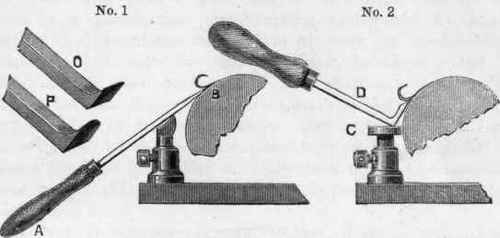
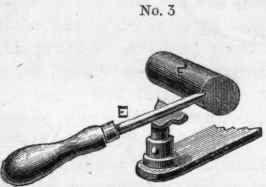


PLATE IX. - METAL-TURNING BY HAND TOOLS.
It may, indeed, seem strange to the ambitious tyro, whose heart is bent on a slide rest, to be told that hand tools are easier to use, and that he must not think for a moment that all he has to do is to put a tool in the rest, turn a handle, and produce excellent work. If it were so, a Lathe man would hardly need the apprenticeship which he is called on to serve. But it is equally true that the use of hand tools may be very quickly acquired, and that good work may be done with them. The principle guiding their use is, nevertheless, exactly the same as that which governs the others; and it is, perhaps, accuracy of position which is of more real importance than accuracy of the cutting angle of edge. For instance, if a cutting edge of 60deg. is the best for wrought iron, one of 62deg. or of 59deg. would cut it almost as well; but one of 60deg., though perfectly ground, not placed exactly right, will do far worse work than one of 70deg. placed correctly. The rule, which is so generally applicable that it may be taken as absolute, is to keep the lower face of the tool, or the face which is nearest to the surface of the work, as accurately tangential as is possible while allowing it to cut - in a word, keep it almost in contact, but not quite. The graver will illustrate this better than any other. The back of the tool is seen at E, No. 5, and the front of it is like M, the side view or profile N. Now, in order to set this tool into cut, let it first lie quite flat against the end of the bar - i.e., lay the bevel, or sloping face, of it in that position. This is technically called "without any clearance." Draw back the tool upon the rest, so as only to let 1/8 in. of its point overlap, but still keep the face as before. Now tilt up the tool very slightly indeed, giving it a very small clearance angle. It will at once cut the metal beautifully. Increase the clearance more and more, noting the result. It will be found to cut worse and worse. Take up the triangular tool, and try the same. It will shave off quite a broad, thin shaving if the clearance is very small, a thicker one by tilting it a little more; but presently it will be found too much tilted over for good work. Either tool may be held in one hand, easily, with a small clearance, so slight is the resistance. Nothing can teach better than this the fundamental principle of a small amount of clearance. This lesson is preparatory to the right understanding of slide-rest tools, the difficulty with these being the impossibility of thus gently altering the angle of clearance, or of slightly varying the position of their edge, or edges engaged with the work: yet it is this very slight variation that makes all the difference between good cutting and bad. It is the same with the heel tool (D of Plate IX.) The lower face, next the work, must make a very small angle with the bar upon which it is engaged, in order to cut the material easily and smoothly. It is just the same, but is not, perhaps, so plainly perceptible in turning hollow work with the triangular tool. Experiment may here, however, be made with great advantage, because, if the tool fails to cut as it should, it must necessarily be because it is not correctly placed, as its angles are 60deg., and are quite the best for use on wrought iron. We may now go a step further. Suppose D (the heel tool) to be placed correctly in the drawing - which it is - it will be seen that, if the handle is lowered, cutting will cease, and the tool will rub against the work. This, therefore, is our limit in that direction. But what will result if we raise the handle ? Not only shall we increase the clearance angle, but we shall also alter the position of the top face of the tool, and shall bring it more nearly into a horizontal position. From this another evil will result. The shaving will be bent up sharply, pressing upon the top face of the tool, and greatly adding to the resistance; and, at the same time, the edge of the tool will become more of a scraper than a cutting tool. It is just the same as with a knife. If you want to cut a pencil, you lay the blade pretty flat. If you wish to scrape the lead to a point, you set the blade up on edge. In the first case, the clearance angle is very small; in the second case, it is actually 90deg., or a right angle. This will show how we are limited in the position we can give a turning tool.
Continue to:


My Books

