


Turning Boxwood And Foreign Hard Wood. Part 4
Description
This section is from the book "Turning Lathes", by James Lukin. Also available from Amazon: Turning Lathes: A Guide to Turning, Screw Cutting, Metal Spinning and Ornamental Turning.
Turning Boxwood And Foreign Hard Wood. Part 4
To cause the traverse a very simple expedient was used. A block of soft but close-grained wood, seen at F, was pressed by a wedge against the selected thread, and the pin or catch in the back collar was removed. As soon as the mandrel was made to revolve, a thread was impressed in the wood block, which thus at once became a stationary nut, or section of a nut; and, as this remained immovable, the mandrel itself was compelled to run forward at the exact rate of the particular screw thread that had been selected. A single point tool, or a chaser of similar pitch, needed only to be held quite still upon the rest, and a screw was cut perfectly identical with that on the mandrel. With this apparatus even a tyro can cut a screw in boxwood or ivory, or other material, and even in soft wood. But, in the latter case, a V tool, as it is called, is used, which is in shape like a narrow strip of writing-paper, folded lengthwise, and sharpened at the end. That for inside work is similar, but cuts at right angles to its length: with these only a single cut is taken, which finishes the screw to its full depth; but with hard wood the chaser is generally allowed to retrace its course two or three times. The old pattern of screw mandrel illustrated is mounted on wooden headstocks, the front and back collars being attached with bolts. They are greatly used at Tunbridge, and abroad, both in Germany and France, but are not now made to any extent in England, having been, in a great measure, displaced by the neater and more expensive form, in which the screws, instead of being cut directly upon the mandrel, are cut upon rings or ferrules of brass or steel, and attached to the back part of the mandrel which projects beyond the collar, and is outside the headstock.

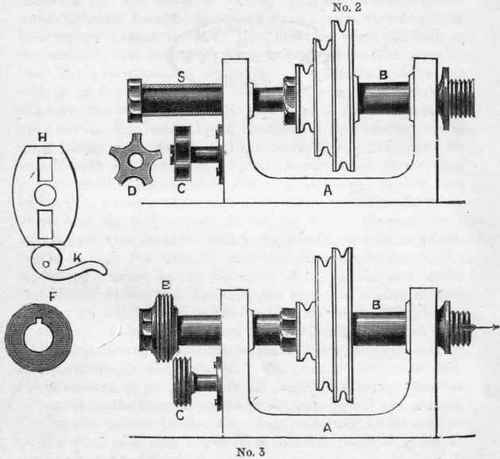
PLATE VIII. - THE TRAVERSING MANDREL.
Before explaining in detail this modern arrangement, it may be as well to go a little into the mode of using the traversing mandrel, as this will apply equally well to both forms of it. The work, it will at once be understood, will travel forward towards the right hand; and, therefore, the back poppet cannot be used: it is only for work chucked on the mandrel, that cannot be done without such other support, that this contrivance is available. A screw cannot be cut with it on the end of a long rod. Thus, also, as this traverse will carry the work forward, the rest must be far enough away, when cutting the inside thread, to allow of this forward movement taking place to the full extent required. This must be tested, both for inside and outside work, before the cutting is commenced. Again, when there is, as always is the case with a box, a short tenon with a shoulder, care must be taken to see that the tool will not, at the end of the traverse, come up against this shoulder, which, by causing a sudden shock, would damage the thread; and the same would happen if, in cutting a screw inside the cover of a box, the end of the tool should strike the inside of the top. It is easy to test this before finally setting the tool to its work. The Lathe is also not allowed to get into full motion, the flywheel only taking a half-turn to and fro, which will give, however, several full rotations to the mandrel. The crank must, therefore, not be allowed to go over, or, in all probability, serious damage will occur, as the threads on the guide ferrules will get jambed. The treadle motion is, therefore, kept carefully under control of the foot, and only a gentle to-and-fro swing is given to the crank axle and flywheel.
A beginner generally finds a little difficulty in holding the chasing tool quite still, and is apt to let it be carried along the rest by the advance of the work. An easy way to prevent this is to drill a hole in the flat-topped rest, and insert a pin on the right of the tool, which will then be kept steadily in its place; or a block of boxwood may be made, with a stem to fit into the socket of the rest, having a groove or channel cut in it for the reception of the chaser, which will be free to move forward into cut, but not to traverse sideways. After a little practice, the difficulty will disappear; but these little aids need never be despised, and may save work, otherwise well turned, from being spoiled. The chief thing is to allow the tool only to take light cuts, so as to present as little resistance as possible to the forward motion of the mandrel.
It is not necessary to finish the thread with the guide-screw in gear, as there is no difficulty after the first cut has been made sufficiently deep to catch fairly the points of the chasing tool. As soon as this is done, it is better to remove the guide, or, at any rate, to throw it out of action, and to finish the thread to its full depth by hand alone. Then, if it is not a good fit, but too tight for its nut or box-cover or other part that is to be attached to it (let it always err on the side of tightness), the chisel can be used, or the flat tool, to take off the tops of the thread, and the chaser can be applied again by hand alone to re-touch and finish the threads again; and this process can be repeated again and again, if necessary, until an accurate fit has been obtained.
In metal-work done with stocks and dies, there is a standard of size for the bore of a nut, to enable it, when tapped, to exactly fit the screw. But in ordinary turned work, in which the traversing mandrel is to be used, a little trying-on of a box-cover is both lawful and very expedient indeed. Suppose the cover to have been just made, and its inside screw cut and finished, the outside of the box tenon must be turned to a diameter equal to that of the inside of the cover, measured to the bottom of the thread cut in it. To measure this is not very easy, because, if done with inside calipers, with points sufficiently fine, you cannot pull them straight out: you may do it with in-and-out calipers if very accurate; but, without pulling them out of the thread, you must, with a second pair of outside calipers, take the width of the points of the first pair - i.e., of course, the points outside, which are just as wide apart as those buried in the threads; you can then close and remove the latter, and the second pair will gauge the tenon. But it is far more usual to work by guess, trying the screwed cover upon the tenon till it appears to be the required size, but leaving it, if anything, too large. It is then cut with a screw thread, and tried as already explained, and, if necessary, cut down, and the thread renewed as often as may prove necessary until it goes on well. But for boxes and scent-bottle cases, and all work that will be constantly taken apart, do not make too tight a fit. It ends in splitting the cover, or being compelled to use the vice to hold the work while it is being unscrewed; and, although a rub of soap will help the matter as an effective lubricant, it is seldom that the work escapes damage, if not entire destruction. A tight fit is not to be called a good fit.
The modern screw mandrel (No. 2) is a neater arrangement than the last, but in principle it is exactly the same. A is the poppet, not of wood, but of cast iron; and this is usually japanned black, except in the front face, where it is made bright. Hard steel collars are let into it to receive the cylindrical hardened mandrel (B), which is free to revolve and to slide lengthwise, but is so well fitted as not to have the least atom of side play. Such a mandrel of best quality will wear very many years without running loose in its bearings. The front end has a short conical neck, and the mandrel is put in in that direction. To draw back the conical part into its bearing in the front collar, a sleeve (shown in section at S) is slipped over the projecting part of the mandrel, and secured by a nut and washer at the back. This, which is also hardened at the end, bears against the back collar, and retains the mandrel in its place. This sleeve fits over a short feather or pin, that prevents it from itself rotating upon the mandrel. For ordinary turning, all parts remain in the position indicated. There being no tail pin to take up the end thrust in such operations as drilling and boring, this comes entirely upon the front cone. These Lathes are not, therefore, well suited for such work, and are mostly purchased by those who practise ornamental turning, in which there is no heavy or detrimental work to be done. The conical neck is, of course, so proportioned that it shall not jamb by the ordinary thrust of the back poppet, when this is in use for turning cylindrical work of such length as to need its support. When it is desired to cut a screw, the box or other article is carefully turned to a form truly cylindrical, the rebate being also accurately rectangular.
The rest is then placed about ¼in. from the work, and (as explained) well towards the right, in which direction the traverse will take place. If the stem of the rest is placed about where the traverse will begin, the hand grasping it and the tool together will be better able to prevent the latter from being carried sideways when the cutting action begins. The sleeve (S) is now removed by unscrewing the nut which holds it, and a ferrule, having been selected, is slipped on in its place. The nut is again attached to secure it (see No. 3). The disc (D C) is turned round by the fingers, to bring uppermost the half-nut matching the ferrule, and then it is raised until it just gears with one or two threads; a drop or two of oil is added, and the mandrel run forward without applying the tool to the work, in order to see that everything works easily and smoothly, as it should.
If all appears satisfactory, the treadle is now used to give half-revolutions to the crank, and the tool is gently but firmly advanced to the work, upon which it will trace an accurate thread, which can be deepened with or without the traversing apparatus, as already stated. In the drawing, the stud, upon which the segment-plate or scalloped disc is mounted, is represented as attached to the headstock by two screws. The plate (seen at H, Plate VIII.), with two slots in it, permits of being slid up and down upon these screws, by which it may also be held when in position. It may be raised by hand, but it is more convenient to do this by an eccentric, like K.
Continue to:


My Books

