


The Rebate Plane
Description
This section is from the book "Manual Instruction: Woodwork. The English Sloyd", by S. Barter. Also available from Amazon: Manual Instruction: Woodwork.
The Rebate Plane
(fig. 59). This plane is used for cutting rebates or steps on the edge of a piece of wood, or grooves in the wood at a distance from either edge.
It varies in width from 1/2 in. to 2 ins., but that used in this course is 11/4 in., and this size, or a little narrower, will be found the handiest.
The great peculiarity of this plane is that it is skew-mouthed, i.e., the iron is set obliquely in the plane as shown. The cutting of the iron has consequently a shearing action, which obviates the risk of splitting the timber in the direction of the fibres.
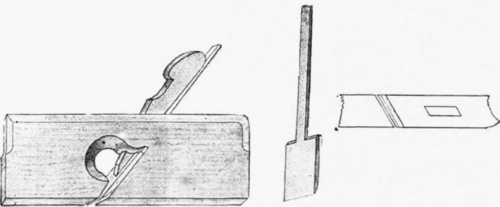
Fig. 59. - Shows the general appearance of a rebate plane, the shape of the iron, and the plan of the mouth, with the hole for wedge and iron.
The angle of the edge of the iron to the side of the plane is usually 75° to 80°, and the more the iron is skewed the cleaner it cuts. The angle should not, however, be less than 75°.
The reason the larger planes are not constructed on these lines is, that it would be impossible to use them on an open surface with a straight stroke, as the large iron would, if placed obliquely in the plane, cause it to swerve in its forward course.
The risk of splitting the timber being avoided by the placing of the iron, the necessity of the cap-iron vanishes, and it is accordingly never seen in this plane. As the rebate plane is to make rebates or grooves which will be regulated partly by the straightness of the side of the plane, the iron must cut on the corners, and the corner of the iron must of course coincide with the angle of the sides and face of the plane, or rather project out from the side very slightly, in order to make sure of its cutting well up to the side of the desired rebate.
As the entire width of the plane is taken up at the bottom by the iron, the latter is made much narrower at the top, to leave substance for the 'cheeks' of the plane.
The iron, shaped as in fig. 59, is placed in from the bottom and the wedge is driven in from the top.
The escapement of this plane, like the set of the iron, is peculiar. The front side makes a very small angle, about 5°, with the cutting edge of the iron. This assists in breaking the shaving, and in a measure replaces the cap-iron.
The escapement terminates in a semicircular hole which is larger on one side than the other, enabling the curly shavings to continually work out to the side of the plane.
Beading planes, hollows, rounds, moulding planes, and many fillisters are constructed on the same principles as the rebate plane.
Continue to:


My Books

