


Exercise V. Fig. 117. Face And Edge Planing. - Drawing With Set-Squares On Wood. - Sawing With Tenon Saw. - Horizontal And Vertical Chiselling
Description
This section is from the book "Manual Instruction: Woodwork. The English Sloyd", by S. Barter. Also available from Amazon: Manual Instruction: Woodwork.
Exercise V. Fig. 117. Face And Edge Planing. - Drawing With Set-Squares On Wood. - Sawing With Tenon Saw. - Horizontal And Vertical Chiselling
Tools Used
Jack plane, try-square, tenon saw, marking gauge, bevel, and various firmer chisels.
Timber
Yellow or white deal, bass-wood or butternut, 1 ft. 6 ins. by 2 1/4 ins. by 7/8 in.
The drawing of this exercise involves various plane geometrical figures, which are drawn in the usual manner, as indicated in fig. 117.
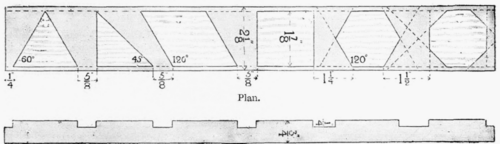
Side elevation.
Fig. 117.
The drawing need only be plan and elevation.
Method
Plane up the wood true to the required dimensions, i.e. 2 1/8 ins. by 13/16 in., and gauge two lines on the face, one 1/8 in. and one 2 ins. from the face edge. This gives two lines running down the length of the wood 1 7/8 in. apart and 1/8 in. from either edge.
Taking one line as the base and the other as the limit of height, draw in the various geometrical figures with compass and pencil, using the blade of the try-square as a straight-edge. Now with the try-square and chisel cut lines over the pencil lines already made. Gauge lines 1/4 in. deep on each. edge.
The figures being now marked, saw them all out down to the gauged line just made - in the case of the hexagon and octagon, saw away from the cut lines 1/32 in. Pare out the waste between the figures horizontally, and the hexagon and octagon will have to be pared vertically to take off the 1/32 in. which was purposely left on to give a little practice in this form of paring.
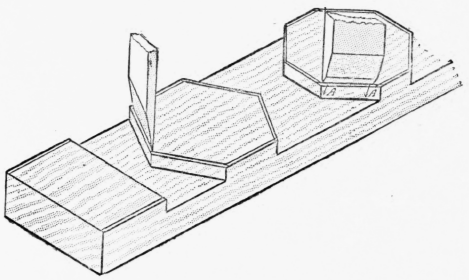
Fig. 118.
The chisel (fig. 118) should be held vertically, with one hand round the handle, and the other to guide the blade; it should be pressed downwards, and with a certain amount of shearing action at the same time, in the direction of a a in fig. 118. The whole of the waste should not be removed at the first cut, but several strokes should be given, and a good clean surface left.
The 1/8 in. at the top and bottom of the figures first gauged is not removed with the chisel but planed away by edge planing.
Continue to:


My Books

