


Epidiascope
Description
This section is from the book "Workshop Receipts For Manufacturers And Scientific Amateurs. Supplement Aluminium To Wireless", by The Chemical Publishing Co.. Also available from Amazon: Workshop Receipts For Manufacturers And Scientific Amateurs.
Epidiascope
This is an apparatus for the projection of the image of solid opaque objects on to a screen. Fig. 71 illustrates a particular form which combines arrangements for :-
(a) ;The projection of solid opaque objects by incident light.
(b) ;The projection of transparencies by transmitted light.
(c) ;The direct projection of microscopic objects.
The body of the apparatus is made of enamelled iron. The back portion of the body contains two high-efficiency projection lamps of 4,000 candle-power, for illuminating opaque objects. The object to be projected is placed on a 12in. square board which is capable of being raised or lowered to a height of 14 inches, which means that objects 12in. square by 14ins. deep can be projected with this apparatus. Projection on to the screen is by means of a large achromatic projection lens fitted in a rack focussing mount. Rough focussing is obtained by the raising and lowering of the object board, the final focussing is done by the rackwork adjustment of the projection lens. Above this lens is fitted a large reflecting mirror which directs the light to the screen. For lantern slides or transparencies the front portion of the iron body contains the various necessary parts.
For these it is necessary to have an intense point of light, and for this purpose a high power arc lamp is used, which is placed behind a 61/2in. diameter compound condenser. The lamp itself is securely fixed to the opaque object board when the latter is in its lowest position. After the rays from the arc have passed through the compound condenser they are diverted through a large aluminium cooling trough which entirely cuts out the heat rays. Directly in front of the cooling trough is placed a reflecting mirror which, placed at 45°, directs the light upward through the lantern slide, etc., and thence through a second projection lens fitted with rackwork and sliding focussing adjustments. A reflecting mirror is fitted above this lens which directs the light to the screen.
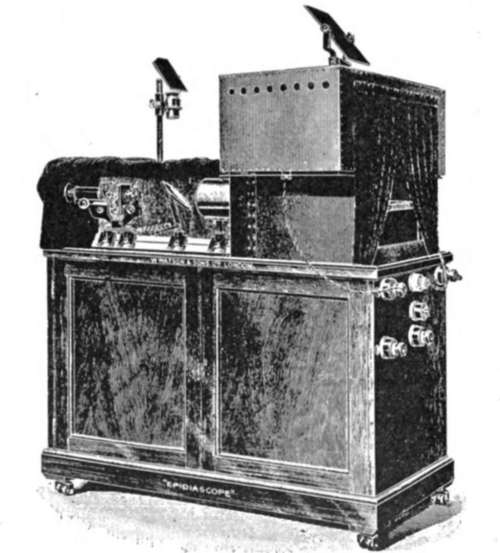
Fig. 71.
For the projection of microscopic objects, the necessary microscope is mounted permanently in a horizontal position directly in and central with the optical axis of the compound condenser. The microscope is fitted with a rackwork coarse and fine adjustment to the body with sliding drawtube, the mechanical stage having horizontal and vertical movements with divisions ; a compound rackwork sub-stage with centreing screws with provision for swinging out of the optical axis if required ; a triple nosepiece and universal holoscopic achromatic condenser in under-stage mount with iris diaphragm. The rays from the arc lamp should be nearly brought to a focus on the back of the substage condenser. The microscope is then adjusted in the ordinary way as for visual work. The cooling trough, reflecting mirror for lantern work, and complete microscope are all mounted with saddles to fit a triangular base. This being permanently mounted in the optical axis of the compound condenser, perfect alignment of the complete optical system is ensured. The whole apparatus is mounted on a mahogany cabinet with cupboard to hold the various accessories. There are, of course, other forms of epidiascopes, many of which deal solely with the projection of the brightly illuminated image of opaque objects, the general method is as described above, though details in construction and arrangement may vary.
Continue to:


My Books

