


Eyepieces
Description
This section is from the book "Workshop Receipts For Manufacturers And Scientific Amateurs. Supplement Aluminium To Wireless", by The Chemical Publishing Co.. Also available from Amazon: Workshop Receipts For Manufacturers And Scientific Amateurs.
Eyepieces
Huyghenian Eyepieces
Fig. 110a illustrates the ordinary form of such eyepiece, and Fig. 110b the capped form. The latter shows the lenses magnifying power, and the standards are 5, 6, 8, 10, 12 and 15 diameters in dotted lines. Huyghenian eyepieces were designed by Huyghens for microscopes or telescopes, and consisting of two plano-convex lenses separated by a considerable space, with both curves turned away from the eye and towards the incidental light. The focal length of the field and eye lenses are in the ratio of 3 : 1, while the distance between them is numerically equal to twice the focal length of the eyelense. The eyepieces are generally engraved with their initial.

Fig. 110a.
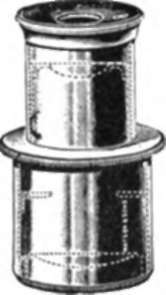
Fig. 110 b.
Lifting Appliances.
Fig. 111 shows a form of the well-known chain block, self-supporting in design, i.e., the load can be left on when required, and will not run down due to its own weight. These blocks can be suspended by the j top hook in any convenient manner. Fig. 112 shows a device for readily suspending it from a steel joist, and Fig. 113 from a wooden beam. Both these two appliances will grip a joint or beam if used on the hook end of the chain block. Clearly it is only a slight step to provide a wheeled trolley to suspend the block from as Fig, 114. This trolley can be either fitted with smooth wheels, or geared for hand traverse, or on a bogie truck for sharp curves.
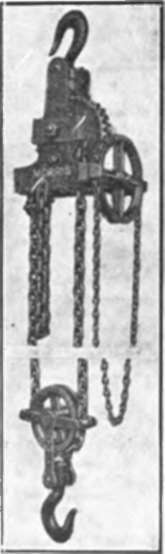
Fig. 111.
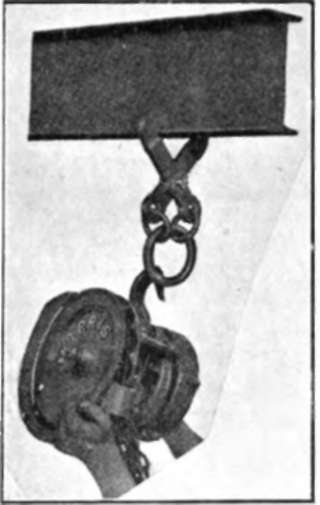
Fic. 112.
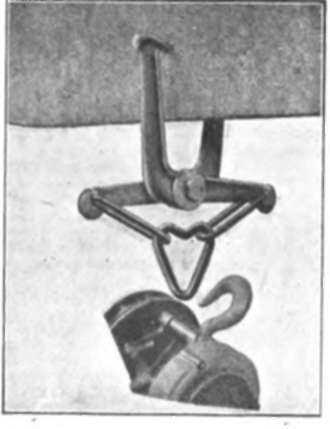
Fig. 113.

Fig. 114.
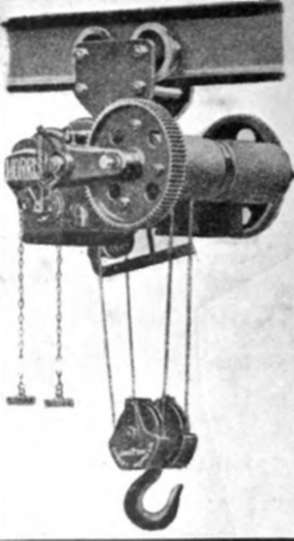
Fig. 115.
The next improvement is to provide an electric motor to do the actual work of lifting, see Fig. 115. This in turn can easily be provided with another motor to turn the trolley wheels, and so move the load as may be required. If the travelling motion is not too far, the current can be led to the motor by a flexible cable, but if this is not possible, then bare wires are led along the joist, well insulated from it, and the electricity obtained for the motor by a sliding current collector.
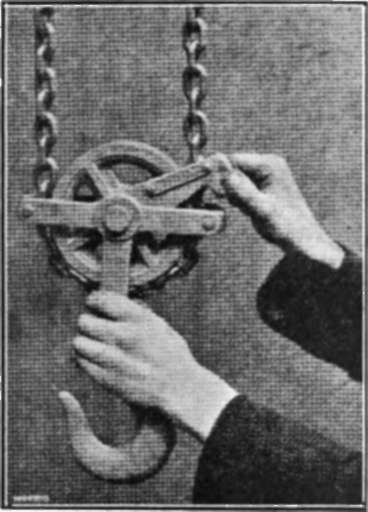
Fig. 116.
Figs. 116 and 117 show an ingenious device for increasing the speed of lift on a chain block to double, while lifting up to 1/2 loads only. The clutch shown is lifted from its usual horizontal position, until it engages with the chain. The lift is then taken by the chain and through the clutch to the lifting hook. Fig. 118 are slings for readily getting a grip on a rectangular load. The teeth shown engage in the sides of any wooden case; while in lifting say a block of stone, shallow recesses would be cut in the stone for the jaws to get a grip in. In using such slings the angle between the chains should not be over 90 degrees if full load is applied, but may be above full load as the chains approach each other.
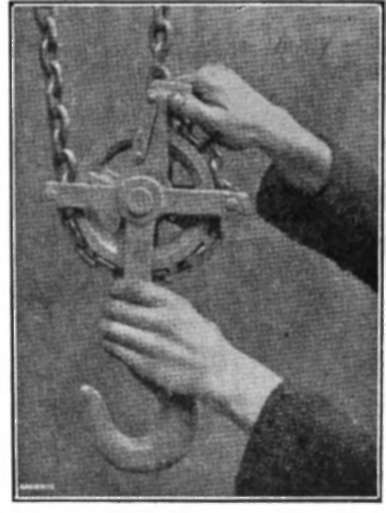
Fig. 117.

Fig. 118.
In all lifting appliances periodical inspection should be made of all parts; a breakage at any time generally means a dropped load, with probable damage to the load, and the workers. The electrical equipment also requires attention; a lifting motor is generally " crane rated," that is it is assumed that it does not run continuously but intermittently, and for a given size of motor is more heavily loaded while at work than one which has to run for long periods. Also as lifting motors are generally out of reach, they are likely to be overlooked and neglected, they should be cleaned and inspected by a competent electrician at regular intervals. If the lifting device is operated by a hand chain, this should be of the correct length, so that it does not drag or run upon the floor. A chain that does so is likely to catch something and cause trouble, and, by running in contact with the floor or articles thereon, is subjected to more wear than need be. * We are indebted to Messrs. Herbert Morris, Ltd., for permission to use the various figures.
Luminous Substances.
Towards the end of the sixteenth century there lived, in the old Italian town of Bologna, one Vincenzo Cascariolo, a cobbler, who devoted much of his time to the study of alchemy.
Near the Monte Paterno, some three miles from Bologna, Cascariolo is said to have picked up a stone which was remarkable for its great weight. The heaviness of the stone excited his curiosity and induced him to investigate its nature in retort and crucible. His heart was set upon the making of gold; this metal might be gold, or one even more precious. Neither of these hopes was realised, but he succeeded in obtaining one of the most curious of substances " which absorbed the rays of the sun by day and emitted them by night."
The stone which had furnished the mystical luminous product was baryles or heavy spar, the natural sulphate of barium. By heating it with charcoal, Cascariolo converted it into the sulphide of barium, a substance now known to have the curious property of shining in the dark after exposure to the rays of the sun.
Luminous Sulphides
Luminescence after exposure to light is most strikingly exhibited by the artificial sulphides of barium, strontium and calcium. If these substances are exposed for some time to direct sunlight, or even to daylight, or to the electric arc, they will shine for hours in the dark with a pale and more or less ill-defined light. The colour of the light depends not only on the nature of the substance, but also upon its physical condition, and on its temperature during exposure. The soft glow emitted by calcium sulphide may be orange, yellow, green, blue or violet according to the method of preparation. It has even been found that the light of a specimen of stronlium sulphide changed from violet to orange, through an extensive range of colour, as the temperature during corresponding exposures varied. The pure sulphides do not phosphoresce, and it seems that the phenomenon is due to the simultaneous presence of impurities.
Continue to:


My Books

