


Forcing And Vulcanising. Continued
Description
This section is from the book "Workshop Receipts For Manufacturers And Scientific Amateurs. Supplement Aluminium To Wireless", by The Chemical Publishing Co.. Also available from Amazon: Workshop Receipts For Manufacturers And Scientific Amateurs.
Forcing And Vulcanising. Continued
It is therefore necessary to study carefully the design of the parts to be manufactured in order to avoid the necessity of removing unnecessary stock.
Diamond tools consist of a steel blank in which a diamond is inserted for the cutting edge.
Some typical tools are illustrated herewith, see Fig. 70. Above will be seen various side and face tools, while below a cut-off tool is illustrated.
A vital condition to ensure satisfactory results is the selection of the diamond, quite apart from the type or location of the mine from which it was procured.
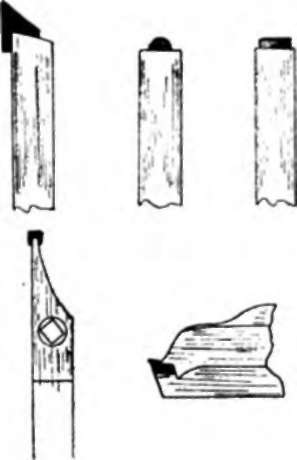
Fig. 70.
Bort diamonds are often used for diamond abrasive wheel dressers, but will not be found so suitable for vulcanite work.
The best way to obtain satisfaction is to purchase from a reputable tool dealer, or from a diamond merchant who specialises in industrial diamonds, as the art of diamond-selection for machine work is impossible of acquisition without practical experience.
Automatics And Capstans
The wire feed screw machine, or capstan lathe, is undoubtedly the machine that is generally used on vulcanite work, where the various operations such as turning, drilling, forming and cutting-off are carried out by hand, but a number of works which produce in large quantities have found it advisable to adopt the automatic.
Of course, with a machine of this type, it is necessary that the bars should be uniform in size, for it is not considered practicable to handle material with a variation of more than -005- 006 with the usual Spring Collett arrangement.
Uniformity in the diameter of the rods is very essential; to obtain this, a special grinding machine is used which will finish the bars or tubes to a limit of 001 ins., and leave a surface which will require very little buffing or polishing.
One of the greatest difficulties in work of this nature is deep drilling, and to eliminate this, tubing is used for such parts as the barrels, caps and so forth, instead of making them from a solid rod.
The reason why deep drilling is so difficult is because no suitable diamond tool has been designed for this operation, and therefore carbon steel drills have to be used. It has also been found necessary to turn long shoulders or diameters rather than undertake the forming opera- tion.
In order to reduce the buffing and polishing operations to a minimum and thus secure a good finish, a very high spindle speed is necessary, with a feed of from 004 ins. to .005 ins. per revolution. This figure, however, is dependent upon the amount of stock to be removed and the quality of finish desired.
It has been found advisable to use a mixture of soda water and lard oil in all turning and boring operations; care must be taken, however, to see that there is sufficient lard oil in this mixture, otherwise there is danger of the compound washing the oil from the bearings entirely.
Sheet Work
For cutting the above when cold, and without splintering in cold weather, a band-saw will be found most suitable, or for hand work a hack-saw. If, however, the shop is kept properly warm in winter, ebonite up to say 1/4 in. thickness and fibre somewhat thicker, can be readily cut with a guillotine.
The ebonite should be kept at 140° to 150° F., according to grade ; while the fibre can be cut in a cold condition.
(The Wireless Trader.)
Continue to:


My Books

