


Lawn Mowers
Description
This section is from the book "Workshop Receipts For Manufacturers And Scientific Amateurs. Supplement Aluminium To Wireless", by The Chemical Publishing Co.. Also available from Amazon: Workshop Receipts For Manufacturers And Scientific Amateurs.
Lawn Mowers
These are now generally made, when intended for hand power, to a common design. The design is such that when pushed along, the flat iron wheel or rollers at the back drives, by means of a chain or gear wheels, a rotary cutter which, allowing the grass to protrude between the cutters, cuts it off against a fixed knife edge, set on the under side of the machine. The number of actual cutting blades set in the rotary cutter, and the speed at which it is rotated, clearly determine two things (1) the number of cuts per unit of length of the lawn and (2) other things being equal, the energy required to propel the mower. The higher the number of cuts made say per foot of travel, the better and smoother must the result be, but this carried to excess must produce a 4 hard-to-push 1 mower. A compromise therefore has to be arrived at, and nine cutters appears to be the maximum that is supplied in a hand-pushed machine. Such a machine will probably be supplied with ball bearings to every journal and with an oil bath for the driving chain. Many cheap forms of mowers exist, which are very light, geared low, and have perhaps only four cutters, they can only give a few cuts per foot of travel, and produce only a rough finish, which can be improved by going over the ground several times. A very heavy mower holds down to the ground well, and is not likely to jump over thick tufts, but is more tiring to use than a medium weight machine. To get the best results with minimum of labour see (1) that all parts run easily, test this by raising the machine on to its handles, and see that all parts spin or revolve easily. If not they probably require oiling, or may be, are clogged up with old or new grass, or the bearings may want easing or adjusting, or the chain may be too tight. When all this is correct see (2) that the cutter blades all make a near approach to actually touching the fixed cutter blade, adjust the distance of the rotary cutters axle from the fixed blade until correct, this is really important, the nearer the contact the cleaner will the cut be. All the rotary cutter blades should be exactly the same distance from the fixed edge, if not, they must be ground to bring about this result; see lower down. (3) See that the edges of all blades have a clean, uniform edge, i.e., not pieces broken out, or dents or burrs. (4) See that all edges are sharp, if not sharp they must be ground, unless the rotary cutter is reversible, in which case reverse it end for end, and readjust if necessary. The best way to grind the rotary cutters is to arrange that the complete cutters revolve in front of a rotary emery wheel, in such a manner that all the blades are well sharpened and ground as a true cylinder. One method would be to mount the cutters between lathe centres, and fix the revolving emery wheel in the usual tool rest. All being then revolved, and the emery wheel travelled along, should give a perfect result.
Another point to watch is to see that the machine is not cutting the grass too short; many people like to practically shave the lawn, but this makes hard work for the mower pusher, and for the machine, and is not fair to the grass roots; they get no protection from a fierce sun. It is suggested that grass should not be cut less than 3/4 inch in height unless for very special reasons. Mowers should not be used when the grass is wet, as the grass then lies flatter than usual, is difficult for the machine to get hold of, is much more likely to clog the machine, leaves it all wet, and also lawns are better not tramped upon while wet. Wipe all moisture and wet grass off all parts of the machine, especially off the cutters, and rub an oily rag over the latter before putting the mower away. Motor driven lawn mowers are now general for keeping large lawns, cricket pitches, etc., in order. They are much quicker in operation, and there is no risk of damaging the grass by hoof marks, etc., which can happen when drawn by a pony or horse, even if wearing leather boots.
Motor-driven machines may be of two main types; one type requires that the attendant walks behind it to guide and control it, see Fig. 110, and the other provides a seat for the attendant, and then is able to operate at above a walking pace. The mowing mechanism is on the same lines as the hand-power mowers, the petrol engine and accessories being an addition. The engines may be either 2-strokc or t-stroke; generally a kick-starter is provided, while the number of cylinders depend upon the size of the mower. For any question or difficulty experienced with these engines, etc., see section on Motor Cycles, which deals with any difficulty likely to arise with such types of engines, etc.
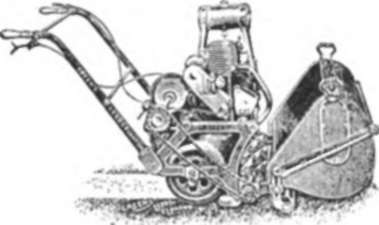
Fig. 110.
Continue to:


My Books

