


Microscopes. Part 3
Description
This section is from the book "Workshop Receipts For Manufacturers And Scientific Amateurs. Supplement Aluminium To Wireless", by The Chemical Publishing Co.. Also available from Amazon: Workshop Receipts For Manufacturers And Scientific Amateurs.
Microscopes. Part 3
The object itself is then sharply focussed with the objective. The condenser must then be moved downwards until the image of the lamp flame appears in the field as a bright central streak between two dark margins, similar to illustration, Fig. 124.
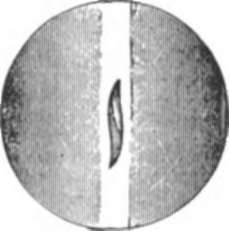
Fig. 124.
When doing this, the Iris diaphragm should be almost entirely closed.
For critical work, the illumination thus obtained-the aperture of the Iris diaphragm of the condenser being adjusted to the most suitable diameter-is the most effective that is possible, it being borne in mind that every objective of medium or high power gives its best definition at one point of the field only, and when working critically everything is sacrificed for that best effect in the centre of the field.
For some studies it is desirable to have the whole of the field illuminated. In such circumstances a bull's-eye may be interposed between the lamp flame and the mirror, or the flat of the wick may be turned round and its surface used instead of the edge.
As critical illumination is rarely used in the work for which a microscope is most generally required, viz. : for identifying and searching for known structures, the electric lamp before referred to should be set as described for the Oil lamp, and the condenser focussed to the point of greatest intensity.
The effective aperture of the objective is only utilized in proportion to the size of the cone of light yielded by the condenser, so it follows that the Iris diaphragm of the condenser must be suitably opened. The flood of light is then frequently too great to be comfortable. Under such conditions a coloured glass screen should be used. For general work it will be found advantageous to employ a light blue glass disc in the condenser to neutralize the yellow colour of the lamplight.
So much can be ascertained by the study of the back lens of the objective during working that it is desirable that the microscope worker should early become acquainted with the phenomena there represented. Text-books on the microscope give a vast amount of information on this subject. Our present object in calling attention to this is to point out that the size of the cone of light which is being utilized by the objective may be at once judged by such an examination.
When the microscope is adjusted for working, the eye-piece is removed and, on looking down the tube, the bright appearance of the back lens of the objective will be seen. Generally speaking, not more than threequarters of this back lens should be filled with light. Very few, if any, objectives will bear more than this advantageously with respect to definition, etc. The amount of illumination necessary varies so much with different objects that may be examined, that familiarity with this method of working is the surest and most accurate means of securing the best and most uniform results. It should be noted that the eye must be placed close to the upper end of the tube during such examinations of the back lens, otherwise an entirely wrong result may be obtained.
The increasing recognition of the advantages to be derived from the use of a well-corrected Achromatic condenser in preference to the ordinary chromatic type suggests that a few hints should be given on this point.
The modern Objective will not work advantageously with more than a 3/4 cone of illumination, i.e., if the eye-piece be removed and the condenser focussed, the back lens of the Objective should be evenly illuminated with a circle three-quarters of its diameter, when axial illumination is used. It will be obvious at once that there must be some relation between the condenser's illuminating power, and the effect at the back of the Objective to produce this result. Both of these effects depend on essential features-the condenser on its aplanatism, and the Objective on its numerical aperture. The value of the condenser does not depend so much on its total numerical aperture as on its correction for aplanatism which imparts the quality of aplanatic or solid cone illumination.
The ordinary Abbe illuminator has an aplanatic cone of about 5 N.A. It is therefore fully effective for central illumination with Objectives having a total numerical aperture of -65, and this is sufficiently near for the great bulk of work that is done with the 1/6 in. Objective of approximately this numerical aperture.
When, however, an oil immersion Objective is used, its effects are limited by the aplanatism or want of aplanatism of the Condenser, and so far as the revelation of fine detail is concerned, very little more is discernible than with the 1/6 in. In fact, a better quality, more perfectly corrected condenser should be used with a 1 /12th in. to obtain from it the results which it is capable of yielding.
The importance of a well-corrected condenser will be recognised by the statement that effective working is ascertained by adding together the numerical aperture of the Objective and the aplanatic cone of the Condenser. Taking the Abbe illuminator as the basis, with the ordinarv oil immersion Objective of 1.30 N.A., you thus get .50 + 1 -30= 1 -80 ; divided by 2 you get -90 as the effective aperture of the Objective. If a condenser with an aplanatic aperture of -95 were used, such as the Holoscopic, the result would be 1 -30+ -95 = 2-25, divided by 2=1-12, an increase of efficiency of about 20 per cent.
There should also be a proper relationship between the power of the condenser and the Objective, and for this purpose the higher power condensers are usually designed to have the upper lens or lenses removable by unscrewing the cells when lower powers and less numerical apertures are required. Dark Ground Illumination.- For
Continue to:


My Books

