


The Sewing Machine
Description
This section is from the book "Workshop Receipts For Manufacturers And Scientific Amateurs. Supplement Aluminium To Wireless", by The Chemical Publishing Co.. Also available from Amazon: Workshop Receipts For Manufacturers And Scientific Amateurs.
The Sewing Machine
The main object of the mechanism of these machines is so to twist or loop one or more threads upon itself or themselves that the pieces of fabric being dealt with are joined together. The simplest type deal with one thread only, making what is termed a "chain " stitch, which is practically made of a repeating series of loops, put through the fabric, each loop being put through the one in front of it, and so on. This stitch has the disadvantage that if the thread be afterwards cut or broken, the stitch will easily come undone in one direction; it has however one advantage in that only one thread is used by the machine. The other form of stitch, termed the "lock " stitch, is formed by using two threads by the machine, one on either side of the fabric, the top thread is pushed through tire fabric, a loop formed by it on the under side and the bottom thread passed through it, both are pulled tight and repeated on the next piece of fabric. If the lock stitch be cut or broken it will not come undone, and if properly made, the two sides should look identical in appearance. If, however, the top thread be too loose, then it will be seen lying as a more or less straight thread on the top of the fabric. If the bottom thread be too tight, then the thread there will show as a more or less straight thread, the proper stitch will pull the place of crossing of the two threads into the centre of thickness of the fabric being dealt with. It is important to get this tightness of thread question correct, as much depends upon it for proper firm sewing and best appearance. The next point of importance in the design of sewing machines is to arrange that while the needle has plenty of slack thread to allow it to carry the thread through the fabric without fear of breaking it, yet the mechanism will also pull the thread tight after each stitch is made and this also without breaking, and this is not the least interesting part of a sewing machine mechanism. Each machine must also have a device for holding the fabric firmly in a fixed position while the stitch is being made, and the needle through the fabric, and urge it forward a predetermined amount while the needle is raised and out of the fabric As most sewing machines are geared up from the driving handle, and as this is frequently turned as fast as can be done, it is evident that very little time is allowed for each of the different operations. In most "lock "stitch machines the bottom thread is wound upon a bobbin which is carried in a shuttle, which is passed rapidly backwards and forwards, on the under side of the machine, through the loops in the top thread as formed by the action of the needle, and presented to the shuttle.
In a machine made by the Twin Bobbin Sewing Machine Co. the bottom thread is drawn straight off a reel of the thread placed as bought on a spindle on the under side of the machine, the top thread loop when formed on the underneath of the fabric is passed right round the bottom reel, and then drawn tight, this forms the "lock " stitch. The machine of course has the advantage that no winding of the bottom bobbin is required. The winding of the bottom bobbin as required by most machines is done by placing the empty bobbin in between centres in a small carrier, the centres being then revolved rapidly by bringing a rubber wheel thereon into contact with the main balance wheel of the sewing machine, and so rapidly filling the bobbin. It is obvious from the above that it is important that the machine needle be sharp, is exactly the right length, has smooth eye so as not to cut the thread, and is put in facing the right way so as to present the loop to the shuttle properly. Fig. 194 gives the names of the chief parts of a well known make, while the purpose of each part is as follows :-
Head-the part above the table containing the stitching mechanism.
Arm-the curved part of the head containing the mechanism for driving the needle and handling the upper thread.
Bed-the flat portion of the head, under which is mounted the mechanism for driving the shuttle and handling the lower thread.
Balance Wheel-the wheel at the right of the head driven by the belt, or by hand.
Bobbin Winder-the mechanism for automatically winding bobbins.
Stitch Regulator -the parts which control the length of the stitch.
Upper Tension- -the means for controlling the deliverv of the upper thread from the spool.
Thread Take-up--the mechanism which pulls up the slack in the thread and locks the stitch.
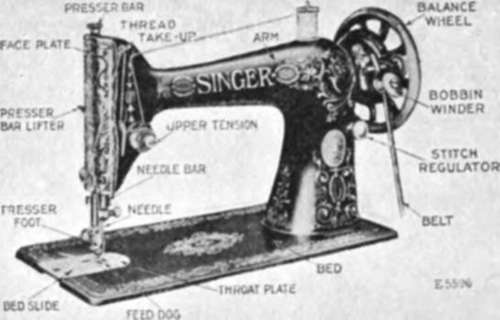
Fig. 194.
Needle Bar -the vertical bar to which the needle is attached and which carries the upper thread down through the fabric at each stitch.
Presser Bar-the vertical bar to which the presser foot is attached. This bar is surrounded by a spring which holds the fabric down against the feed dog when sewing, but may be released by raising the presser bar lifter.
Face Plate-the vertical plate on the left of the arm which may be removed to give access to the needle bar, presser bar and take-up.
Throat Plate-the plate in the bed directlv under the needle through which the needle passes and through which the feed dog projects upward.
Feed Dog the toothed part which projects upward through slots in the throat plate, carrying the fabric from the operator at each stitch. The movement of the feed dog is controlled by the stitch regulator to give the desired length of stitch.
Continue to:


My Books

