


Tool Cutting Angles
Description
This section is from the book "Workshop Receipts For Manufacturers And Scientific Amateurs. Supplement Aluminium To Wireless", by The Chemical Publishing Co.. Also available from Amazon: Workshop Receipts For Manufacturers And Scientific Amateurs.
Tool Cutting Angles
It is essential to get a clear idea of the angles of the various surfaces comprising a metal cutting tool. These angles are concerned with the hardness of the metal to be cut, the speed at which the work is to be done, and the feeds it is proposed to use while doing the work.
Before considering what angles should be found in tools for j various purposes, consider the nomenclature in use. No standard system exists, but certain terms have a fairly general meaning. The diagram (Fig. 96) shows a cutting tool with the various angles indicated. The angle (a) between the top face of the tool and the line perpendicular to the work axis, is the angle of top rake, or " front top rake." Distinct from this is the angle made by the same front top face of the tool and the line of travel of the tool, or the work axis ; (c) which is known as the " side top rake," or just " side rake." The angle (b) at the front of the tool, between the front face and the line perpendicular to the tool shank, is called the front rake " or " front clearance." It will be seen that the angle formed by the tool lip itself is that between the front face and the upper face (e), and this is the " tool angle."
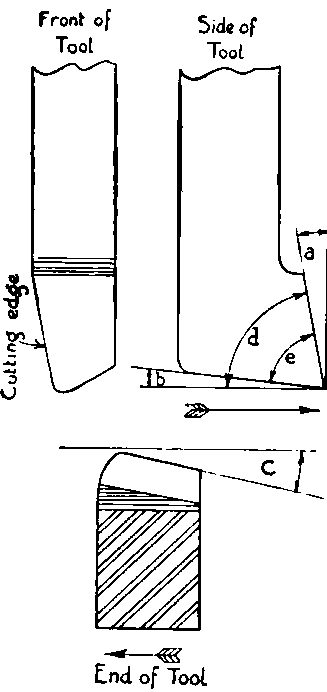
Fig. 96.
It is important to note that this is not the same as the " cutting angle," which is that angle between the top face of the tool and the tangent to the surface of the work (d). Thus the cutting angle (d) is the sum of the angle of the tool (e), and the front clearance (b).
Cutting tools can be ground so that they have front top rake and no side rake, or side rake and no front top rake. More often a combination of the two is used. Many of the older types of cutting tool were made with only front top rake, because the cuts taken were shallow, and the rake was in the direction of the shaving being removed from the work, as it were. With more powerful machines and heavy cutting, however, side cutting is essential, and then the tool must be given a certain amount of side top rake. In Fig. 97 is shown a tool for taking light cuts, with front top rake only, and Fig. 98 a roughing tool for heavy side cutting, with side rake only. This emphasizes the difference between the two types, and this difference is very important in tool grinding and setting.
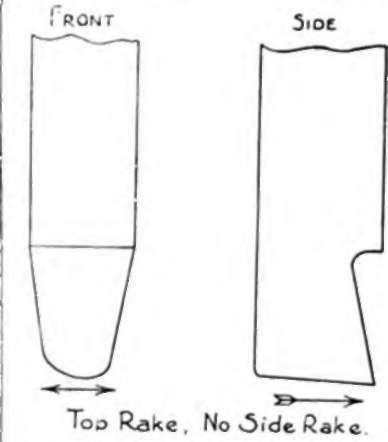
Fig. 97.
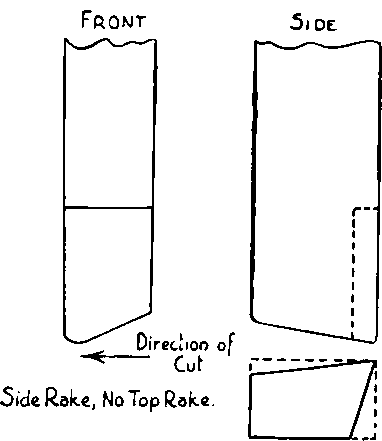
Fig. 98.
In a tool such as in Fig. 99, which is a heavy roughing tool, there really exists a fair combination of the two rakes, and the true cutting angle of the tool will be seen to depend on the portion of the tool which is actually cutting. Thus in this case the shaving is removed by the portion shown with a heavy black line, and the rake of the tool should really be measured along a line x--x, approximately at right angles to the cutting edge in plan view.
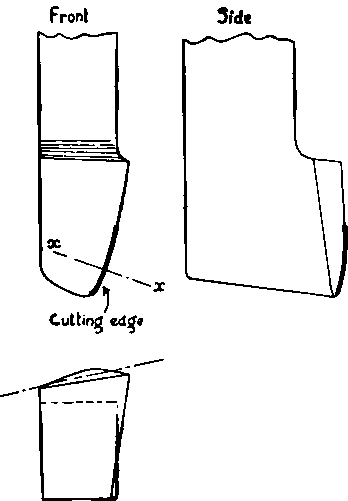
Fig. 99.
The tool must be sufficiently keen to cut the material as easily as possible, but must yet have sufficient strength behind the actual cutting edge to stand up to its work. The tool angle should be as small as is consistent with performance, the tool removing the metal with the least amount of resistance and pressure while at the same time having high powers of endurance. These conditions are opposing, and consequently a certain amount of compromise is resorted to in practice.
Roughly speaking, a tool must have the more obtuse cutting angle the harder the metal to be cut. The tools for the softer steels and metals can have much more acute cutting angles than those for hard cast iron and tool steel, but these same tools tried on the hard materials would have their cutting edges rapidly chipped or dulled. No hard and fast angles can be given for any metal, but there are fairly generally accepted limits within which lathe tools can be ground and set.
It will be seen that reducing the cutting angle tends to weaken the tool and leave the actual cutting edge thin and the more apt to burn under the heating produced by heavy cutting. A certain amount of assistance can be given by reducing the front rake or clearance (see Fig. 96), but this cannot be carried too far, or the tool will rub on the work as it is forced through under the feed. The top or side rake of a tool is very necessary in reducing the very heavy cutting pressures produced, but in order to enable the cutting edge to stand up to the cut the tool is usually made with a rather larger cutting angle than might otherwise be used.
Continue to:


My Books

