


Skunk Cabbage
Description
This section is from "The American Cyclopaedia", by George Ripley And Charles A. Dana. Also available from Amazon: The New American Cyclopædia. 16 volumes complete..
Skunk Cabbage
Skunk Cabbage, a plant the peculiar odor and the large clusters of luxuriant leaves of which readily suggested the common name. Botanically it has received the names pothos, ictodes, dracontium, and others, but botanists have finally settled upon symplocarpus (Gr. συμπλοκή, connection, and καρπός, fruit, in reference to the manner in which the ovaries form a connected or compound fruit). In all the different genera in which it has been placed, it retained the descriptive specific name foetidus. It belongs to the arum family, which is well known through its handsome exotic representative Richardia, the calla lily, or lily of the Nile. The skunk cabbage is one of our very earliest spring flowers, and appears in wet places from New England to North Carolina; the flowers come long before the leaves in the latitude of New York, often as early as February, and they are very abundant in March and April. The plant is an endogen, and its perfect flowers have four petals each, with as many opposite stamens, and a simple pistil with a one-ovuled ovary, which has a four-angled style.
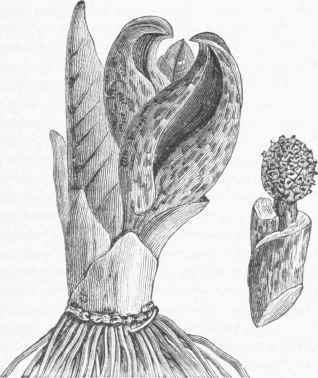
Skunk Cabbage (Symplocarpus foetidus).
These flowers are crowded in a dense globular cluster upon a short stem or spadix, and the cluster is surrounded by a peculiar, shell-formed hood or spathe, with an incurved point and of the shape shown in the engraving; this hood is sometimes of a dark lurid purple color, but is more frequently striped and spotted with yellow and purple, and sometimes varied with blotches of green and red. The hoods may be found long before the leaves appear, as these seem to require warm weather for their luxuriant growth; but they grow very rapidly when they start, and are heart-shaped, on short petioles and 1 to 2 ft. long; they form large clusters, which disappear very suddenly after midsummer, the spathe around the flowers having decayed much earlier. The fruit is a large oval fleshy mass, consisting of the purplish and green, berry-like seeds immersed in the enlarged spadix. All parts of the plant have a strong and strikingly skunk-like odor, which has been likened to a combination of garlic and asafoetida; the seeds are odorless when whole, but very strong when bruised. The root has been used as a stimulant and expectorant, but it rapidly deteriorates when dried.
The leaves are sometimes used to dress blisters to keep up the discharge.
Continue to:


My Books

