


Skunk
Description
This section is from "The American Cyclopaedia", by George Ripley And Charles A. Dana. Also available from Amazon: The New American Cyclopædia. 16 volumes complete..
Skunk
Skunk, an American carnivorous mammal of the weasel family, badger subfamily, and genus mephitis (Cuv.). It may be distinguished from its congeners by a more slender and elongated body, pointed nose, feet adapted for digging, with the anterior claws the longest and the soles usually naked, and a long bushy tail. The cheek teeth are the upper posterior being very large and nearly square; the head is small, with a projecting naked nose, small and piercing eyes, and short and rounded ears; the feet are short, with five closely united toes; the palms naked and the soles mostly so; they are essentially plantigrade, and walk with the back much arched and the tail erect; they are nocturnal, and feed on animal substances. Though weak, timid, and slow in their motions, they are effectually armed against the most ferocious enemies in an acrid and exceedingly offensive fluid secreted by glands whose ducts open near the anus; these glands are surrounded by a thick muscular covering, the contractions of which are sufficient to eject the fluid to a distance of 14 ft. - The common skunk (M, mephitica, Shaw; M. chinga, Tiedm.) is from 16½ to 20 in. long, the tail being 13 or 14 in. additional; the prevailing color is black, with a narrow line on the forehead, broad triangular patch on nape continuous with a narrow line on each side of the back, and tail tuft, white; the variation is considerable, the white markings being wider in some specimens, and in others wanting; the posterior third of the soles is hairy.
When about to use its natural means of defence, it raises its tail over the back, and ejects the secretion in two thread-like streams with great force and accuracy; it can also diffuse it in a fine spray on near objects; it is almost impossible to remove the odor from clothes impregnated with it, and a dog which has been touched by it is a nuisance for months; it is said to be phosphorescent at night. It is a very cleanly animal, and never allows its own fur to be soiled with its secretion. It sometimes commits havoc among hens, chickens, and eggs, but is far less injurious than the mink and weasels, and from its clumsiness is more easily detected; it feeds on small quadrupeds and birds, reptiles, insects, nuts, and fruits. It has from six to nine young at a time, and would prove exceedingly annoying were not great numbers killed by dogs and carnivorous mammals and birds, and caught in traps at the mouths of their burrows, which are generally near the surface, in level ground, and 6 to 8 ft. in extent. They remain in their burrows in the northern states from December to the middle of February, laying up no winter stores, but retiring in a very fat condition, and remaining dull and inactive, though not properly hibernating.
This species is abundant in the northern and middle states, and found from lat. 57° N. to Florida and Louisiana, and west to the Mississippi river. Its flesh is white and fat, and if properly skinned in no way tainted by its secretion; it is highly esteemed by the Indians, and is eaten by the whites in various parts of the country; the oil, nearly pure oleine, is excellent for leather, but is of no special use in medicino; the fur is rather coarse, but is sometimes used for common purposes, and of late years thousands of skins have been annually carried to Europe, where they make their appearance in various disguises. The secretion has been successfully employed in some forms of asthma, in the dose of a drop three times a day, though it so taints the patient's excretions that the remedy is generally considered worse than the disease; it has also been used as a powerful antispasmodic in asthma, hysteria, and other nervous disorders, applied to the nostrils. - There are several other species in the United States, especially in Texas and California. In an article in the " American Journal of Science " for May, 1874, Mr. Hovey says that this animal is very dangerous in the western states.
It is often affected by a disease which renders its saliva so poisonous that its bite is more to be feared than that of the rattlesnake, He gives many instances in which persons sleeping on the ground have been bitten, generally with fatal, and always with dangerous consequences.

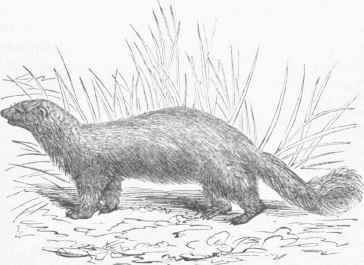
Common Skunk (Mephitis mephitica).
Continue to:


My Books

