


Stork
Description
This section is from "The American Cyclopaedia", by George Ripley And Charles A. Dana. Also available from Amazon: The New American Cyclopædia. 16 volumes complete..
Stork
Stork, a wading bird of the heron family, subfamily ciconinoe, and genus ciconia (Linn.); other allied genera are the jabiru and marabou, described under their own names. In the storks the bill is long, straight, strong, gradually tapering to a sharp tip; sides compressed; wings long and ample, the third and fourth quills the longest and equal; tail short and broad; tarsi long and scaled; toes short and stout, webbed to the first joint; hind toe elevated, partly resting on the ground. They are large, most abundant in warm countries, and performing periodical migrations to and from the marshy regions of Europe, Asia, and Africa; like vultures and other carrion feeders, they eat almost any kind of garbage that comes in their way, and are hence valuable scaven-gers in hot climates; they seek their food on the borders of streams; the body is light and well balanced; during flight the head is thrown back and the legs are extended; the space round the orbits is destitute of feathers, and in some the whole face and throat are naked.
There are about a dozen species, of which the best known is the white stork (C. alba, Briss.); it is 3½ ft. long, the bill 7¾ in.; the general color is white, with the quills and wing coverts black, and bill and feet red; around the eyes a bald blackish circle; it is the cigogne of the French. They arrive in N. Europe, especially in Holland and Germany, in the spring, returning in the autumn to Africa by night and in large flocks; the only noise they make is by clapping the mandibles together like a pair of castanets; they rest sleeping on one leg, with the neck folded and head turned backward on the shoulder. The food consists of reptiles, fish, young birds, and insects. The nest is large, coarsely made of sticks and twigs, placed on housetops (often in the midst of crowded cities), and is repaired by the males year after year; the eggs are three or four, white tinged with buff, 25/6 by 2 in.; both sexes incubate, and the young are hatched in about a month; the nestlings are tenderly cared for, and are fed by food regurgitated from the parents' stomachs. The flight is very high, and the gait slow, with long and measured steps; the disposition is gentle, the manner familiar, and the docility considerable; they do not propagate in captivity.
The stork was considered by the ancients as the personification of piety, conjugal and filial love, gratitude, and temperance; it was supposed to bear a charmed life, and it was a crime to offer it violence; in some places it was even an object of worship, and in hieroglyphic language it is the symbol of piety and beneficence; "pious" or "beneficent " is also the meaning of its name in He-brew ('hasidah). The black stork (C. nigra, Bechst.) is about 2¾ ft. long, with a bill of 5½ in.; the color above is black with green and purplish gloss, and white below. It avoids the vicinity of man, nests in trees, and feeds like the herons chiefly on fish; it is found in many countries of Europe, especially in the Alps. The American stork (C. Americana, Briss.) is about as large as the white species; it is found in South America, particularly in Brazil.
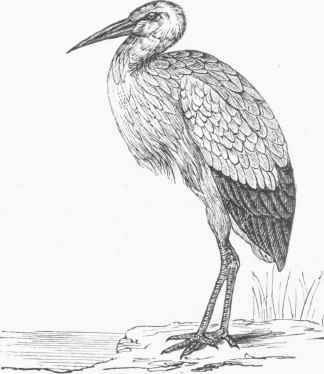
White Stork (Ciconia alba).
Continue to:


My Books

