


Corea
Description
This section is from "The American Cyclopaedia", by George Ripley And Charles A. Dana. Also available from Amazon: The New American Cyclopædia. 16 volumes complete..
Corea
Corea, a kingdom on the E. coast of Asia, bounded N. by Mantchooria, N. E. by the Russian Amoor country, E. by the sea of Japan, S. by the strait of Corea, and W. by the Yellow sea and the Chinese province of Liaotung, and lying between lat. 34° 25' and 43° N., and lon. 124° and 130° 30' E.; area, 90,000 sq. m. The population has been variously estimated from 8,000,000 to 20,000,000. No accounts of the geography or constitution of the Corean kingdom are in existence, and only the barest notion of the internal configuration of the country has been arrived at. It comprises a peninsula 400 m. long and 140 m. wide, most of the adjacent islands, especially numerous on the W. coast, and a part of the main continent. Its length from N. to S. is 660 m. It is separated from Mantchooria by the Shangpeshan mountains, and the Chimtai range follows the E. coast along its whole extent. Nearly all the principal rivers run W. down the larger watershed which slopes from the Chimtai to the Yellow sea. The largest is the Yalu in the northwest, which is deep and rapid, and navigable for large ships 22 miles.
South of this are the Tatong and the Han. On other watersheds are the Falu, which flows from the Chimtai into the strait of Corea, and the Tumen, a large river in the northeast which flows into the sea of Japan. The coast, which is generally high and rocky, is particularly abrupt on the E. side. On this side there are few islands except in lat. 39° 45' N., in Broughton's bay. In the strait of Corea there are many islands, and between lat. 34° and 35° N., on the W. side, are the Amherst isles and the Corean archipelago. These coast islands are seldom more than three or four miles long, are rocky and high, but generally inhabited. The island of Quelpaert, 60 m. S. of the peninsula, is about 60 m. in circumference, and on it is Mt. Auckland, 6,558 ft. high. The climate is cold, especially in the north, where the Tumen is frozen for six months in the year, and barley is the only grain which can be raised. In the southwest, where the climate is more temperate, the soil is more fertile than elsewhere. The country produces wheat, rice, millet, cotton, hemp, ginseng, and fruits. Tobacco and cotton are cultivated to some extent. The orange, citron, hazlenut, pear, chestnut, peach, mulberry, and wild grape are common.
Cattle, a breed of diminutive horses, hogs, and many domestic animals common to Europe, are raised. The keeping of sheep, however, is said to be prohibited by the government. In the forests of the coast and mountainous districts of the north bears, wildcats, panthers, deer, and the sable and other fur-bearing animals are found. The royal tiger is a native of the country, and has a longer and closer fur than in Bengal. Gold, silver, iron, and salt are said to abound, but mining is restricted by the government to its own requirements. Coal is also said to exist. - The inhabitants are of the Mongolian race, of larger size than the Chinese, resembling the Japanese, but with features more prominently Mongolian in type. In dress, architecture, and social life they much resemble the Chinese, with the exception of being the only people in eastern Asia with whom the ancient caste distinctions are still rigidly in force. They do not cut off their hair, nor are their women kept under such restraint as in China. The language differs widely from both Chinese and Japanese, but it is like the latter in its polysyllabic form, and its alphabet of 27 letters.
The higher classes are well educated, use the Chinese characters in writing, and are followers of Confucius. The mass of the people are Buddhists. Roman Catholic missionaries have been laboring in Corea since 1632, and in 1857 there were 15,200 converts. On account of the strict laws against them, the missionaries work in secret. The Coreans oppose not only the introduction of Christianity, but of all foreign civilization and commerce. The only intercourse allowed with China is officially confined to two points, viz., Peking, which is annually visited by an envoy accompanied by a few privileged traders, and the "gate town " near the city of Funghwang in Liaotung, on the frontier dividing the two countries, where a fair is periodically held. But the Chinese manage secretly to carry on trade at the islands on the coasts of Corea. The principal manufactures are silk, cotton, cotton paper, grass cloth, rice paper, arms, and horsehair caps; which articles, with ginseng, skins, gold, silver, iron, rice, and oil, are the chief exports.
The principal trade is with Japan, from which are imported pepper, aromatic woods, horns, and European and Japanese manufactured goods. - The government is despotic, and as regards the mass of the people is unrestrained; but powerful parties among the nobles appear to exercise a certain control over the king's actions, and decide questions of disputed succession, which frequently arise. Absolute power over the lives and. property of the people seems to be in the hands of even the lowest officials, and frightful flagellations are often inflicted by their order on persons guilty only of trifling offences. The king pays tribute to China and Japan. The ministry is divided into five departments, and the country into eight taos or administrative districts. Over each tao is a governor responsible to the king. These taos are subdivided into 41 koons, with 33 towns of the first class, 38 of the second, and 70 of the third. Kienghi-tao, or Handling, or Wangking as the Chinese call it, literally royal capital (called by the French Seoul), the capital, is at a short distance inland on the river Han. The other principal towns are Kieng, Tsien, Piengyang on the Tatong river, and Hienhing on Broughton's bay.
The whole population is liable to military service, but no standing army is maintained, unless it be a guard to the king. They know accordingly nothing of military discipline and tactics. The people take turns in doing duty as armed police, and while serving in that capacity wear a rounded top to the crown of their hat. They have spears, bows, and a kind of matchlocks, which, in spite of their primitive description, exhibit a very workmanlike finish. The guards are furnished with an armor of chain mail, which was found in the recent encounter with the United States naval force to be proof against sword cuts and musket balls, but not against rifle shots; it was however so heavy, a single suit with helmet weighing about 20 pounds, that the troops were rendered almost incapable of locomotion. The Coreans live in the most frugal manner, and articles of daily necessity to the Chinese and Japanese are unknown among them. They do not drink tea, and their most palatable beverage is the water in which rice or millet has been boiled. The wealthy indulge in an infusion of ginseng, and in a kind of rough spirit distilled from various grains. The universal material for clothing is a coarse white fabric of cotton or hemp.
The lower classes wear in summer jackets and wide short trousers; the higher classes wear over a vest and trousers a long gown with buttons in front, and sometimes dyed of a blue color. Every Corean carries a belt with a tobacco pouch and a pipe, a long stem of bamboo. Officials wear upon their hats the figures of different birds or animals, and a variety of small balls of amber or silver, securing the chin strap above the ear. Military officials denote their rank by an outer jacket of colored silks. - Corea was known from a very early period to the Chinese, who claim that it was civilized by their sovereign Khil-su in 1120 B. C. In the 13th century the Mongol conquerors incorporated the greater part of Corea with the Chinese empire; but in the 14th century the founder of the Ming dynasty acknowledged the claimant of the Corean throne, and conferred upon him the title of feudatory king, or Kao-li Wang, which designation is the origin of our word Corea (Fr. Coree), obtained from the Japanese, who represent the Chinese sound as Ku-rai. The Coreans were conquered by the Japanese in 1592, but in 1598, with the aid of the Chinese, compelled their conquerors to abandon the country.
In 1866 a French expedition escaladed Kanghoa, a town on the Han, 40 m. from its mouth, and endeavored to obtain satisfaction from the Corean government for the murder of two Roman Catholic bishops and seven priests who had been put to death by order of the ministry; but the town was found to be wholly deserted. The Coreans sent to the French some professions of desiring to negotiate with them, but were only bent on gaining time for the purpose of overwhelming the handful of invaders. The French found themselves one day confronted by about 500 soldiers, who discharged on them a heavy fire, wounding 32 men and 3 officers. Admiral Roze had to embark his forces, and returning to Chefoo found that the French government would not support this hasty action, inaugurated by the ambassador at Peking. In the same year an American trading ship, the General Sherman, ascended the Piengyang river, and was destroyed with all on board, in obedience to orders from the regent, while lying dry on the shore, having departed from the proper channel during a period of floods. In 1871 a United States squadron under Admiral Rodgers sailed to Corea from Nagasaki, advanced up the river Han, and began to survey the river and forts in the direction of the capital.
While thus occupied they were fired upon from the forts, and as a punishment for this action the Americans on June 11 captured and destroyed several of their river fortifications. Being unable however to open negotiations with the king, Admiral Rodgers released the prisoners whom he had taken.
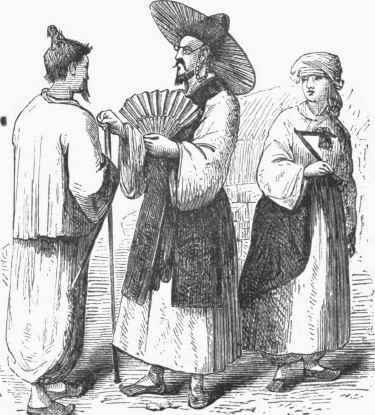
Coreans.
Continue to:


My Books

