


Corfu. I
Description
This section is from "The American Cyclopaedia", by George Ripley And Charles A. Dana. Also available from Amazon: The New American Cyclopædia. 16 volumes complete..
Corfu. I
A nomarchy of the kingdom of Greece, comprising the islands of Corfu, Paxo, Leucadia, and several smaller islands; area, 427 sq. m.; pop. in 1870, 96,940. II. One of the Ionian islands (anc. Corcyra), lying between lat. 39° 21' and 39° 51' N., and lon. 19° 36' and 20° 8' E., off the S. part of the coast of Albania, from which it is separated by an irregular channel from 1 to 20 m. in width; length from N. W. to S. E., 40 m.; greatest breadth, 20 m.; area, 227 sq. m.; pop. in 1871, 75,466. From the north it tapers gradually to its' S. extremity, where it ends in Cape Branco. The surface is mountainous, especially in the north, where Mt. Pantocratoras rises to upward of 3,000 ft. The high lands are rugged and bare, but the valleys are very fertile and watered by small streams, which in summer are mostly dry. The climate is mild, the annual range of the thermometer being from 31° to 88°, but with sudden changes. Earthquakes are frequent. The principal products are olive oil, of which the yield in ordinary seasons is about 200,000 barrels, wheat, maize, oats, wine, cotton, flax, oranges, citrons, salt, honey, and wax.
The island is divided into three eparchies, Corfu, Oros, and Mesi, and sends 12 members to the legislative assembly of Greece. - Corfu is believed to be the Homeric Scheria, the domain of King Alcinous. About 734 B. C. it was colonized by the Corinthians, and soon after it became a leading maritime power, and a formidable rival of Corinth. In 665 the Corcy-rean fleet vanquished one sent against it by the mother city, and this engagement is said by Thucydides to be the first naval battle on record. In the Persian wars the Corcyreans, according to Herodotus, betrayed the national cause, and subsequently by calling in the aid of Athens against Corinth kindled the Pelopon-nesian war, during the progress of which they lost their power and importance through the ruinous struggles of the democratic and oligarchical factions. In 229 B. C. the island fell into the hands of the Romans. It afterward belonged successively to the Eastern empire, the Normans, and the Venetians, and in 1797 was occupied by the French. Two years later it was taken by the Russians and Turks, subsequently united with the other Ionian islands, ceded to France, and captured by the English. With the rest of the Ionian islands it was placed under the protection of Great Britain by the congress of Vienna, but was ceded to Greece in 1864. A Greek garrison took possession on May 28 of that year.
III. A city, capital of the nomarchy, situated on the E. coast of the island, 5 m. from the coast of Albania, and 212 m. N. W. of Athens; pop. in 1871,15,452. It consists of two parts, the town and citadel, and has several suburbs. The citadel is built upon a rocky point projecting into the sea, and between it and the town is an esplanade laid out with avenues and trees, and containing a statue of Count Schulenburg, who defended the city for the Venetians against the Turks in 1716. The citadel contains the barracks, arsenal, hospital, the former residence of the British commissioner, now occupied by the Greek government, and a lighthouse. There are two other fortresses, Fort Neuf, at the west end of the town, and Vido on a small island 1 m. distant. The streets are Italian in style, some having arcades like those of Padua and Bologna, but are irregular, and the houses are small. There are a cathedral, several ancient churches, a university, gymnasium, ecclesiastical seminary, and other schools. The town is supplied with water brought in pipes a distance of 7 m. It is the residence of a Greek archbishop and of a Catholic bishop.
It communicates with Otranto in Italy by weekly packets, and with Trieste, Athens, Gibraltar, and England by steamers sailing twice a month; and is connected with Otranto and with Malta by submarine telegraphs. It was the capital of the' Ionian republic.
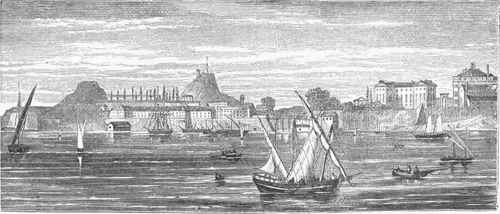
Corfu - View of Town and Citadel.
Continue to:


My Books

