


Gnu
Description
This section is from "The American Cyclopaedia", by George Ripley And Charles A. Dana. Also available from Amazon: The New American Cyclopædia. 16 volumes complete..
Gnu
Gnu , a hollow-horned ruminating animal, inhabiting the plains of southern and central Africa, generally classed with the bovidoe or ox family, of the genus catoblepas (H. Smith) or connochetes (Gray); the wilde beest of the Dutch colonists at the Cape. It is one of the most singular of animals, having the head and horns of a buffalo, the body and mane of a horse, and the limbs of an antelope. The form of the head, neck, and shoulders is decidedly bovine, robust, and clumsy; the forehead wide and flat, the muzzle broad, and covered with hair except the valvular opening of the nostrils; the eyes large; ears long, narrow, and pointed; horns present I in both sexes, above and behind the eyes, close together at their origin, descending at first downward and outward, then curving upward and backward, flattened at the base, cylindrical at the tip, rough and irregular. The hair on the brows and forehead is long and shaggy, giving a fierce expression to the face; the neck has a rigid mane above, and a long, hairy dewlap below; the shoulders are deep, and surmounted by a moderate hump; the body is rounded like that of a horse, and the limbs delicately formed; the tail is moderately long, with a brush at the end; the hair elsewhere on the body is short; the hoofs are rather large for the limbs, and the skin of the knees is bare and callous, from their habit of going on their knees in attack and defence.
The general color of the common species (C. gnu, II. Smith) is yellowish tawny, darkest on the back and legs, with the tips of the long hair blackish. The gnu, though clumsy in appearance, is very swift and active, galloping over the plains like a horse, and feeding in large herds like wild cattle; when alarmed, it rarely takes to flight until it has examined into the cause of the danger, a curiosity of which the hunter is able to take advantage; it is very pugnacious, and is tamed with difficulty. The common species is about 3 ft. 10 in. high at the shoulders, and 6 1/2 ft. long from nose to tail. A second and larger species is the kokoon or brindled gnu, blauwe wilde beest (C. taurina et gorgon, II. Smith), which measures about 5 ft. at the shoulders and 7 1/2 ft. from nose to tail, the tail 1 3/4 ft., and the horns about 2 ft. long. The face is blackish, the sides of the head and neck yellowish gray, the latter and the shoulders with vertical dark stripes; the body above and the sides glossy reddish gray; below, and the limbs, reddish brown. Both species inhabit the extensive grassy plains of central Africa, advancing southward after the summer rains to the Orange river, south of which only the common and first named species ranges.
Great numbers are killed every year by the Cape colonists, but their annual visitations still continue; the flesh is considered excellent.
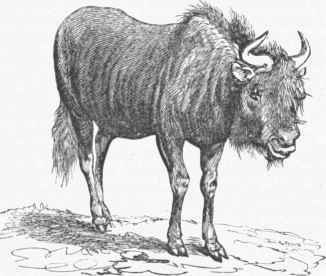
White Gnu (Catoblepas gnu).
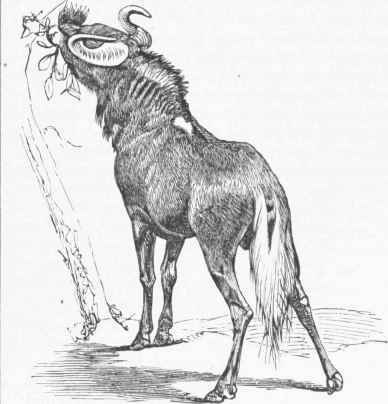
Brindled Gnu (Catoblepas gorgon).
Continue to:


My Books

